Linguistic diversity integration and cultural unity initiatives
Source:The Hindu ↗
Why It Matters
This initiative represents a significant state-led effort to bridge the North-South cultural and linguistic divide, which is highly relevant for GS1 (Indian Society, Unity in Diversity) and GS2 (National Integration, Federalism). It provides contemporary examples for essay and mains answers on how India can manage its linguistic pluralism.
Summary
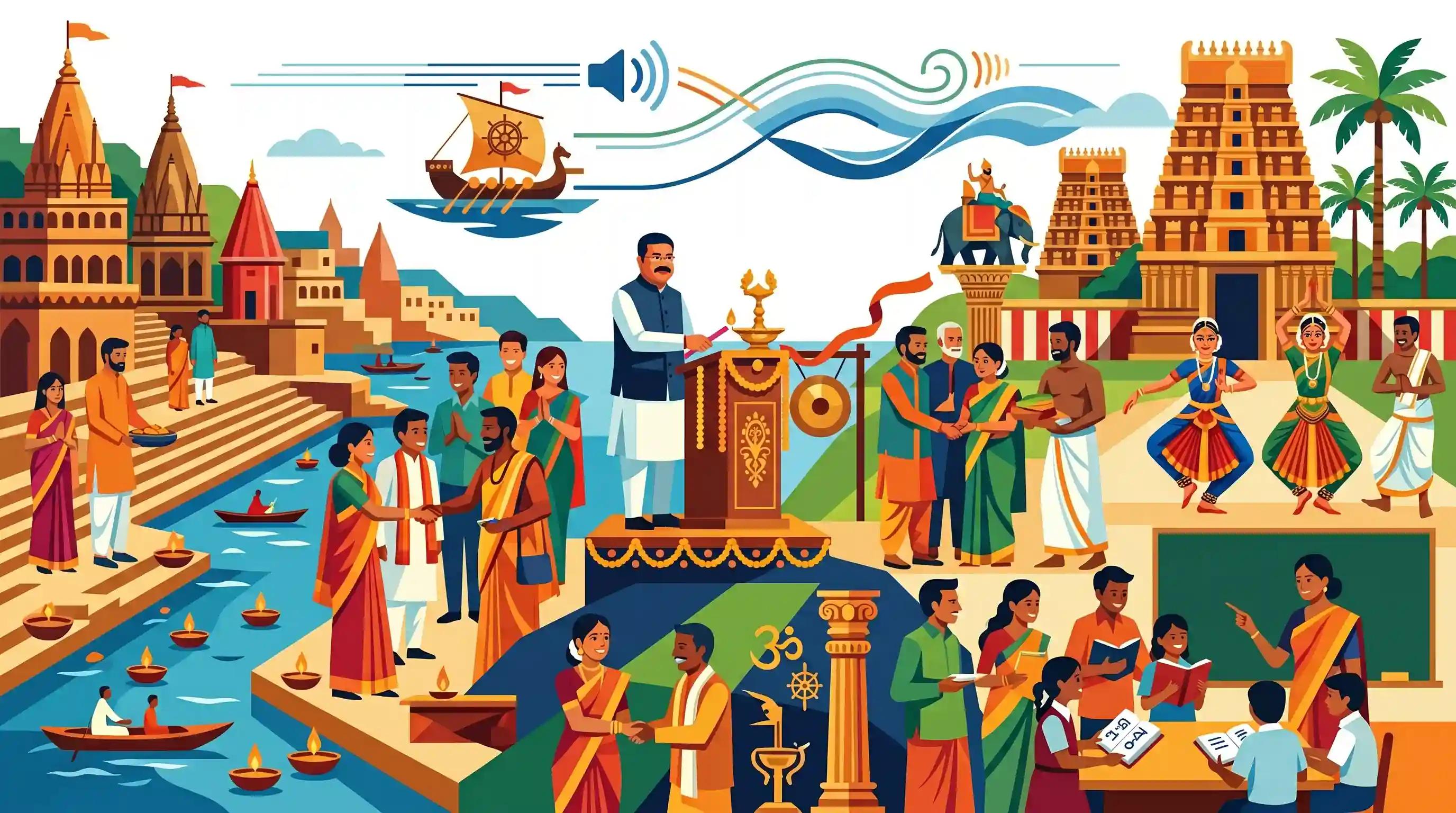
Union Education Minister Dharmendra Pradhan inaugurated the fourth edition of the 'Kashi Tamil Sangamam' in Varanasi, emphasizing that language should serve as a unifying force rather than a tool for political division. The event, organized under the 'Ek Bharat Shreshtha Bharat' initiative, aims to revive the deep historical and cultural ties between Tamil Nadu and Kashi, dating back to the eras of the Chera, Chola, and Vijayanagara empires. To promote cross-cultural linguistic exchange, a 'Tamil karkalam' (let's learn Tamil) initiative was launched for locals and students in Varanasi.
Key Points
- The fourth edition of the Kashi Tamil Sangamam was inaugurated in Varanasi to celebrate and revive the historical ties between Kashi and Tamil Nadu.
- Union Education Minister Dharmendra Pradhan criticized political elements for attempting to create linguistic divisions, emphasizing that languages should unite India.
- The event highlighted historical links between Kashi and South Indian dynasties, including the Chera, Chola, Pandya, Pallava, Chalukya, and Vijayanagara empires.
- A new initiative, 'Tamil karkalam' (let's learn Tamil), was introduced to encourage the people of Varanasi and BHU students to learn the Tamil language.
- The 'Sage Agastya Vehicle Expedition' from Tenkasi to Varanasi was flagged off to symbolize the ancient, enduring connections between the regions.
Important Terms
Kashi Tamil Sangamam

Annual cultural event rekindling ancient civilizational ties between North and South India (Tamil Nadu and Varanasi). Organized by the Ministry of Education to celebrate shared cultural and spiritual heritage.
UPSC context
GS Paper I (Art & Culture); tests knowledge of regional cultural linkages and India's civilizational unity.
Ek Bharat Shreshtha Bharat
Government initiative launched in 2015 to promote national integration through structured cultural exchange between paired States and Union Territories, fostering a sense of common identity.
UPSC context
GS Paper II (Governance); relevant for national integration strategies and government schemes promoting cultural awareness.
Banaras Hindu University (BHU)
A premier central university in Varanasi serving as a nodal institution and knowledge partner for Kashi Tamil Sangamam, hosting academic sessions and cultural delegates from Tamil Nadu.
UPSC context
GS Paper II (Social Justice/Education); highlights the role of prestigious academic institutions in fostering national unity and heritage.
Indian Institute of Technology (IIT) Madras
Leading technical institution serving as a knowledge partner for Kashi Tamil Sangamam, managing technical registration, logistics, and educational modules to promote Tamil language learning.
UPSC context
GS Paper II (Education/Governance); showcases inter-institutional collaboration for cultural diplomacy and implementing national education-related schemes.
Prelims Trap
The Kashi Tamil Sangamam is an annual cultural festival organized entirely by the Ministry of Culture and Tourism.
Despite its heavily cultural nature, the Sangamam is spearheaded by the Ministry of Education under the 'Ek Bharat Shreshtha Bharat' initiative, not the Ministry of Culture.
Static Concepts Connected
What is the traditional role of Sage Agastya in Sangam History?
- Father of Tamil: Revered as the originator of the Tamil language and the compiler of its first grammar text, 'Agattiyam'.
- First Sangam Chair: According to traditional accounts, he presided over the First Tamil Sangam held at Madurai.
- Siddha Medicine Originator: Considered a founding figure and primary ascetic in the traditional Siddha system of medicine.
Which Constitutional provisions guide the Union on linguistic diversity and national integration?
- Article 351: Directs the Union to promote the Hindi language, drawing vocabulary primarily from Sanskrit and secondarily from other Indian languages (like Tamil) to reflect composite culture.
- Article 350A: Mandates the state to provide adequate facilities for instruction in the mother-tongue at the primary education stage for linguistic minorities.
- Eighth Schedule: Lists 22 recognized languages, obligating the government to ensure their parallel development and protect linguistic plurality.
Cross-Topic Patterns
Temple Architecture & Sacred Geographies
The 15th-century Kasi Viswanathar Temple in Tenkasi shows how southern kings replicated northern pilgrimages, linking Pandyan temple architecture with pan-Indian spiritual corridors.
NEP 2020 & Three-Language Formula
Varanasi's 'Tamil karkalam' initiative practically implements the NEP 2020 ethos, pushing reciprocal South-Indian language learning in the Hindi heartland to defuse linguistic regionalism.

Expect a multi-statement Prelims question linking Sangam-era Sage Agastya, Siddha medicine origins, and Tenkasi temple architecture.
Linked PYQs · 4
Linked PYQs · 4
- 2020MainsGS1
Is diversity and pluralism in India under threat due to globalisation ? Justify your answer.
- 2017MainsGS1
In the context of the diversity of India, can it be said that the regions form cultural units rather than the States ? Give reasons with examples for your viewpoint.
- 2022PrelimsGS1
Which one of the following statements about Sangam literature in ancient South India is correct?
- 2024MainsGS1
Critically analyse the proposition that there is a high correlation between India's cultural diversities and socio-economic marginalities.
