Appointment of Active Politicians as Governors and Federal Friction
Source:Indian Express ↗
Why It Matters
The role of the Governor is a frequent topic in UPSC examinations (both Prelims and Mains). Understanding the controversies surrounding gubernatorial appointments, discretionary powers, and their impact on federalism is critical for analyzing contemporary Centre-State dynamics.
Summary
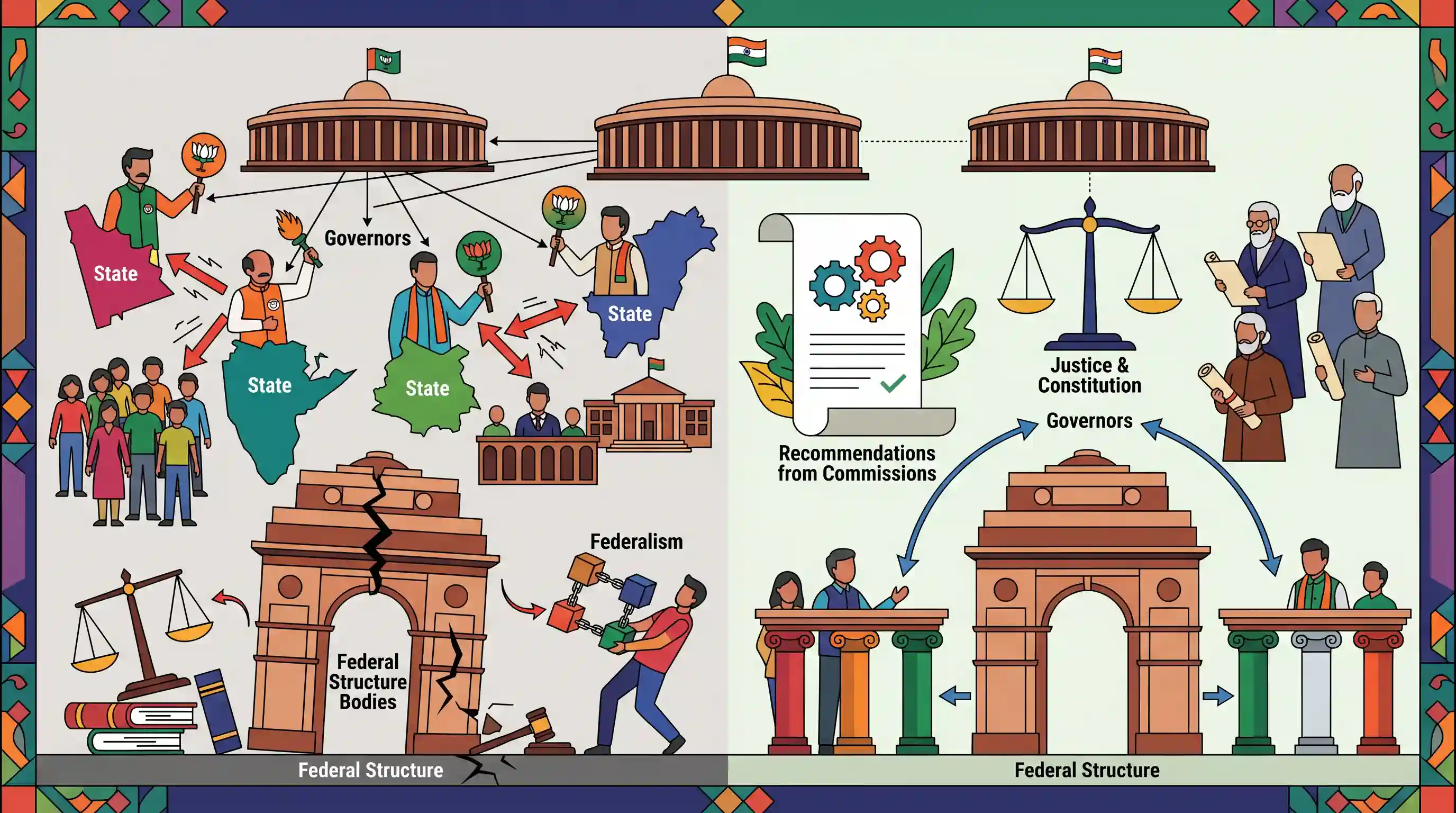
The article highlights the growing constitutional and political crisis stemming from the appointment of active politicians as Governors in Indian states. It argues that such appointments lead to partisan behavior, where Governors act as agents of the Centre rather than neutral constitutional heads, creating friction with elected state governments. This trend threatens India's federal structure and democratic ethos. The author advocates for implementing the recommendations of various constitutional commissions, which emphasize appointing eminent individuals without active political affiliations, to preserve the sanctity and non-partisan nature of the gubernatorial office.
Key Points
- The Constitution envisions the Governor as a neutral, non-partisan head of the state who functions primarily on the aid and advice of the Council of Ministers.
- The increasing appointment of active politicians to gubernatorial posts has led to severe friction between Governors and elected state governments.
- Partisan actions by Governors, including delaying assent to crucial bills and intervening in day-to-day administration, severely undermine the federal structure.
- Adhering to the recommendations of the Sarkaria and Punchhi Commissions regarding the appointment of eminent, non-political figures is essential to restore the dignity and impartiality of the Governor's office.
Important Terms
Sarkaria Commission

A 1983 commission on Centre-State relations recommending Governors be eminent figures from outside the state, detached from local politics, and appointed only after consulting the Chief Minister.
UPSC context
GS Paper II (Polity); essential for questions on federalism and reforming the Governor's office to ensure neutrality.
Punchhi Commission
A 2007 commission that proposed a committee-based appointment for Governors, fixed five-year tenures, and the removal of the 'Doctrine of Pleasure' to safeguard the office's independence.
UPSC context
GS Paper II (Polity); frequently cited in discussions on resolving Centre-State friction and gubernatorial overreach.
Venkatachaliah Commission
Also known as the NCRWC (2002), it recommended that Governors should be required to resign from political parties before appointment and should complete their full five-year term.
UPSC context
GS Paper II (Polity); relevant for constitutional reform topics and ensuring non-partisan conduct of constitutional heads.
Doctrine of Pleasure
Under Article 156, the Governor holds office at the President's (effectively the Union's) discretion, allowing for removal without assigned reasons or a formal process.
UPSC context
GS Paper II (Polity); a critical legal concept testing understanding of gubernatorial vulnerability and Centre-State power dynamics.
Article 200
The constitutional provision outlining a Governor's options upon receiving a state bill: grant assent, withhold it, return it for reconsideration, or reserve it for the President.
UPSC context
GS Paper II (Legislature); central to recent controversies involving 'pocket vetoes' and delays in state legislation.
Cooperative Federalism
A constitutional concept where the Centre and States work together to solve common problems, requiring neutral intermediaries like the Governor to maintain trust and balance.
UPSC context
GS Paper II (Governance); the overarching framework for analyzing Centre-State relations and the impact of partisan politics.
Prelims Trap
The Constitution prescribes a strict maximum time limit for the Governor to act on State Bills under Article 200.
Article 200 only states the Governor must return non-money bills 'as soon as possible.' It prescribes no numeric time limit, creating a loophole for indefinite delays.
Static Concepts Connected
What is the scope of a Governor's discretionary powers under the Constitution?
- Constitutional discretion: Reserving state bills for the President (Art 200), recommending President's Rule (Art 356), and administering adjoining Union Territories as an administrator.
- Situational discretion: Appointing a Chief Minister in a hung assembly or dissolving the legislative assembly when the Council of Ministers loses its majority.
How did Sarkaria and Punchhi Commissions seek to reform the Governor's office?
- Sarkaria Commission (1983): Recommended appointing eminent individuals from outside the state, strictly without active political links in the recent past, to ensure neutrality.
- Punchhi Commission (2007): Recommended a fixed five-year tenure, CM consultation prior to appointment, and removal only via a resolution (impeachment) by the State Legislature.
Cross-Topic Patterns
Governor's Assent & Judicial Review
Recent SC interventions (e.g., in Punjab and Kerala) show the judiciary actively interpreting Article 200 to prevent Governors from using indefinite delays to paralyze elected state legislatures.
Asymmetric Federalism & Schedule 5/6
The Governor's political bias becomes highly sensitive in Scheduled Areas, where they hold special overriding administrative and reporting powers independent of the state's Council of Ministers.

Expect a 2026 Prelims question comparing the exact constitutional text of the President's veto (Art 111) vs the Governor's veto (Art 200).
Linked PYQs · 4
Linked PYQs · 4
- 2024MainsGS2
What changes has the Union Government recently introduced in the domain of Centre-State relations ? Suggest measures to be adopted to build the trust between the Centre and the States and for strengthening federalism.
- 2022MainsGS2
Discuss the essential conditions for exercise of the legislative powers by the Governor. Discuss the legality of re-promulgation of ordinances by the Governor without placing them before the Legislature.
- 2014PrelimsGS1
Which of the following are the discretionary powers given to the Governor of a State? 1. Sending a report to the President of India for imposing the President's rule 2. Appointing the Ministers 3. Reserving certain bills passed by the State Legislature for consideration of the President of India 4. Making the rules to conduct the business of the State Government Select the correct answer using the code given below.
- 2025PrelimsGS1
Consider the following statements : I. The Constitution of India explicitly mentions that in certain spheres the Governor of a State acts in his/her own discretion. II. The President of India can, of his/her own, reserve a bill passed by a State Legislature for his/her consideration without it being forwarded by the Governor of the State concerned. Which of the statements given above is/are correct?
