Supreme Court on Law and Order: Role of Political Executive
Source:The Hindu ↗
Why It Matters
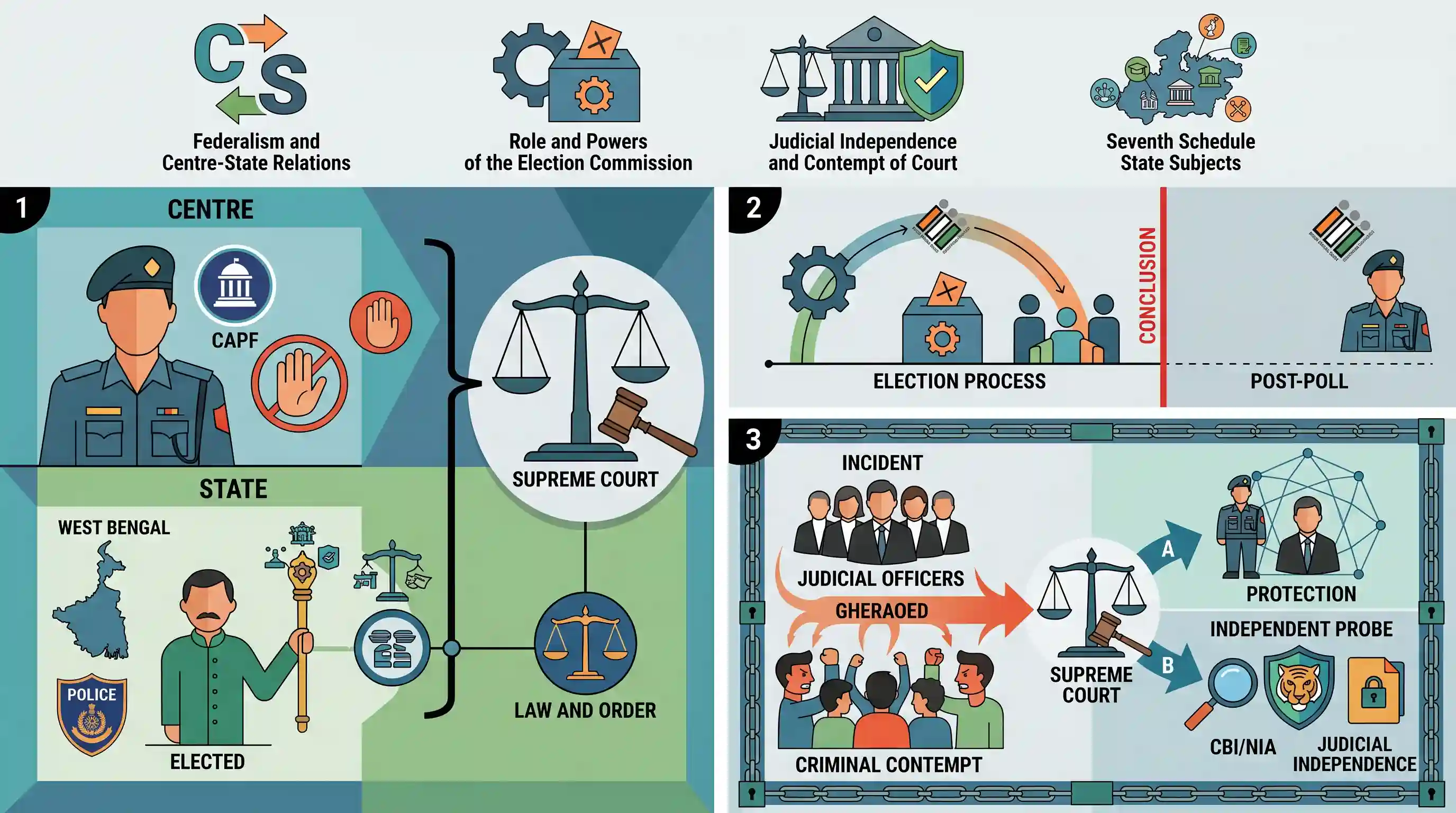
This article highlights crucial constitutional demarcations regarding the management of law and order (a State subject under the Seventh Schedule), the specific timeline of the Election Commission's authority under Article 324, and the judiciary's proactive measures to protect its officers from criminal contempt, making it highly relevant for GS2 Polity and Governance.
Summary
The Supreme Court emphasized that law and order is a State subject and decisions regarding it fall under the purview of the elected political executive. The observation came while declining a plea seeking the continuation of central forces deployment in West Bengal to prevent post-poll violence after the Assembly elections. The Election Commission (EC) clarified its mandate concludes with the election process. Separately, the Court had previously directed the EC to deploy central forces to protect judicial officers from criminal contempt, following an incident where officers involved in the Special Intensive Revision (SIR) exercise were gheraoed in Malda. The Court also ordered an independent probe by the CBI or NIA into this incident to safeguard judicial independence.
Key Points
- The Supreme Court reaffirmed that 'law and order' is a State subject, and its management falls under the elected political executive.
- The Court declined a plea to extend the deployment of central forces in West Bengal to prevent post-poll violence following the Assembly elections.
- The Election Commission clarified that its jurisdiction and mandate over state machinery end once the election process is officially concluded.
- In a related issue, the SC previously directed the EC to requisition central forces to protect judicial officers involved in the Special Intensive Revision (SIR) exercise in Malda.
- To uphold judicial independence, the Court ordered a CBI or NIA probe into the criminal contempt incident targeting these judicial officers.
Important Terms
Special Intensive Revision exercise

A comprehensive, house-to-house voter verification drive by the ECI to ensure electoral roll 'purity' by removing duplicates and ineligible voters, distinct from routine annual revisions.
UPSC context
GS II: Electoral reforms, Representation of the People Act, and the constitutional mandate of the ECI under Article 324.
Political executive
The elected branch of government (Council of Ministers) responsible for policy decisions and administration, including maintaining law and order, which the SC recently reaffirmed as their domain.
UPSC context
GS II: Separation of powers, Executive vs. Judiciary, and the constitutional framework of Indian governance.
Election Commission of India
The constitutional body authorized by Article 324 to superintend, direct, and control elections, whose administrative control over security forces concludes once the electoral process ends.
UPSC context
GS II: Constitutional bodies, their powers, and the limitations of their mandate in federal security matters.
National Investigation Agency
India's primary counter-terror agency, directed by the Supreme Court in this context to probe attacks on judicial officers to ensure an independent investigation beyond state influence.
UPSC context
GS III: Statutory bodies and internal security; tests the center's role in state law-and-order through federal agencies.
Sanatani Sangsad
The petitioner organization in the West Bengal post-poll violence case, seeking the continued deployment of Central Armed Police Forces (CAPF) through judicial intervention.
UPSC context
GS II: Role of NGOs and pressure groups in judicial activism and electoral security.
State subject
A list in the Seventh Schedule of the Constitution designating subjects (like Law and Order) where the State Government has exclusive power to legislate and administer.
UPSC context
GS II: Federal structure, Seventh Schedule, and the division of powers between the Union and States.
Prelims Trap
The Election Commission can unilaterally extend the deployment of Central Forces to manage post-poll violence.
The EC's jurisdiction and Model Code of Conduct strictly end when the election process concludes. Post-poll public order falls exclusively under the State executive.
Static Concepts Connected
What are the constitutional provisions for 'Public Order' and Central Forces?
- State List: Entry 1 (Public Order) and Entry 2 (Police) explicitly vest primary law and order responsibilities with the elected state government.
- Union List: Entry 2A permits the deployment of Union armed forces in aid of civil power, but usually requires State consent or judicial orders for routine law enforcement.
- Article 355: Mandates the Union to protect states against internal disturbance, often invoked theoretically during severe breakdowns of constitutional machinery or extreme post-poll violence.
When does the Election Commission's control over state administrative machinery end?
- Article 324: Vests the superintendence, direction, and control of elections, including disciplinary control over deputed state officials, entirely in the Election Commission.
- End of Mandate: The EC's special administrative and disciplinary control over state police and civil administration strictly ceases the moment election results are formally notified.
Cross-Topic Patterns
CBI jurisdiction vs State consent
Though law and order is a State subject, Constitutional Courts can bypass the need for a State's 'General Consent' to order a CBI or NIA probe, ensuring independent investigation into serious incidents.
Criminal Contempt + Electoral Roll revision
Intimidating judicial officers tasked with EC exercises (like the Special Intensive Revision) attracts the Contempt of Courts Act, 1971. This bridges electoral integrity machinery directly with judicial independence protections.

Expect a tricky 2026 prelims statement testing the exact timeline of EC's jurisdiction ending vs the Union's Article 355 powers post-poll.
Linked PYQs · 3
Linked PYQs · 3
- 2024MainsGS2
What changes has the Union Government recently introduced in the domain of Centre-State relations ? Suggest measures to be adopted to build the trust between the Centre and the States and for strengthening federalism.
- 2023MainsGS2
“Constitutionally guaranteed judicial independence is a prerequisite of democracy.” Comment.
- 2022MainsGS2
Discuss the role of the Election Commission of India in the light of the evolution of the Model Code of Conduct.
