Middle Class Political Awakening Reshapes Democratic Protests
Source:Indian Express ↗
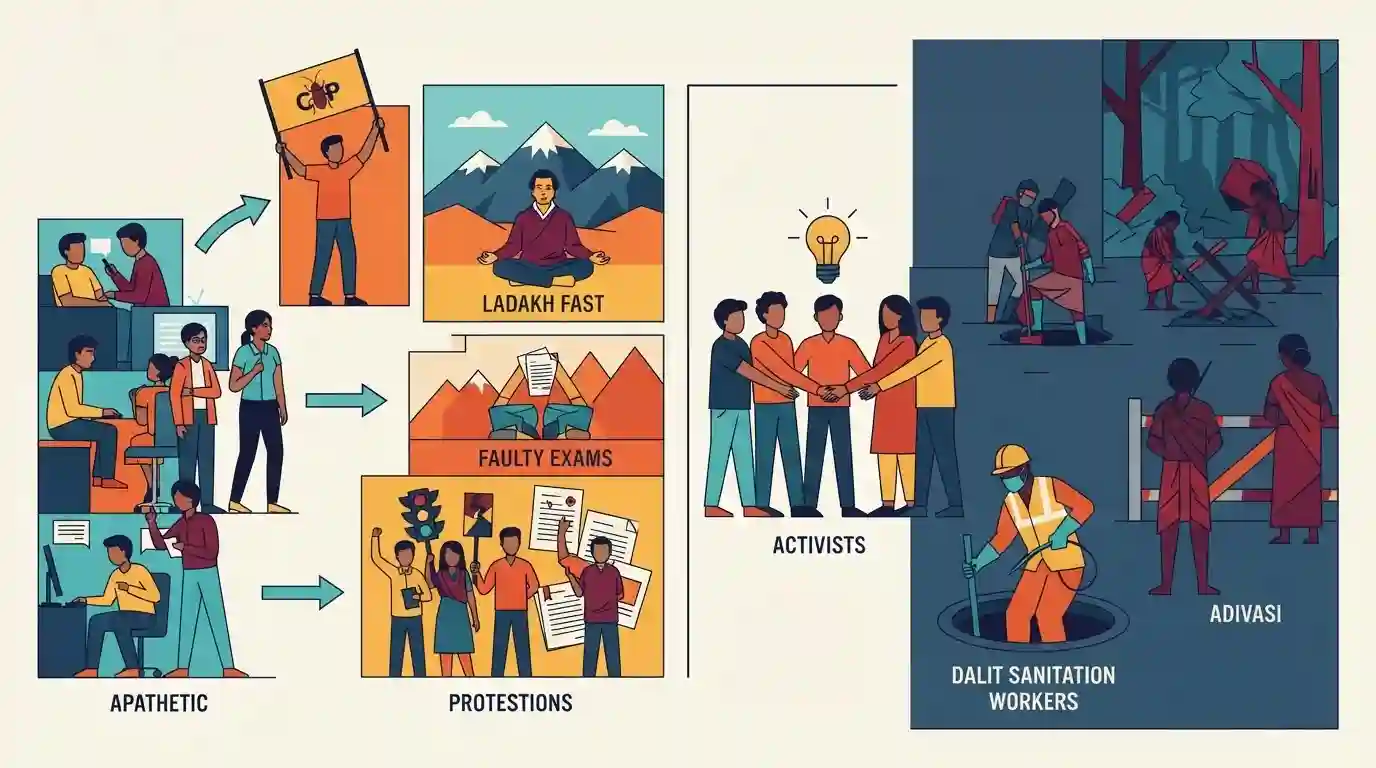
Why It Matters
It bridges GS2 (Civil Society, Vulnerable Sections) and GS4 (Ethics of apathy vs engagement), providing excellent contemporary examples (CJP, NEET protests, Sonam Wangchuk) to illustrate the shifting nature of democratic participation and the structural inequalities that persist in India.
Summary
The article reflects on the burgeoning political engagement of India’s middle class, moving from apathetic complicity to active participation, as seen in recent movements like Sonam Wangchuk's fast for Ladakh and the formation of the 'Cockroach Janta Party' (CJP). The author notes that issues traditionally seen as personal or non-political—such as faulty exams (NEET/CBSE), vehicular fuel issues, or urban civic problems—are forcing the middle class to demand accountability. However, the piece also draws a sharp contrast with the severe, systemic injustices faced by marginalized communities, like Dalit sanitation workers who continue to die in sewers and Adivasis facing structural violence. This highlights a dichotomy where middle-class inconveniences trigger political awakening, while extreme violence against the marginalized remains normalized. Ultimately, this emerging middle-class solidarity signals a shift towards empathetic citizenship and a realization that 'the personal is political.'
Key Points
- India's traditionally apathetic middle class is increasingly engaging in political protests, driven by governance failures that directly impact their daily lives, such as the NEET exam paper leaks and urban civic issues.
- The formation of the 'Cockroach Janta Party' and solidarity with Sonam Wangchuk’s climate fast indicate a realization among the middle class that private, everyday inconveniences are intrinsically linked to state policies ('the personal is political').
- The article starkly contrasts these emerging middle-class grievances with the systemic, life-threatening marginalization faced by Dalits and Adivasis, pointing out the normalization of tragedies like the deaths of manual scavengers in sewers.
- This political awakening, while not yet a radical revolution, represents a crucial ethical shift from silent complicity to civic empathy and solidarity across different sections of society.
Important Terms
Cockroach Janta Party (CJP)

A satirical Indian youth-led political movement launched in 2026 that has evolved into a real street campaign demanding accountability over educational paper leaks and unemployment.
UPSC context
GS Paper II (Civil Society & Citizen Participation) and GS IV (Public Ethics). Tests digital satire as a tool for driving youth accountability.
NEET (National Eligibility cum Entrance Test)
The standardized national-level pre-medical entrance examination in India, which faced immense public scrutiny in 2026 due to administrative lapses, paper leaks, and systemic irregularities.
UPSC context
GS Paper II (Social Sector/Education). Tests administrative integrity, public service delivery, and institutional accountability in national examinations.
All India Students' Association (AISA)
A prominent left-wing student organization in India, affiliated with the CPI (ML) Liberation, known for organizing student-led protests demanding educational reforms and civil rights.
UPSC context
GS Paper II (Role of Pressure Groups). Tests the role of student organizations in policy advocacy and civil society mobilization.
CBSE (Central Board of Secondary Education)
The central education board of India that regulates school curricula and examinations. It faced scrutiny in 2026 over technological irregularities in its evaluation systems.
UPSC context
GS Paper II (Social Sector/Education). Tests the governance of secondary education boards and technological integrity in public exams.
Delhi Police
The law enforcement agency for the National Capital Territory of Delhi, operating under the direct control of the Union Ministry of Home Affairs, Government of India.
UPSC context
GS Paper II (Federalism & UT Administration). Tests Union-State relations, law and order jurisdiction, and public safety administration.
Prelims Trap
The constitutional right to protest includes a fundamental right to strike and block public pathways for civil grievances.
While the fundamental right to assemble peaceably and form associations is protected under Article 19, the Supreme Court has consistently held that the right to strike or block public spaces indefinitely is not a fundamental right.
Static Concepts Connected
What constitutional safeguards and legislative measures address manual scavenging in India?
- Article 17: Abolishes untouchability and forbids its practice, addressing the historical socio-cultural roots of manual scavenging.
- PEMSR Act, 2013: Prohibits employment of manual scavengers and hazardous cleaning of sewers/septic tanks without protective gear.
- Supreme Court Ruling: In Safai Karamchari Andolan case, the SC ordered comprehensive rehabilitation and mandated compensation for sewer deaths.
What constitutional provisions govern autonomy for tribal-majority regions like Ladakh?
- Sixth Schedule: Provides for Autonomous District Councils (ADCs) with legislative and administrative powers over land, forests, and customs.
- Article 371 series: Offers asymmetric federal protections to safeguard local land ownership, employment, and cultural identity across diverse states.
Cross-Topic Patterns
Federalism vs. Indigenous Autonomy
Ladakh's demands link regional environmental conservation with the Sixth Schedule, showing how federal restructuring is vital for ecological security.
Technology leaks and governance trust
Public outcry over NEET exam leaks connects digital administrative vulnerabilities with the eroding social contract between the state and the middle class.

Mains 2026 may contrast middle-class-led civic movements with subaltern struggles to evaluate candidates on the ethics of inclusive policy.
Linked PYQs · 4
Linked PYQs · 4
- 2025MainsGS2
Civil Society Organizations are often perceived as being anti-State actors than non-State actors. Do you agree? Justify.
- 2015MainsGS1
Debate the issue of whether and how contemporary movements for assertion of Dalit identity work towards annihilation of caste.
- 2023MainsGS2
“Development and welfare schemes for the vulnerable, by its nature, are discriminatory in approach.” Do you agree? Give reasons for your answer.
- 2017MainsGS4
Young people with ethical conduct are not willing to come forward to join active politics. Suggest steps to motivate them to come forward.
