Poland military bans Chinese vehicles over security concerns
Source:The Hindu ↗
Why It Matters
Highlights the emerging security threats posed by everyday connected devices (IoT) and foreign-made hardware. For UPSC aspirants, it provides a contemporary example of how data privacy, cyber security frameworks, and geopolitical tensions intersect, emphasizing the need for robust domestic tech regulations and secure defense protocols.
Summary
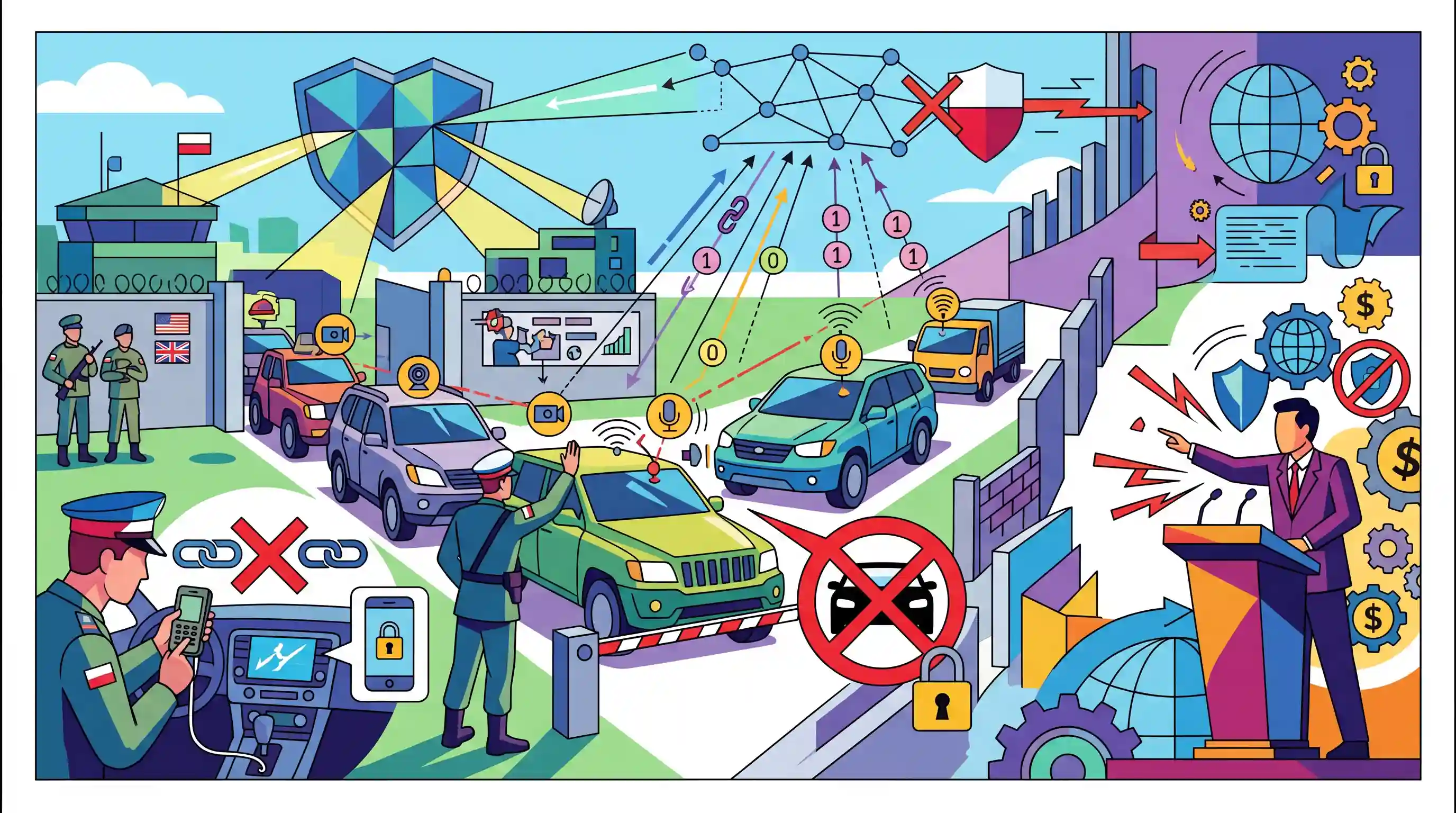
The Polish army has implemented a ban preventing Chinese-made vehicles from entering military facilities, citing concerns over potential espionage and data harvesting. Modern connected vehicles are equipped with sophisticated sensors capable of collecting sensitive location, video, and audio data. The ban extends to prohibiting the connection of official military phones to vehicle infotainment systems. This policy aligns with similar restrictions across NATO countries aimed at protecting national security from foreign technology. China has condemned such bans, arguing they misuse national security justifications to hinder fair market competition.
Key Points
- Poland's military has banned Chinese-made vehicles from its premises due to data security and espionage concerns.
- The restriction targets the risk of uncontrolled data acquisition—including video, sound, and location—by modern smart vehicles equipped with advanced sensors and connectivity.
- Military personnel are also prohibited from connecting official devices to infotainment systems in Chinese vehicles to prevent data leakage.
- This move reflects broader NATO-wide apprehensions regarding Chinese technology and the securitization of foreign supply chains.
- China has criticized the move, claiming it abuses the concept of national security to suppress Chinese companies.
Important Terms
NATO (North Atlantic Treaty Organization)

A 32-member intergovernmental military alliance based on the North Atlantic Treaty (1949), dedicated to collective defense and security cooperation across Europe and North America.
UPSC context
GS Paper II (International Relations); important for understanding global security architecture and India’s strategic engagements with Western military blocs.
Data Harvesting
The large-scale, often automated, collection of personal or sensitive information from digital devices, sensors, or online activities, frequently raising privacy and national security concerns.
UPSC context
GS Paper III (Cyber Security); pertains to internal security challenges through communication networks and data protection legislation.
Strategic Autonomy
The ability of a state or union (like the EU) to pursue national interests and foreign policy independently, without over-reliance on foreign powers for security or technology.
UPSC context
GS Paper II (International Relations); a core principle of Indian foreign policy and evolving European security doctrines.
Technology Decoupling
The strategic reduction of economic and technological interdependence between nations, particularly between Western allies and China, to mitigate supply chain risks and espionage.
UPSC context
GS Paper III (Science & Technology/Security); involves global shifts in hardware supply chains and sovereign technology development.
Critical Infrastructure
Physical or virtual assets and systems so vital to a nation that their incapacity or destruction would have a debilitating impact on national security or public safety.
UPSC context
GS Paper III (Internal Security); relevant for policies on protecting defense installations and digital networks from foreign interference.
Polish Armed Forces
The military organization of Poland, a key NATO member on the alliance's eastern flank, responsible for national defense and contributing to collective security missions.
UPSC context
GS Paper II (International Relations); context for NATO-Russia-China dynamics and regional security in Central Europe.
Prelims Trap
"Bans on foreign technology citing national security are explicitly prohibited under WTO's Most-Favored-Nation (MFN) principle."
False. GATT Article XXI provides a "National Security Exception," allowing members to bypass MFN obligations to protect essential security interests—increasingly invoked for tech bans.
Static Concepts Connected
How do Internet of Things (IoT) endpoints act as espionage vectors?
- Ambient data harvesting: Smart devices with sensors collect massive unregulated ambient data (geolocation, audio, visual) and transmit it to foreign servers.
- Network bridging: Connecting secure defense hardware (like military smartphones) to unverified IoT (car infotainment) allows malware to bypass primary firewalls.
- Remote weaponization: Foreign-controlled firmware updates can secretly convert civilian tech into active surveillance nodes during geopolitical conflicts.
What is the National Security Exception under WTO rules?
- GATT Article XXI: GATT Article XXI allows member nations to breach standard WTO trade obligations if necessary to protect essential security interests.
- Trade decoupling tool: Historically self-judging, it is now increasingly weaponized to restrict foreign telecom, apps, and EVs without facing immediate WTO sanctions.
Cross-Topic Patterns
Connected EVs + Trusted Source mandates
Automobiles as 'computers on wheels' expands cyber vulnerabilities. This mirrors India’s National Security Directive on Telecom Sector, demanding "trusted sources" to prevent foreign backdoor access.
Securitization of supply chains
Western EV bans and India's block on Chinese CCTV components highlight a global shift from purely economic trade policies to security-driven 'technology decoupling' across critical infrastructure.

Expect a 2026 Prelims question linking IoT endpoints (smart EVs) to data localization mandates and GATT Article XXI security exceptions.
Linked PYQs · 3
Linked PYQs · 3
- 2022MainsGS3
What are the different elements of cyber security ? Keeping in view the challenges in cyber security, examine the extent to which India has successfully developed a comprehensive National Cyber Security Strategy.
- 2017MainsGS3
Discuss the potential threats of Cyber attack and the security framework to prevent it.
- 2021MainsGS3
Keeping in view India's internal security, analyse the impact of cross-border cyber attacks. Also discuss defensive measures against these sophisticated attacks.
