Administrative Reforms for Civil Services Governance Paradigm
Source:The Hindu ↗
Why It Matters
This address outlines the current administration's official vision for bureaucratic reform and governance architecture. For UPSC aspirants, it provides excellent fodder and key phrases (e.g., 'facilitator of growth over keeper of rule books', 'next-generation reforms') directly from the Prime Minister that can be effectively utilized in GS Paper 2 (Governance) and GS Paper 4 (Public Administration Ethics) answers.
Summary
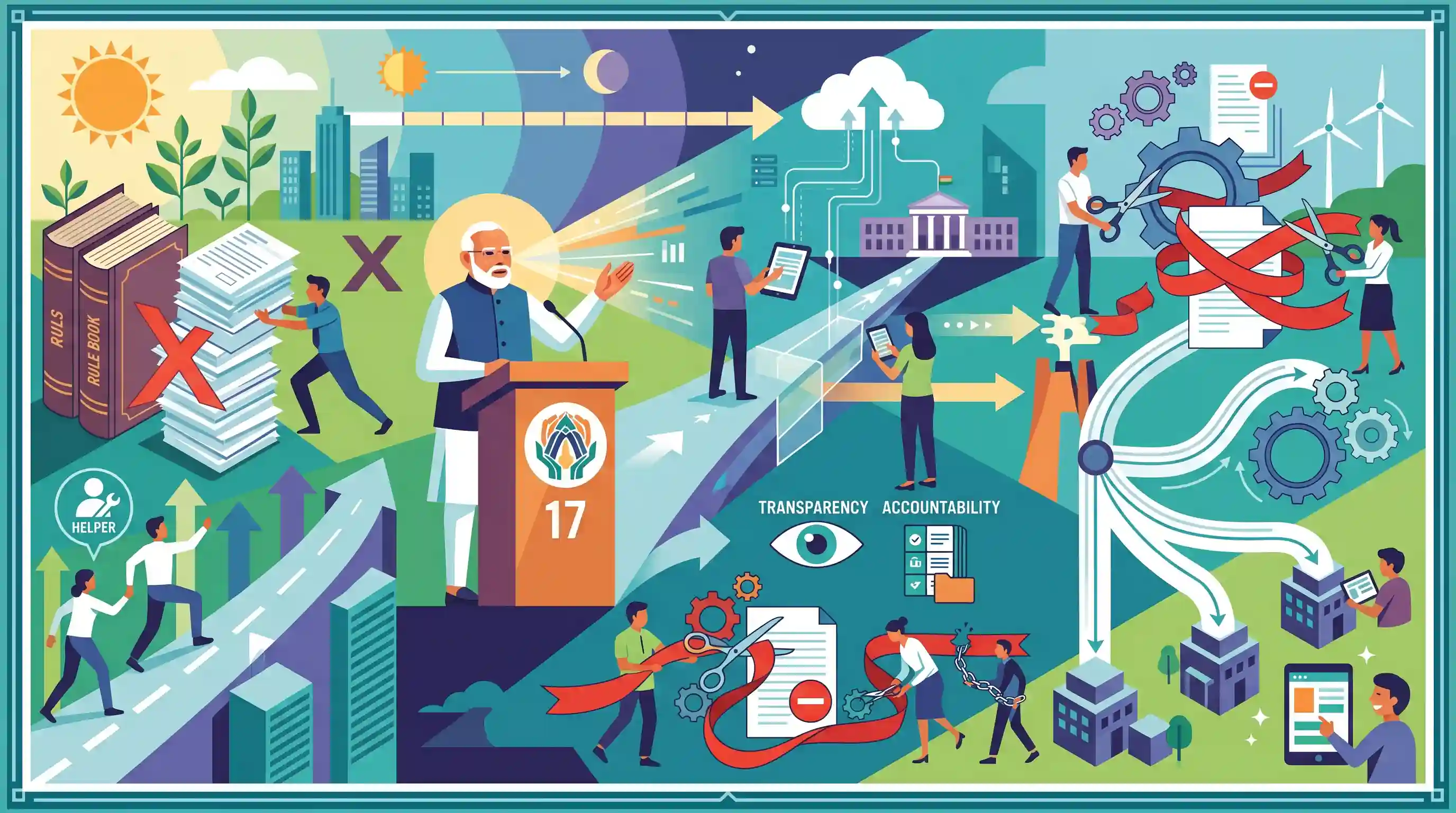
Addressing the 17th Civil Services Day, Prime Minister Narendra Modi stressed that India's bureaucracy must evolve from being a mere "keeper of rule books" to an "enabler" and "facilitator of growth." Emphasizing that policies being formulated today will shape the nation's trajectory for the next 1,000 years, he called for next-generation administrative reforms and the leveraging of technology to bridge the government-citizen gap. He also highlighted the government's successful efforts in promoting the ease of doing business by removing over 40,000 compliances and decriminalizing 3,400 legal provisions, urging officials to eliminate red tape down to the block level to fulfill the extraordinary aspirations of a rapidly developing India.
Key Points
- Prime Minister Narendra Modi addressed the 17th Civil Services Day, emphasizing its theme: "Holistic Development of India."
- He urged civil servants to transition from a regulatory mindset ("keeper of rule books") to proactive facilitators of growth and enablers of society.
- The PM highlighted the removal of over 40,000 compliances and the decriminalization of more than 3,400 legal provisions to significantly boost the ease of doing business.
- He stressed the critical need to eliminate bureaucratic red tape at the state, district, and block levels to fully capitalize on global investment enthusiasm.
- Modi showcased India's G20 Presidency as a prime example of setting new global benchmarks in governance, transparency, innovation, and participatory democracy.
- The focus of administration must shift toward next-generation reforms, leveraging technology to bridge the gap between the government and citizens, and ensuring no citizen is left behind.
Important Terms
Civil Services Day

Observed on April 21 to commemorate Sardar Vallabhbhai Patel's 1947 address to probationers, where he famously called civil servants the "Steel Frame of India."
UPSC context
GS Paper II (Governance); essential for understanding the institutional role and historical evolution of India's bureaucracy.
Mission Karmayogi
The National Programme for Civil Services Capacity Building (NPCSCB), aimed at shifting governance from a "rules-based" to a "roles-based" approach through continuous, technology-driven learning.
UPSC context
GS Paper II (Administrative Reforms); a cornerstone for questions on modernizing bureaucracy and improving public service delivery.
Jan Vishwas Act
A landmark legislation (2023) designed to decriminalize minor and procedural offences across multiple central laws, replacing criminal penalties with civil penalties to foster trust-based governance.
UPSC context
GS Paper II (Governance) & GS Paper III (Economy); tests knowledge of legal reforms and the "Minimum Government, Maximum Governance" philosophy.
Ease of Doing Business (EoDB)
A set of reforms aimed at simplifying the regulatory environment for businesses, including reducing compliance burdens, digitizing approvals, and improving contract enforcement.
UPSC context
GS Paper III (Indian Economy); critical for discussing investment climate and manufacturing growth (Make in India).
E-Governance
The deliberate use of ICT to simplify and improve government processes, enhancing transparency, accountability, and the speed of citizen-centric service delivery.
UPSC context
GS Paper II (Governance); a recurring theme in digital infrastructure and transparency-related questions.
Red Tape
A metaphor for excessive bureaucracy, rigid conformity to formal rules, and procedural delays that hinder efficient decision-making and project implementation.
UPSC context
GS Paper II (Governance) & GS Paper IV (Ethics); relevant to discussions on corruption, efficiency, and administrative ethics.
Prelims Trap
The recent decriminalization of 3,400 provisions was mandated to improve India's ranking in the World Bank’s Ease of Doing Business Index.
The World Bank discontinued the Ease of Doing Business Index in 2021. India's decriminalization push (e.g., Jan Vishwas Act) is driven by domestic "trust-based governance," not this defunct index.
Static Concepts Connected
What is the shift from Weberian Bureaucracy to New Public Management (NPM)?
- Weberian model: Focuses on strict hierarchy, rigid adherence to rules (the "keeper of rule books" mindset), and procedural correctness over end results.
- NPM paradigm: Emphasizes outcomes over processes, user-centric digital service delivery, and redefining the civil servant as a proactive "facilitator of growth."
How does the Jan Vishwas Act promote ease of doing business and governance?
- Decriminalizing minor offenses: Converts minor, non-fraudulent offenses across 42 Central Acts from criminal liability (imprisonment) to civil penalties or fines.
- Trust-based governance: Reduces the compliance burden and harassment of businesses, fostering a shift from a suspicious regulatory state to a facilitative one.
- Unclogging courts: By replacing prosecution with administrative adjudication for minor infractions, it significantly reduces the pending caseload on the lower judiciary.
Cross-Topic Patterns
Mission Karmayogi & Capacity Building
The PM's call for "next-generation reforms" connects directly to Mission Karmayogi (NPCSCB), which aims to transition civil servants from rule-based training to role-based, citizen-centric capacity building.
Decriminalization & MSME 'Dwarfs'
The removal of 40,000 compliances tackles the Economic Survey's 'dwarf MSME' problem, where firms historically stayed intentionally small to avoid the burden of complex regulatory scrutiny and harassment.

Mains 2026 GS-2 will likely ask how Mission Karmayogi & decriminalization acts aid the shift from 'regulatory' to 'facilitatory' governance.
Linked PYQs · 5
Linked PYQs · 5
- 2020MainsGS2
Institutional quality is a crucial driver of economic performance". In this context suggest reforms in Civil Service for strengthening democracy.
- 2024MainsGS2
The Doctrine of Democratic Governance makes it necessary that the public perception of the integrity and commitment of civil servants becomes absolutely positive. Discuss.
- 2023MainsGS2
e-governance, as a critical tool of governance, has ushered in effectiveness, transparency and accountability in governments. What inadequacies hamper the enhancement of these features ?
- 2024MainsGS2
e-governance is not just about the routine application of digital technology in service delivery process. It is as much about multifarious interactions for ensuring transparency and accountability. In this context evaluate the role of the 'Interactive Service Model' of e-governance.
- 2021MainsGS4
Identify ten essential values that are needed to be an effective public servant. Describe the ways and means to prevent non-ethical behaviour in the public servants.
