Police Transfers Spark Political Controversy in Himachal Pradesh
Source:uni ↗
Why It Matters
The article underscores the recurrent challenge of politicisation of bureaucracy and the misuse of state machinery for political gains, highlighting crucial themes relevant to GS2 (Governance) and GS4 (Ethics in Public Administration).
Summary
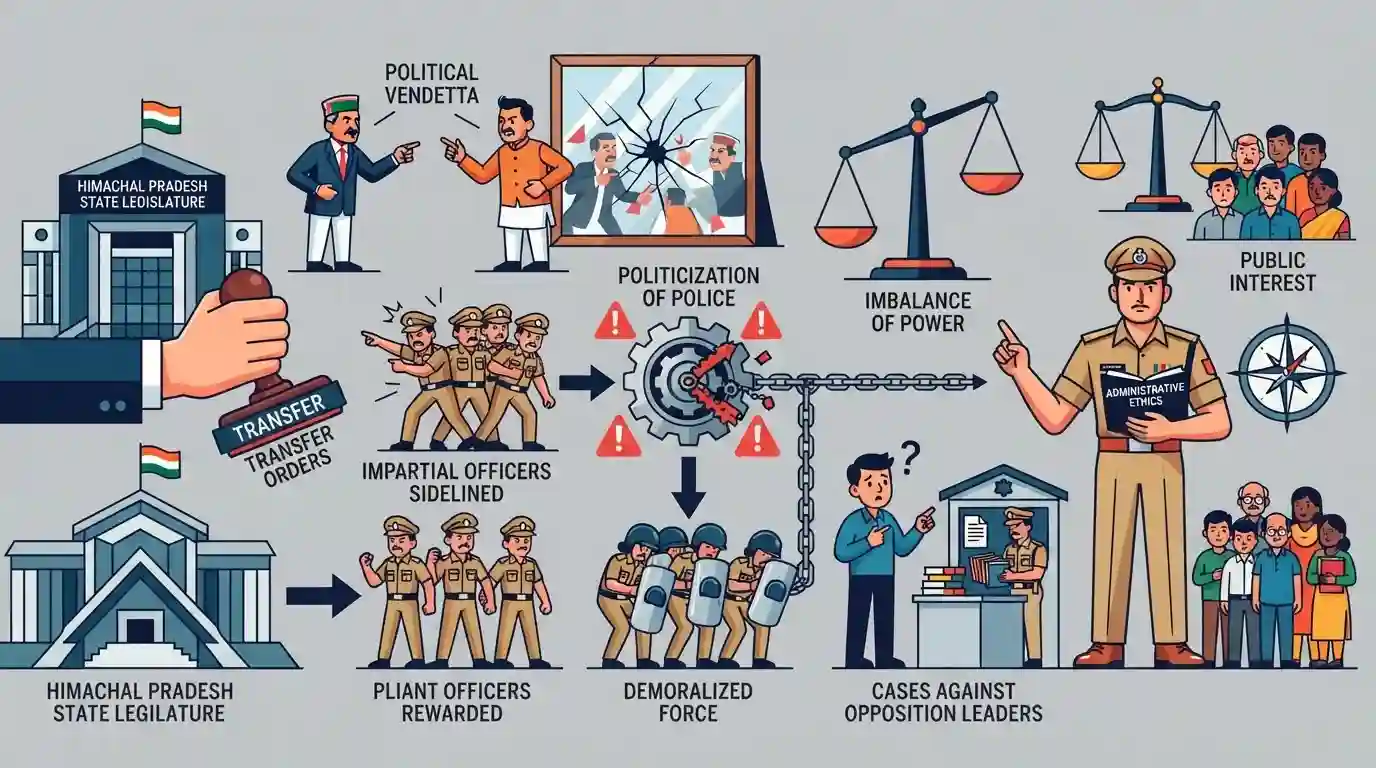
A political row has erupted in Himachal Pradesh over recent police transfer orders issued by the Sukhu government. BJP MLA Sudhir Sharma has strongly criticized the moves, alleging that the state administration is misusing the police machinery for political vendettas. Sharma pointed to the recent registration of cases against prominent BJP leaders, including state president Rajeev Bindal, and claimed that impartial officers are being sidelined while pliant ones are rewarded. He warned that such politicisation of the police force demoralizes officers and urged that transfers be guided solely by administrative needs and public interest.
Key Points
- A political dispute has surfaced in Himachal Pradesh following recent police transfer orders by the Sukhu-led Congress government.
- BJP MLA Sudhir Sharma accused the government of political vendetta, alleging that police transfers are being used to reward officers who target political opponents and sideline impartial officials.
- The allegations follow recent cases filed against BJP state president Rajeev Bindal and MLAs Ashish Sharma and Hoshiyar Singh.
- Sharma asserted that politically motivated transfers undermine the morale of the police force and emphasized that such actions should strictly adhere to administrative requirements and public interest.
Important Terms
Politicisation of Civil Services

The phenomenon where civil servants align with or are pressured by the ruling political party, compromising their neutrality, meritocracy, and independent functioning in favor of partisan interests.
UPSC context
Crucial for GS Paper 2 and 4; tests understanding of administrative reforms, institutional integrity, and ethics in governance.
Political Neutrality
A foundational value of civil services ensuring officers remain unaligned with any political party, providing impartial, objective, and evidence-based service regardless of the government in power.
UPSC context
Essential for GS Paper 4 (Foundational Values); tests the ethical framework required for impartial public administration.
Himachal Pradesh Police
The primary law enforcement agency of Himachal Pradesh. As "Police" falls under the State List in the Indian Constitution, the state government controls its administration, including officer transfers.
UPSC context
Connects to GS Paper 2 (State Subjects) and GS 3 (Security); highlights police administration and state government jurisdiction.
Bharatiya Janata Party (BJP)
One of India's major national political parties. It currently serves as the principal opposition party in the Himachal Pradesh state legislative assembly.
UPSC context
Relevant for GS Paper 2 (Polity); tests knowledge of the party system, legislative dynamics, and the opposition's role in a democracy.
Indian National Congress (INC)
A major national political party in India, currently holding power and forming the state government in Himachal Pradesh under Chief Minister Sukhvinder Singh Sukhu.
UPSC context
Relevant for GS Paper 2 (Polity); tests understanding of political parties, state governance structures, and the exercise of executive power.
Prelims Trap
"The Police Establishment Board is a statutory body created under the Police Act, 1861."
PEBs are not statutory bodies under the 1861 Act. They were mandated by the Supreme Court in the Prakash Singh case (2006).
Static Concepts Connected
What are the core directives of the Prakash Singh case (2006) on police reforms?
- Security Commission: Establish a State Security Commission to ensure the state government does not exercise unwarranted influence over the state police force.
- Fixed Tenure: Mandate a minimum two-year tenure for the Director General of Police (DGP) and other operational field officers like SPs and SHOs.
- Establishment Board: Create a Police Establishment Board to decide transfers, postings, and promotions for officers below the rank of Deputy Superintendent of Police (DSP).
- Complaints Authority: Set up a Police Complaints Authority at state and district levels to inquire into serious public complaints against police officers.
What mechanisms exist to prevent arbitrary bureaucratic transfers in India?
- Civil Services Board: The Supreme Court in T.S.R. Subramanian (2013) mandated the creation of CSBs to regulate transfers and explicitly record reasons for any premature postings.
- Minimum Tenure Rules: The 2nd Administrative Reforms Commission (ARC) recommended a fixed 2-3 year tenure for field postings to halt the weaponization of frequent transfers by the executive.
- Conduct Rules: Central Civil Services (Conduct) Rules mandate officers to maintain absolute integrity and political neutrality, serving as an ethical baseline against irregular political directions.
Cross-Topic Patterns
All India Services + Federalism
Controversies over IPS officer postings frequently overlap with Centre-State friction, linking state police administration directly to federalism debates under Article 312.
GS-IV Ethics + Administration
The weaponization of transfers forms classic GS-IV case studies, pitting an officer's 'political neutrality' and 'impartiality' against 'obedience to the political executive'.

Mains 2026 will likely test the efficacy of Police Establishment Boards (PEBs) against political patronage using state-level case studies.
Linked PYQs · 1
Linked PYQs · 1
- 2013HPAS_PRELIMSGS1
What were the main findings of the N.N. Vohra Committee ?
