Madras HC on Police Neutrality and Rule of Law
Source:The Hindu ↗
Why It Matters
It addresses core themes of civil service accountability, neutrality, and the separation of political influence from law enforcement administration.
Summary
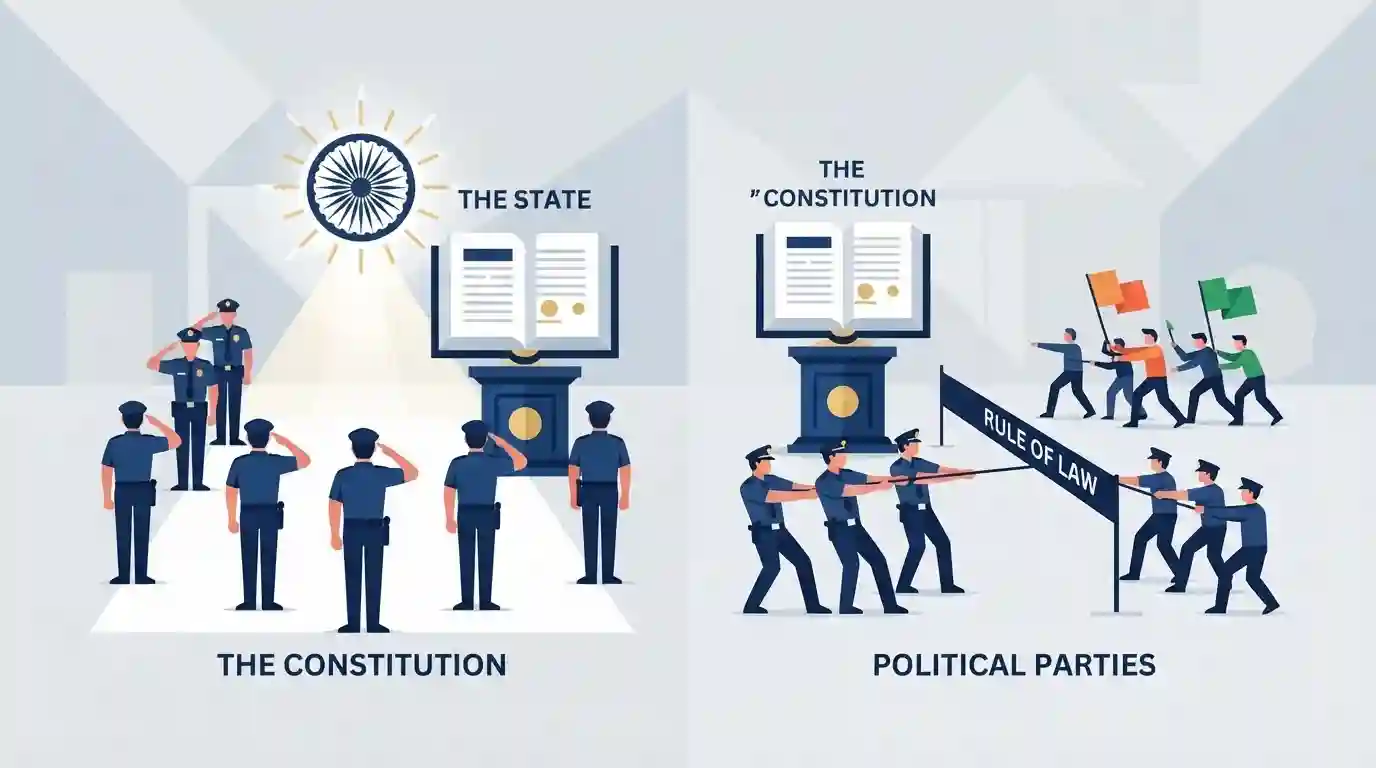
The Madras High Court has asserted that police departments must remain loyal to the Constitution and the State rather than whichever political party happens to be in power, drawing attention to civil service neutrality and the rule of law.
Key Points
- The Madras High Court emphasized that police forces must serve the State (which endures) rather than the ruling political party (which changes).
- The ruling underscores the importance of institutional neutrality, rule of law, and civil service integrity.
- It highlights the growing concern over the politicization of law enforcement agencies and the need for professional autonomy.
Important Terms
Civil Service Neutrality

The principle that bureaucrats and law enforcement personnel must remain politically impartial, loyal to the Constitution and the enduring State rather than transient ruling political parties.
UPSC context
UPSC CSE General Studies Paper II: Polity and Governance – features of civil services, accountability, and police reforms.
Madras High Court
The constitutional high court with jurisdiction over the state of Tamil Nadu and the Union Territory of Puducherry, frequently issuing guidelines on governance and rule of law.
UPSC context
UPSC CSE General Studies Paper II: Structure, organization, and functioning of the Judiciary.
Prelims Trap
The Union Ministry of Home Affairs has ultimate statutory authority to transfer and discipline state police cadres.
Aspirants often assume police forces are exclusively a Union subject under Schedule VII, missing that 'Police' is a State List subject where Centre has minimal direct administrative control.
Static Concepts Connected
What are the key structural recommendations of the Prakash Singh v. Union of India (2006) judgment on police reforms?
- Security Commission: State Security Commission: Established to ensure that the State government does not exercise unwarranted influence over the police.
- Fixed Tenure: Fixed Tenure: Provided a minimum tenure of two years for the DGP and other key police officers to ensure stability.
- Functional Split: Separation of Functions: Separated investigation work from law and order duties to improve professional expertise.
- Establishment Board: Police Establishment Board: Handled transfers, postings, promotions and other service matters of officers below the rank of DSP.
Cross-Topic Patterns
Police Neutrality vs. Executive Overreach
Courts frequently invoke civil service neutrality alongside anti-defection and governor-legislature disputes when examining executive overreach.
Prakash Singh Directives vs. State Action
The Madras HC's reminder links directly to the Supreme Court's stalled directions on structural police reforms in Prakash Singh v. Union of India.

Expect a direct statement-based question pairing Prakash Singh guidelines with the constitutional doctrine of civil service neutrality.
Linked PYQs · 2
Linked PYQs · 2
- 2024MainsGS2
The Doctrine of Democratic Governance makes it necessary that the public perception of the integrity and commitment of civil servants becomes absolutely positive. Discuss.
- 2017MainsGS2
Initially Civil Services in India were designed to achieve the goals of neutrality and effectiveness, which seems to be lacking in the present context. Do you agree with the view that drastic reforms are required in Civil Services? Comment.
