Supreme Court Refuses Plea on Bhojpur Police Encounter Probe
Source:The Hindu ↗
Why It Matters
The decision highlights the operational dynamics of concurrent jurisdiction under Articles 32 and 226, the procedural significance of the landmark PUCL (2014) guidelines on police encounters, and the administrative deployment of judicial commissions by state governments.
Summary
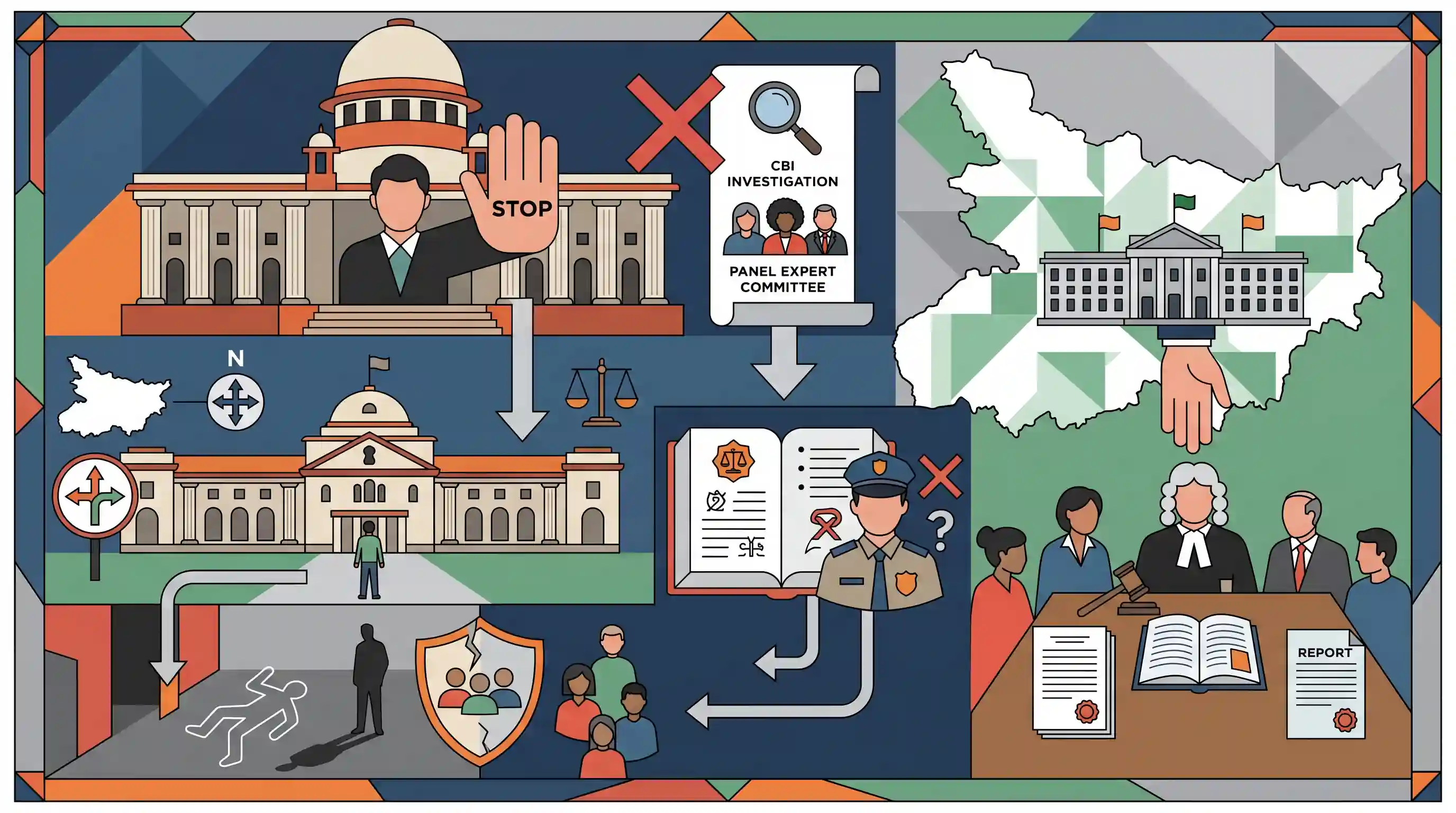
The Supreme Court declined to entertain a writ petition seeking a CBI probe and an expert committee investigation into the alleged extra-judicial killing of Bharat Bhushan Tiwari in Bhojpur, Bihar. The SC advised the petitioner to approach the Patna High Court instead, pointing to its better position to monitor local matters. Meanwhile, the Bihar government established a judicial inquiry commission headed by retired Justice Vinod Kumar Sinha to probe the incident, amidst arguments regarding the non-compliance of the landmark 2014 PUCL guidelines on police encounters.
Key Points
- The Supreme Court of India, comprising a Bench of Justices M.M. Sundresh and Sheel Nagu, refused to entertain a PIL seeking a CBI probe and an expert committee investigation into the police encounter of Bharat Bhushan Tiwari in Bilauti village, Bhojpur district, Bihar.
- The Apex Court directed the petitioner, advocate Vishal Tiwari, to approach the Patna High Court, noting that the High Court has better proximity and administrative capacity to monitor the case locally.
- The petitioner asserted that police authorities failed to follow the landmark 16-point guidelines on extra-judicial killings established by the Supreme Court in the 2014 PUCL v. State of Maharashtra case.
- The Bihar State Government, led by Chief Minister Samrat Choudhary, had already constituted a judicial commission headed by retired Patna High Court Judge Justice Vinod Kumar Sinha on June 24, 2026, to investigate the Bhojpur encounter.
Important Terms
PUCL v. State of Maharashtra (2014) Guidelines

A landmark set of 16 mandatory procedural requirements laid down by the Supreme Court to ensure independent, transparent, and thorough investigations into all police encounter deaths.
UPSC context
GS Paper II: Criminal Justice Reforms. Tests knowledge of judicial guidelines governing police accountability and Article 21 rights.
Article 32 of the Constitution of India
A fundamental right guaranteeing citizens the right to petition the Supreme Court directly for the enforcement of other fundamental rights, often called the 'heart and soul' of the Constitution.
UPSC context
GS Paper II: Constitutional Remedies. Tests understanding of the Supreme Court's original writ jurisdiction and protection of fundamental rights.
Article 226 of the Constitution of India
A constitutional provision empowering High Courts to issue writs for the enforcement of fundamental rights and for 'any other purpose,' granting them a wider remedial scope than the Supreme Court.
UPSC context
GS Paper II: Indian Judiciary. Tests understanding of the discretionary writ jurisdiction of High Courts and structural hierarchy in remedies.
Central Bureau of Investigation (CBI)
India's premier central investigative agency, operating under the Ministry of Personnel, Public Grievances and Pensions, specializing in corruption, economic crimes, and complex inter-state or sensational cases.
UPSC context
GS Paper II: Statutory/Executive Bodies. Tests knowledge of the CBI's jurisdiction, governance, and role in conducting high-profile probes.
People's Union for Civil Liberties (PUCL)
A prominent Indian human rights organization established in 1976, dedicated to advocating for civil liberties, monitoring human rights abuses, and initiating public interest litigations to defend constitutional rights.
UPSC context
GS Paper II: Non-State Actors. Tests understanding of civil liberties organizations in strengthening democratic governance and judicial accountability.
Supreme Court of India
The highest judicial court of India established under the Constitution, serving as the final court of appeal, the ultimate interpreter of the Constitution, and the guardian of fundamental rights.
UPSC context
GS Paper II: Union Judiciary. Tests knowledge of the apex court's jurisdictions, powers of judicial review, and federal balancing role.
Prelims Trap
The Supreme Court cannot refuse to entertain a writ petition under Article 32 as the right to move the SC is itself a fundamental right.
While Article 32 is a fundamental right, the SC has established that it can direct petitioners to first exhaust remedies under Article 226 for administrative and local monitoring convenience.
Static Concepts Connected
What are the core distinctions between Article 32 and Article 226 writ jurisdictions?
- Scope of Rights: Article 32 is restricted to enforcing Fundamental Rights, whereas Article 226 covers Fundamental Rights as well as ordinary legal rights.
- Nature of Remedy: Article 32 is itself a Fundamental Right, making SC access guaranteed, whereas Article 226 is a constitutional power exercised at the High Court's discretion.
What mandatory procedures did the SC lay down in PUCL v. State of Maharashtra (2014)?
- Independent Investigation: Investigation must be conducted by the state CID or an independent police team from another police station, not the involved team.
- Magisterial Inquiry: A mandatory magisterial inquiry under Section 176 CrPC (now BNSS) must be conducted in every case of police encounter death.
- Promotion Restriction: No out-of-turn promotions or gallantry awards can be granted to the involved officers until the inquiry establishes clean conduct.
Cross-Topic Patterns
Writ hierarchy vs Judicial backlog
The Supreme Court's practice of redirecting Article 32 petitions to Article 226 highlights the struggle between protecting absolute fundamental rights and managing the apex court's overwhelming administrative caseload.
Police reform and Cooperative Federalism
Though 'Police' is a State List subject, central judicial guidelines (PUCL 2014) check state executive excesses, balancing state autonomy with national human rights standards.

UPSC 2026 may test the comparative limits of Article 32 and 226, specifically regarding alternative remedies and judicial discretion.
Linked PYQs · 2
Linked PYQs · 2
- 2025BPSC_PRELIMSGS1
Which one of the following subjects fall within the jurisdiction of both High Court and Supreme Court?
- 2015BPSC_PRELIMSGS1
Justice J. S. Verma Committee's Report, 2013 deals with:
