Police Detention and Protest Arrests under BNSS
Source:Indian Express ↗
આ શા માટે મહત્વનું છે
Understanding the balance between state police powers for maintaining public order and individual fundamental liberties under criminal law reforms like the BNSS is essential for aspirants of civil services.
સારાંશ
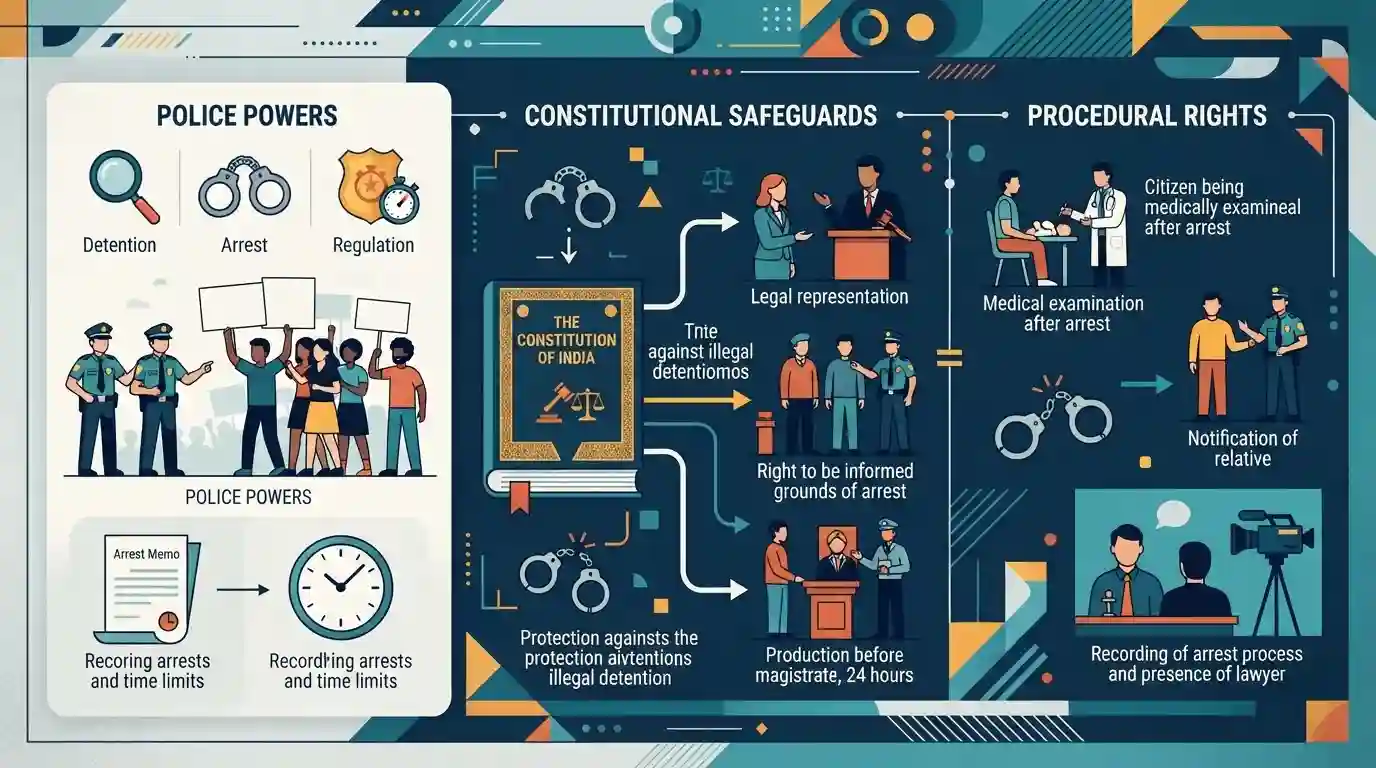
An analytical breakdown of police powers of detention and arrest during protests under the newly enacted Bharatiya Nagarik Suraksha Sanhita (BNSS), highlighting constitutional safeguards and procedural rights of citizens.
મુખ્ય મુદ્દા
- The article explains the legal provisions regarding police detention, arrest, and public protests under the Bharatiya Nagarik Suraksha Sanhita (BNSS).
- It outlines fundamental rights related to personal liberty (Article 21) and protection against arbitrary arrest (Article 22).
- Distinctions between preventive detention, routine arrest during protests, and police custody vs. judicial custody are emphasized.
- Procedural safeguards mandated by the Supreme Court and statutory frameworks are critical to protect citizens' rights during civil demonstrations.
મહત્વપૂર્ણ શબ્દો
Bharatiya Nagarik Suraksha Sanhita (BNSS)

The newly enacted criminal procedure code replacing the colonial-era CrPC, governing police powers of arrest, detention, investigation, and trial procedures in India.
UPSC context
UPSC GS Paper II (Polity and Governance - Criminal Justice Reforms). Tests understanding of new criminal laws and procedural rights.
Code of Criminal Procedure (CrPC)
The erstwhile principal legislation governing procedural criminal law in India from 1974 until its replacement by the BNSS in 2024.
UPSC context
UPSC GS Paper II (Polity and Governance). Crucial for evaluating historical criminal jurisprudence versus modern reforms.
Supreme Court of India
The apex judicial body of India and ultimate guardian of the Constitution, responsible for protecting fundamental rights against state overreach and unlawful detention.
UPSC context
UPSC GS Paper II (Indian Constitution, Judicial Review, Rights). Tests the judiciary's role in safeguarding citizen liberties during protests.
પ્રિલિમ્સ ટ્રેપ
The BNSS abolishes all forms of police custody and preventive detention during public demonstrations.
Aspirants often assume BNSS completely eliminates police custody or preventive detention, whereas it actually expands certain investigative windows while codifying digital procedures.
સંલગ્ન સ્થિર ખ્યાલો
What are the constitutional safeguards against arrest and detention under Article 22?
- Communication of Grounds: Grounds of arrest must be communicated to the arrested person as soon as may be.
- Legal Representation: The arrested person has the right to consult and be defended by a legal practitioner of their choice.
- Magistrate Production: Production before the nearest magistrate within 24 hours of arrest, excluding travel time.
- Exclusions: Protection does not apply to enemy aliens or persons arrested under preventive detention laws.
આંતર-વિષય પેટર્ન
Criminal Procedure Code Reforms & Article 21
The expansion of police custody limits under the BNSS intersects directly with judicial oversight frameworks established by landmark Supreme Court rulings like D.K. Basu.

Expect a statement-based prelims question comparing colonial-era CrPC provisions with new BNSS custodial timelines and safeguards.
સંલગ્ન PYQ · 3
સંલગ્ન PYQ · 3
- 2024MainsGS2
Right to privacy is intrinsic to life and personal liberty and is inherently protected under Article 21 of the constitution. Explain. In this reference discuss the law relating to D.N.A. testing of child in the womb to establish its paternity.
- 2026PrelimsGS1
Which of the following statements about a Zero First Information Report (Zero FIR) under the Bharatiya Nagarik Suraksha Sanhita (BNSS), 2023 is/are correct ? 1. A Zero FIR can be lodged at a police station, even though the place of commission of a cognizable/non-cognizable offence is outside the territorial jurisdiction of that police station. 2. The Officer-in-Charge of the police station where a Zero FIR has been lodged may, with the permission of the competent authority, initiate a preliminary enquiry. 3. Under Zero FIR, it is obligatory for the informant to furnish information electronically. Select the answer using the code given below :
- 2021PrelimsGS1
With reference to India, consider the following statements : 1. Judicial custody means an accused is in the custody of the concerned magistrate and such accused is locked up in police station, not in jail. 2. During judicial custody, the police officer in charge of the case is not allowed to interrogate the suspect without the approval of the court. Which of the statements given above is/are correct?
