Conditional police permission for political rally in Delhi
Source:Indian Express ↗
Why It Matters
The incident exemplifies the conflict between the fundamental right to assemble peacefully (Article 19) and the state's power to maintain public order (Section 163 BNSS). It also illustrates the unique administrative challenges and federal friction in Delhi, where law and order fall under the Union Government's jurisdiction rather than the elected state government.
Summary
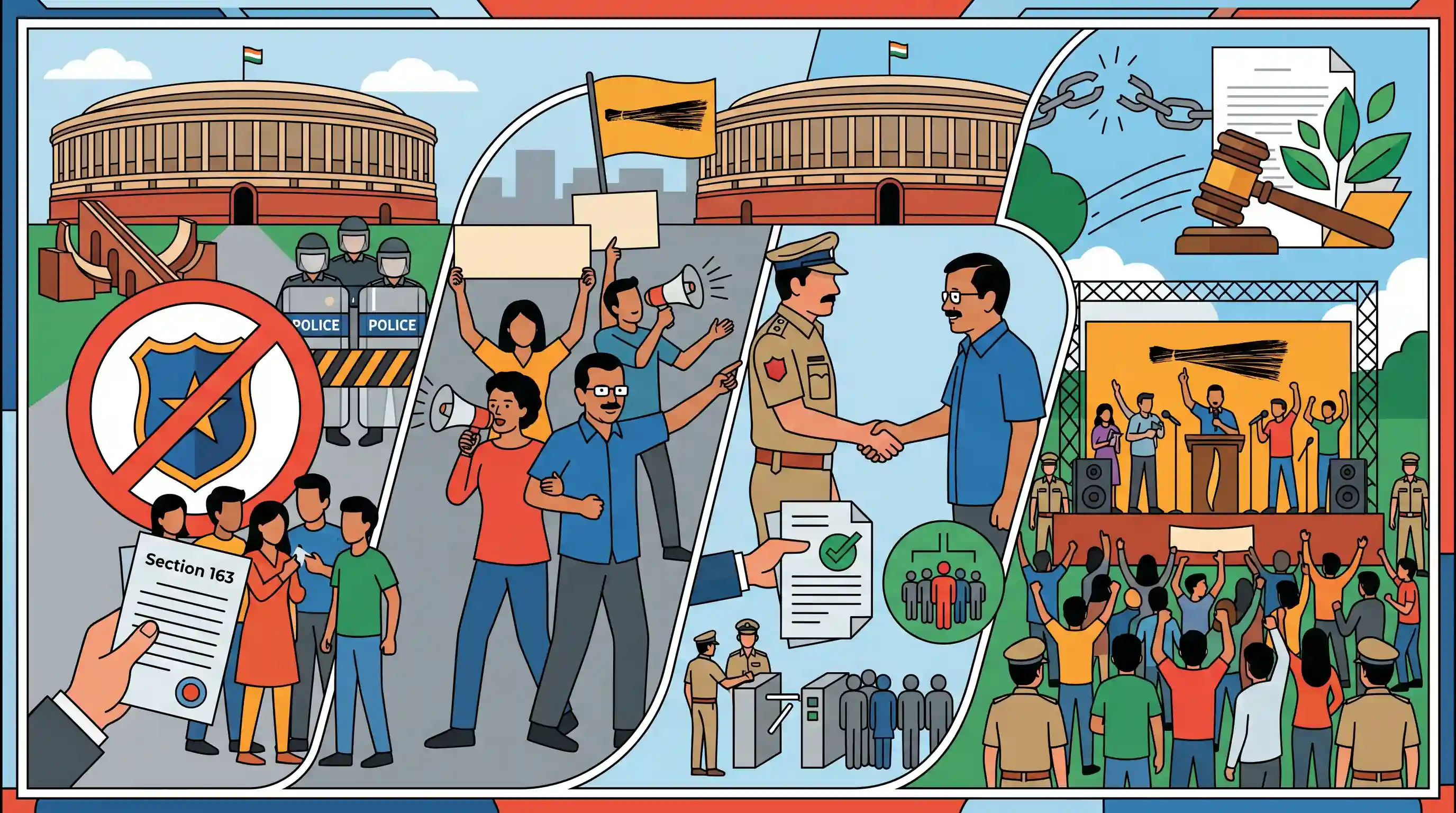
The Delhi Police initially denied but later conditionally permitted an Aam Aadmi Party (AAP) rally at Jantar Mantar. The initial refusal cited Section 163 of the Bharatiya Nagarik Suraksha Sanhita (BNSS)—analogous to the old Section 144 CrPC—due to the venue's proximity to Parliament. AAP leaders, including Arvind Kejriwal, invoked the constitutional right to freedom of speech and peaceful assembly under Article 19 to protest the denial. The rally, aimed at celebrating the discharge of party leaders in an excise policy case, eventually proceeded with a 10,000-person limit. This incident underscores the ongoing tensions between the elected Delhi government and the Delhi Police (controlled by the Centre via the Lieutenant Governor) regarding public order and constitutional freedoms.
Key Points
- The Delhi Police initially denied permission for an AAP rally at Jantar Mantar, citing Section 163 of the Bharatiya Nagarik Suraksha Sanhita (BNSS) imposed near Parliament.
- Following a backlash and appeals invoking the constitutional right to peaceful assembly, the police later permitted the rally with conditions, such as a cap of 10,000 participants.
- The rally, titled 'Aapka Vidhayak Aapke Dwar', was held to celebrate the legal discharge of AAP leaders Arvind Kejriwal and Manish Sisodia in an alleged excise policy case.
- The event highlighted ongoing administrative frictions between the elected Delhi government and the Delhi Police, which reports to the Union Government via the Lieutenant Governor.
Important Terms
Bharatiya Nagarik Suraksha Sanhita (BNSS)

The 2023 legislation replacing the Code of Criminal Procedure (CrPC). It outlines procedures for investigation, arrest, and trial, aiming to modernize India’s criminal justice system through technology and revised timelines.
UPSC context
GS Paper II (Polity/Governance). Tests knowledge of legal reforms and criminal justice system evolution.
Article 19 of the Constitution
A fundamental right protecting six essential freedoms, including speech and assembly. It forms the bedrock of individual liberty, ensuring citizens can express views and protest peacefully.
UPSC context
GS Paper II (Polity). A core topic frequently tested in Prelims and Mains regarding Fundamental Rights.
Section 163 of BNSS
The successor to Section 144 CrPC, empowering magistrates to prohibit gatherings or actions to prevent urgent nuisance, danger to human life, or disturbances to public order and tranquility.
UPSC context
GS Paper II (Polity). Relevant for topics on public order, police powers, and civil liberties.
Article 239AA
A constitutional provision granting Delhi special status with an elected legislature, while reserving control over police, land, and public order for the Central Government through the Lieutenant Governor.
UPSC context
GS Paper II (Governance/Federalism). Vital for questions on Centre-State relations and Delhi's unique administrative structure.
Reasonable Restrictions
Legal limits placed on fundamental rights under Article 19(2) to 19(6) to protect public order, national sovereignty, security, and morality, balancing individual liberty with societal needs.
UPSC context
GS Paper II (Polity). Essential for understanding the non-absolute nature of constitutional rights and judicial review.
Lieutenant Governor (LG)
The constitutional head of a Union Territory, appointed by the President. In Delhi, the LG wields significant executive powers, particularly over reserved subjects like police and public order.
UPSC context
GS Paper II (Polity). Tests understanding of Union Territory administration and federal conflicts in the National Capital.
Prelims Trap
"The Delhi Legislative Assembly can make laws on all State List entries except Police and Public Order."
It also explicitly excludes 'Land' (Entry 18). Aspirants often forget Land and only remember Police/Public Order due to frequent news about protests and law enforcement.
Static Concepts Connected
What are the grounds for restricting the Right to Assemble (Article 19(1)(b))?
- Sovereignty & Integrity: Added by the 16th Constitutional Amendment Act to prevent secessionist or anti-national assemblies.
- Public Order: Assemblies can be restricted if they threaten public peace. Notably, 'Morality' and 'Security of the State' are NOT grounds for restricting assembly (unlike freedom of speech).
What is the constitutional framework for Delhi's governance under Article 239AA?
- 69th Amendment: Introduced by the 69th Amendment (1991), it designated Delhi as the National Capital Territory with an elected Legislative Assembly.
- Three Exceptions: The Delhi Assembly is explicitly barred from legislating on three State List subjects: Public Order, Police, and Land. These remain under Union control via the LG.
Cross-Topic Patterns
Right to Protest vs Public Mobility
Connects the Jantar Mantar regulations (Mazdoor Kisan case) with the Shaheen Bagh ruling, emphasizing the Supreme Court's balancing of Article 19(1)(b) against the general public's right to free movement.
BNSS Sec 163 replaces CrPC Sec 144
The operational shift to the Bharatiya Nagarik Suraksha Sanhita (BNSS) makes the powers of Executive Magistrates to issue prohibitory orders under Section 163 highly relevant for upcoming Prelims.

Expect a multi-statement question integrating BNSS Sec 163 powers with the exact constitutional restrictions on Article 19(1)(b) assembly.
Linked PYQs · 2
Linked PYQs · 2
- 2016MainsGS2
Discuss the essentials of the 69th Constitutional Amendment Act and anomalies, if any, that have led to recent reported conflicts between the elected representatives and the institution of the Lieutenant Governor in the administration of Delhi. Do you think that this will give rise to a new trend in the functioning of the Indian federal politics?
- 2023MainsGS2
“The Constitution of India is a living instrument with capabilities of enormous dynamism. It is a constitution made for a progressive society.” Illustrate with special reference to the expanding horizons of the right to life and personal liberty.
