Patna Police disperse student protest march towards Raj Bhavan
Source:The Hindu ↗
Why It Matters
Understanding the dynamics of student protests and political clashes in Bihar is relevant for state politics and law & order administration, reflecting the local response to major national controversies like the NEET exam issue and parliamentary debates.
Summary
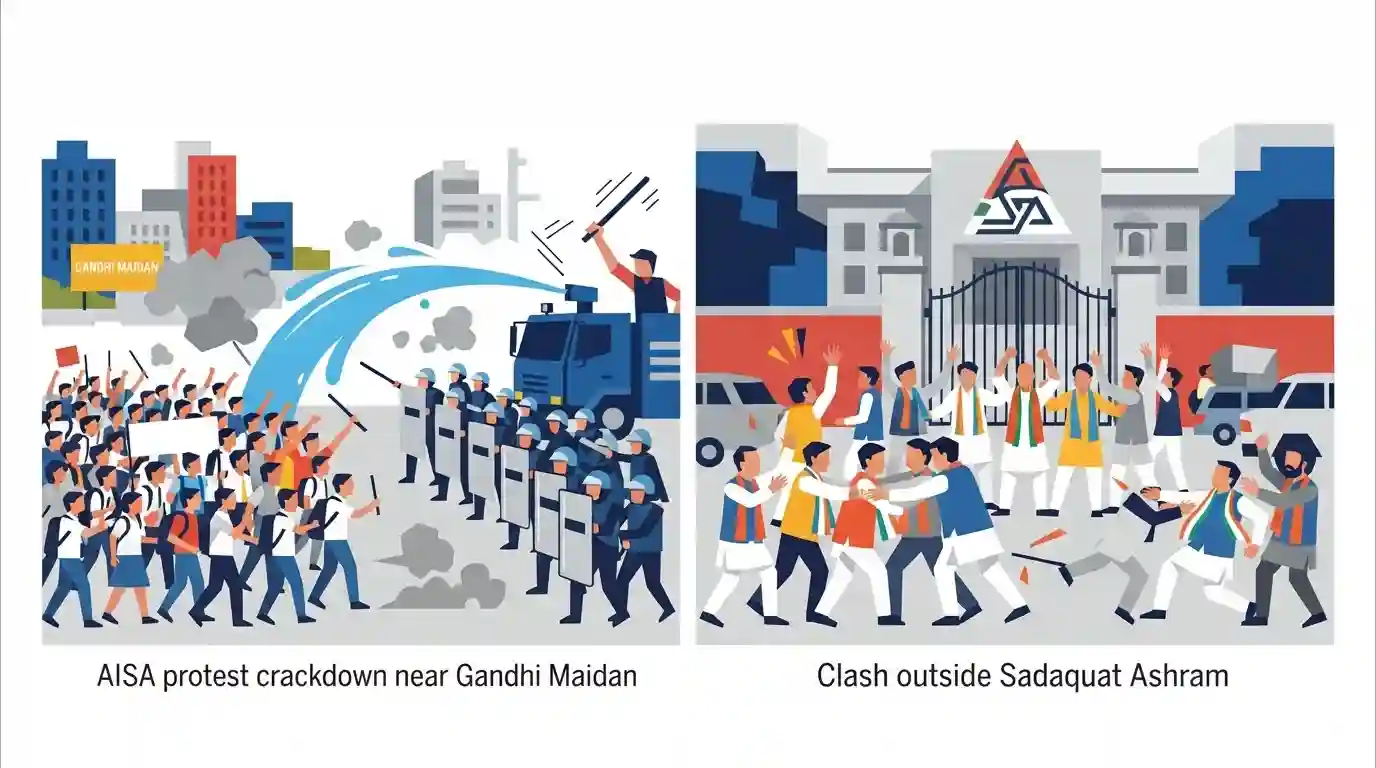
The article details a crackdown by Patna Police on members of the All India Students' Association (AISA) who were marching towards the Raj Bhavan to demand the resignation of Union Education Minister Dharmendra Pradhan over the NEET exam row. Police used water cannons, tear gas, and a baton-charge to disperse the protesters near Gandhi Maidan. In a separate incident, clashes broke out outside Sadaquat Ashram, the Bihar Congress headquarters, between Congress and BJP workers protesting against remarks made by Rahul Gandhi in the Lok Sabha.
Key Points
- AISA workers organized a protest march in Patna demanding the resignation of Union Education Minister Dharmendra Pradhan over alleged irregularities in the NEET examination.
- Patna Police employed lathi-charge, water cannons, and tear gas to disperse the protesting students near the JP roundabout adjacent to Gandhi Maidan.
- Separately, a clash occurred outside Sadaquat Ashram, the Bihar Congress headquarters, between BJP and Congress workers following BJP protests against Leader of Opposition Rahul Gandhi's recent remarks in Parliament.
- The events highlight escalating political and student agitations in Bihar surrounding national educational issues and parliamentary debates.
Important Terms
Right to Protest

A constitutional right derived from Article 19(1)(a) and 19(1)(b) of the Indian Constitution, guaranteeing citizens the freedom to voice dissent and assemble peacefully without arms, subject to reasonable restrictions.
UPSC context
GS Paper II (Polity); tests understanding of Fundamental Rights, Article 19, and the balance between civil liberties and public order.
National Testing Agency (NTA)
An autonomous, specialist testing organization established under India's Ministry of Education to conduct standardized, efficient, and transparent entrance examinations for admissions and fellowships in higher educational institutions.
UPSC context
GS Paper II (Governance); tests knowledge of statutory and autonomous bodies, educational governance, and examination reforms.
Sadaquat Ashram
A historic ashram in Patna established by Maulana Mazharul Haque in 1921. It served as a key center of nationalist activities during India's freedom struggle and currently serves as the Bihar Pradesh Congress Committee headquarters.
UPSC context
GS Paper I (Modern Indian History); tests knowledge of regional freedom struggles, key leaders like Rajendra Prasad, and post-independence history.
All India Students' Association (AISA)
A left-wing student organization in India, founded in 1990 in Prayagraj. It is ideologically aligned with the Communist Party of India (Marxist–Leninist) Liberation and actively campaigns for student rights and educational reforms.
UPSC context
GS Paper II (Polity/Governance); tests understanding of pressure groups, student movements, and democratic mobilization in political processes.
Bihar Pradesh Congress Committee
The state-level branch of the Indian National Congress in Bihar. Headquartered at Patna's historic Sadaquat Ashram, it coordinates the party's organizational, electoral, and legislative activities within the state.
UPSC context
GS Paper II (Polity); tests knowledge of party structures, regional politics, and federal-state dynamics in Indian democracy.
Prelims Trap
"The National Testing Agency (NTA) is a statutory body established by an Act of Parliament to conduct higher education entrance exams."
The NTA is not a statutory body. It is an independent, autonomous organization registered as a society under the Indian Societies Registration Act, 1860.
Static Concepts Connected
What is the historical significance of Sadaquat Ashram in the Freedom Struggle?
- Foundation: Established in 1921 by Maulana Mazharul Haque during the Non-Cooperation Movement on land donated by Sheikh Khairuddin.
- Bihar Vidyapith: Mahatma Gandhi inaugurated Bihar Vidyapith here in 1921 to promote indigenous education, with Dr. Rajendra Prasad serving as its Principal.
- Presidential Legacy: It served as the retirement residence for Dr. Rajendra Prasad, India's first President, until his passing in 1963.
What is the statutory framework governing the Leader of Opposition (LoP)?
- Statutory Backing: Officially recognized under a 1977 Act, granting the LoP the salary, status, and rank equivalent to a Cabinet Minister.
- 10% Rule: By parliamentary convention and rules, an opposition party must secure at least 10% of total House seats to claim the official LoP position.
- Committee Roles: The LoP is a mandatory member of high-level statutory selection committees for institutions like the Lokpal, CVC, NHRC, CIC, and CBI.
Cross-Topic Patterns
Right to Protest vs. Public Order
The AISA march highlights the recurring GS2 friction between Article 19(1)(b) (peaceful assembly) and reasonable restrictions imposed by the State under Article 19(3) for maintaining public order.
NTA & Institutional Accountability
The NEET crisis exposes governance vulnerabilities within autonomous societies like the NTA, linking to syllabus themes on the accountability and effectiveness of non-statutory executive bodies.

Expect a Prelims match-the-following on freedom struggle institutions (Sadaquat Ashram/Bihar Vidyapith) or a multi-statement on LoP roles.
