MP High Court Mandates Bail Rights Notice for Bailable Offences
Source:lawbeat ↗
Why It Matters
This ruling bridges constitutional fundamental rights (Article 21 and 22) with the procedural provisions of the newly enacted criminal laws (BNSS/BNS). It is highly relevant for Prelims questions on writ jurisdiction, High Court powers, and the classification of bailable/cognizable offences.
Summary
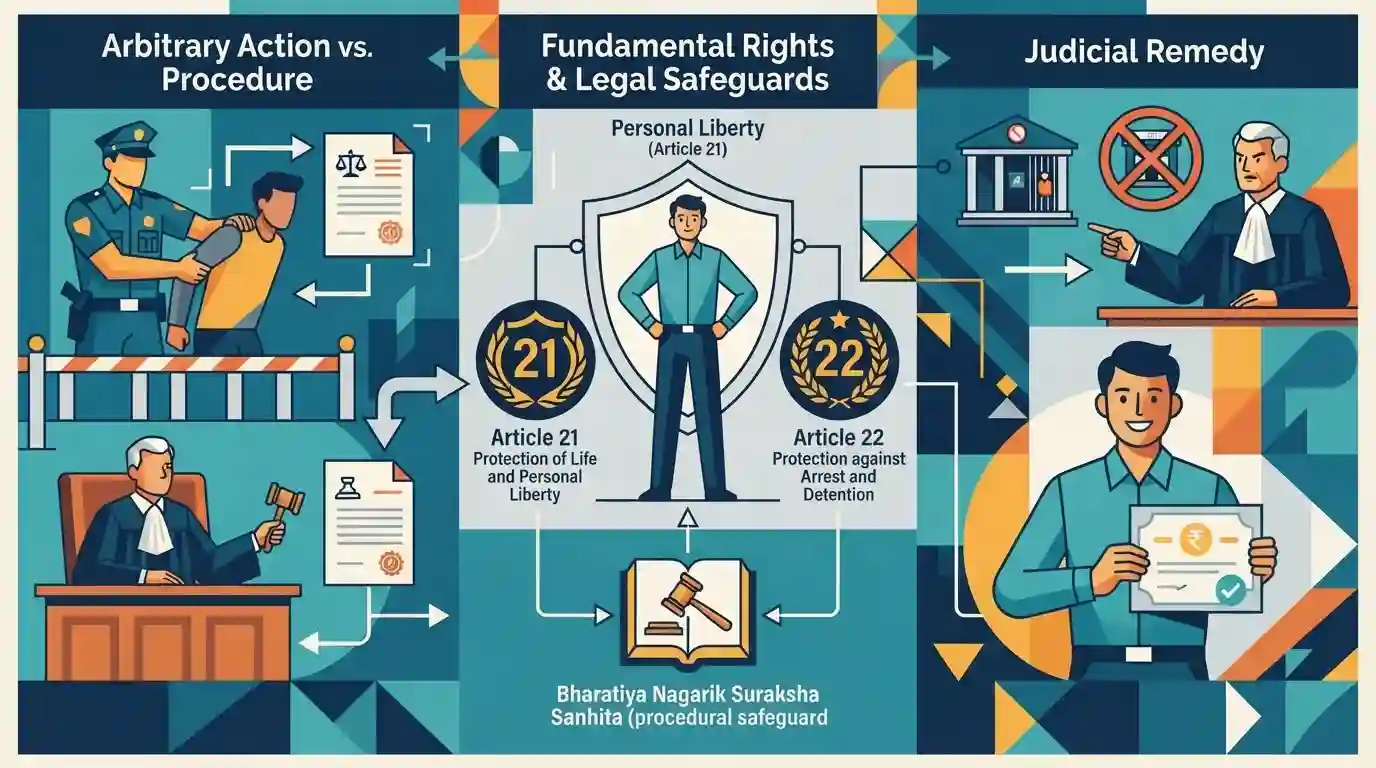
The Madhya Pradesh High Court has held that police cannot detain a person accused of a bailable offence without explicitly informing them of their legal right to seek bail. The court emphasized that this mandatory procedural safeguard, codified under the Bharatiya Nagarik Suraksha Sanhita (BNSS), is essential to protecting the fundamental right to personal liberty under Article 21 and Article 22 of the Constitution. The ruling highlights judicial intolerance towards arbitrary police action and illegal detention, awarding compensation to the aggrieved individual.
Key Points
- The Madhya Pradesh High Court ruled that detaining an individual for a bailable offence without informing them of their right to bail is illegal and unconstitutional.
- Such detention violates the fundamental right to personal liberty guaranteed under Article 21 and the protections against arbitrary arrest under Article 22 of the Constitution.
- Under Section 47(2) of the Bharatiya Nagarik Suraksha Sanhita (BNSS), which replaced Section 50 of the CrPC, police are legally mandated to inform the accused of their right to be released on bail for bailable offences.
- The High Court directed compensation to be paid to the victim for the violation of their fundamental rights due to unlawful police detention.
Important Terms
Bharatiya Nagarik Suraksha Sanhita (BNSS)

The procedural law enacted in 2023 that replaced the Code of Criminal Procedure (CrPC), 1973, governing criminal procedure, arrests, investigations, and bail in India.
UPSC context
GS Paper II (Polity & Governance). Key for criminal justice reforms, judicial procedures, and statutory rights of citizens.
Bharatiya Nyaya Sanhita (BNS)
The substantive criminal code of India, enacted in 2023 to replace the Indian Penal Code (IPC), 1860, defining offences and prescribing punishments.
UPSC context
GS Paper II (Polity & Governance). Important for understanding the modernization of penal laws and statutory safeguards.
Constitution of India
The supreme law of India, establishing the political framework, government duties, and fundamental rights—including Articles 21 and 22—to protect citizen liberties.
UPSC context
GS Paper II (Indian Constitution). Essential for analyzing the balance between state power and individual fundamental rights.
Bailable Offence
A less serious class of criminal offences under Indian law where an accused has an automatic statutory right to be released on bail upon furnishing a bond.
UPSC context
GS Paper II (Judiciary & Rights Issues). Tests understanding of procedural safeguards, personal liberty, and police powers.
Article 21 (Right to Life and Personal Liberty)
A fundamental right in the Indian Constitution stating that no person shall be deprived of life or personal liberty except according to procedure established by law.
UPSC context
GS Paper II (Fundamental Rights). Crucial for questions on judicial activism, police reforms, and individual freedoms.
Prelims Trap
Monetary compensation for illegal police detention cannot be directly awarded by constitutional courts, requiring a separate civil suit.
Constitutional courts can directly award monetary compensation under Article 32 and 226 for violations of Article 21, bypassing traditional sovereign immunity.
Static Concepts Connected
What is the Doctrine of Constitutional Tort in India?
- Judicial origin: Established in the Rudul Sah case (1983), permitting courts to award monetary compensation for state violations of Article 21.
- Sovereign immunity bypassed: The state cannot claim sovereign immunity as a defense when its agents violate fundamental rights of citizens.
- Writ jurisdiction remedy: Invoked under Articles 32 and 226 as a public law remedy, distinct from civil damages in private law.
What are the primary safeguards under Article 22(1) and 22(2)?
- Grounds of arrest: No person arrested shall be detained in custody without being informed of the grounds of such arrest.
- Right to counsel: Every arrested person has the right to consult and be defended by a legal practitioner of their choice.
- Magistrate production: Must be produced before the nearest magistrate within 24 hours of arrest, excluding travel time.
Cross-Topic Patterns
Police reforms and Article 21
Failure to inform accused of bail rights highlights the gap in police sensitisation, linking directly to the Supreme Court's pending Prakash Singh directives on police reforms.
BNSS codification of judicial guidelines
The transition from CrPC to BNSS reflects how long-standing judicial guidelines (e.g., D.K. Basu) are gradually being codified into explicit statutory mandates.

The transition from CrPC to BNSS concerning statutory bail safeguards and Article 22 limits is highly likely to feature in Prelims 2026.
Linked PYQs · 3
Linked PYQs · 3
- 2023MPPSC_PRELIMSGS1
Through Which Amendment of the Constitution has the Right to Education became a Fundamental Right?
- 2022MPPSC_PRELIMSGS1
According to which Article of the Indian Constitution, can the President of India (in consultation with the Chief Justice) transfer a Judge of a High Court from one court to another?
- 2013MPPSC_PRELIMSGS1
Under the protection of civil rights act, 1955, all offences are
