Ken-Betwa River Interlinking Project and Tribal Protests
Source:The Hindu ↗
কেন এটি গুরুত্বপূর্ণ
The Ken-Betwa Link Project is the pioneer project of India's National River Linking Project (NRLP). It embodies a critical governance dilemma: addressing water scarcity in drought-prone Bundelkhand versus the socio-ecological cost of tribal displacement, rehabilitation deficits, and ecological submerge. This development-versus-rights conflict is a recurring theme in GS3 (Environment, Infrastructure) and GS2 (Welfare of Vulnerable Sections).
সারসংক্ষেপ
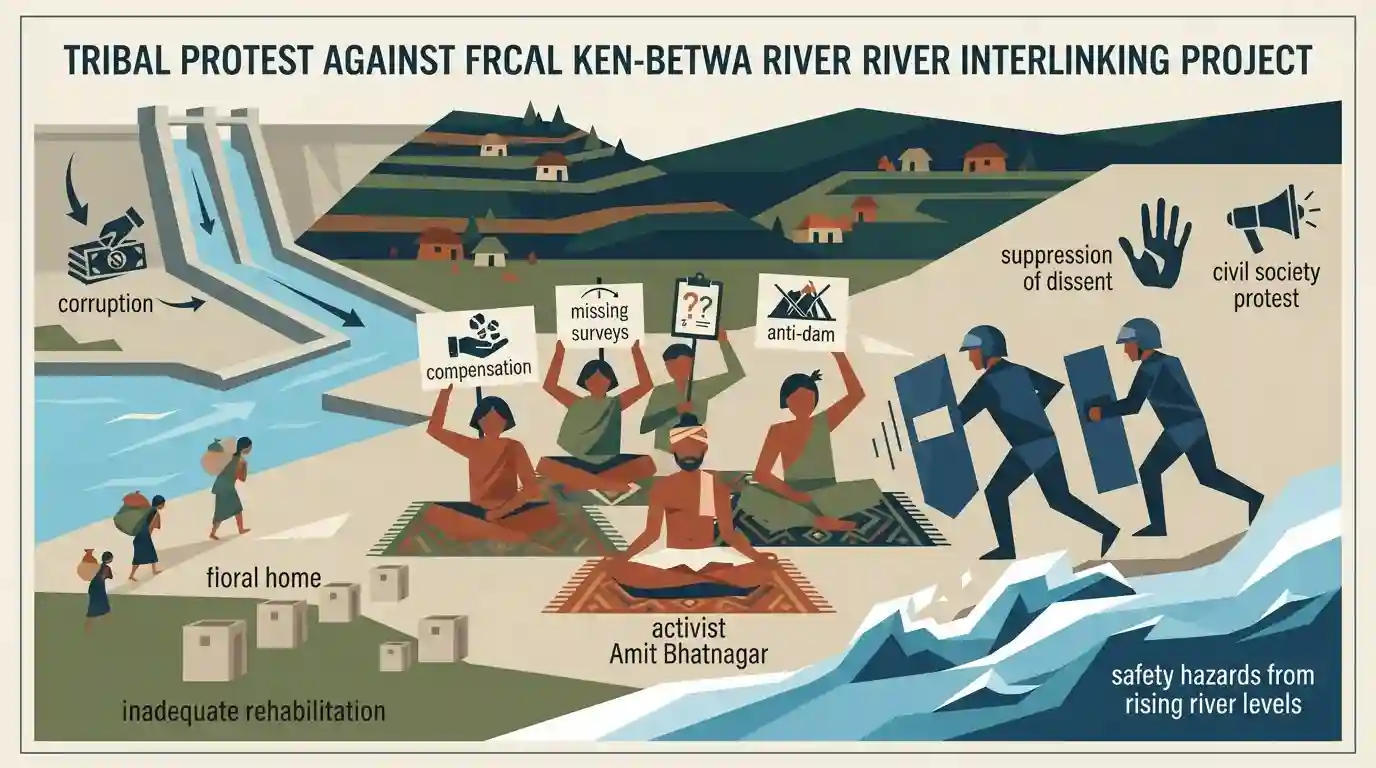
A 15-day tribal protest in Chhatarpur, Madhya Pradesh, against the ₹44,000-crore Ken-Betwa river interlinking project was dismantled by police. Led by activist Amit Bhatnagar—who was on a 14-day hunger strike—the protest highlighted grievances regarding inadequate rehabilitation packages, omission of displaced families from surveys, and alleged ₹400-crore corruption in land acquisition. Police cited safety hazards from rising river levels to justify their intervention, evoking criticism regarding the suppressing of democratic dissent and highlighting the persistent challenges of development-induced displacement.
মূল বিষয়
- A 15-day tribal protest on the banks of the Barana river in Chhatarpur, Madhya Pradesh, against the ₹44,000-crore Ken-Betwa river-linking project was forcibly ended by police action.
- The protest, led by activist Amit Bhatnagar (who was on a 14-day hunger strike) and primarily comprised of tribal women from Panna and Chhatarpur districts, demanded fair compensation, updated surveys to include excluded families, and an investigation into alleged ₹400-crore corruption in land acquisition payouts.
- Protesters employed symbolic demonstrations, including setting up pyres in the riverbed with the slogan 'nyaya do varna maar do' (give us justice or kill us).
- Police dismantled the protest and hospitalized Bhatnagar, citing safety concerns over rising water levels in the Barana river due to rains, drawing sharp criticism from opposition leaders.
- The incident highlights the ongoing friction between major national infrastructure projects (like river interlinking) and the socio-economic rights, land displacement, and rehabilitation of indigenous/tribal communities.
গুরুত্বপূর্ণ শব্দ
Ken-Betwa River Interlinking Project (KBLP)

India's first major river interlinking initiative, transferring surplus water from the Ken River (MP) to the Betwa River (UP) to irrigate the drought-prone Bundelkhand region while raising environmental and rehabilitation concerns.
UPSC context
GS Paper I (Geography) & GS III (Environment/Infrastructure); tests inter-basin water transfer and socio-ecological impacts.
Union Government
The federal executive authority of India, established by the Constitution, responsible for national-level governance, defense, foreign policy, and implementing major development and infrastructure projects across states.
UPSC context
GS Paper II (Polity); tests federal structures, executive powers, and coordination with state governments.
Madhya Pradesh Government
The subnational government administering Madhya Pradesh, responsible for local governance, public order, and executing state-level welfare, rehabilitation, and land acquisition policies.
UPSC context
GS Paper II (Polity); tests state-level governance, rehabilitation policies, and local public administration.
Madhya Pradesh Police
The state's primary law enforcement agency responsible for maintaining public order, managing civil protests, and ensuring internal security within Madhya Pradesh under the state's Home Department.
UPSC context
GS Paper III (Internal Security); tests policing administration, maintenance of public order, and managing public dissent.
প্রিলিমস ফাঁদ
The Ken-Betwa Link Project transfers surplus water from the Betwa river basin to the water-deficit Ken river basin.
The transfer is from the Ken river (surplus) to the Betwa river (deficit). Both are right-bank tributaries of the Yamuna flowing northwards.
সংযুক্ত স্থির ধারণা
What is the National Perspective Plan (NPP) for River Interlinking?
- Origin and Scope: Formulated in 1980 by the Ministry of Water Resources to address regional water imbalances through inter-basin water transfers.
- Two Components: Comprises two components: the Himalayan Component (14 links) and the Peninsular Component (16 links, including Ken-Betwa).
- Nodal Agency: Managed by the National Water Development Agency (NWDA) under the Ministry of Jal Shakti.
What are the key provisions of the LARR Act, 2013 regarding tribal displacement?
- Gram Sabha Consent: Requires mandatory prior consent of the Gram Sabha or Panchayats in Scheduled Areas before initiating land acquisition.
- Social Impact Assessment: Mandates a Social Impact Assessment (SIA) to determine if the project serves a public purpose and estimate its human cost.
- Rehabilitation Package: Provides for one-third of compensation to be paid upfront, with distinct rehabilitation packages for Scheduled Castes and Scheduled Tribes.
আন্তঃবিষয় প্যাটার্ন
Infra projects vs Tiger Conservation
Submergence of Panna Tiger Reserve’s core area highlights the structural conflict between national infrastructure development (SDG 9) and wildlife conservation commitments (SDG 15).
PESA, Fifth Schedule, and Eminent Domain
State land acquisition for public utility frequently bypasses the spirit of Gram Sabha consent in tribal areas, testing the constitutional balance of the Fifth Schedule.

Ken-Betwa's donor-recipient direction, Yamuna tributary status, and Panna TR submergence will likely feature in a 2026 Prelims geography question.
সংযুক্ত PYQ · 3
সংযুক্ত PYQ · 3
- 2020MainsGS1
The interlinking of rivers can provide viable solutions to the multi-dimensional inter-related problems of droughts, floods and interrupted navigation. Critically examine.
- 2024MainsGS3
What role do environmental NGOs and activists play in influencing Environmental Impact Assessment (EIA) outcomes for major projects in India? Cite four examples with all important details.
- 2016MainsGS3
Rehabilitation of human settlements is one of the important environmental impacts which always attracts controversy while planning major projects. Discuss the measures to be adopted to mitigate the impact of the recent incidents of cloudbursts in many places of Uttarakhand.
