Poland Military Modernisation Strategy and Airspace Security
Source:The Hindu ↗
Why It Matters
Provides key context on the regional repercussions of the Russia-Ukraine war, illustrating how frontline NATO states are adjusting their defence strategies. It is highly relevant for GS2 (International Relations) regarding European geopolitics and GS3 (Internal Security) regarding the emerging threat of drones in border airspace violations.
Summary
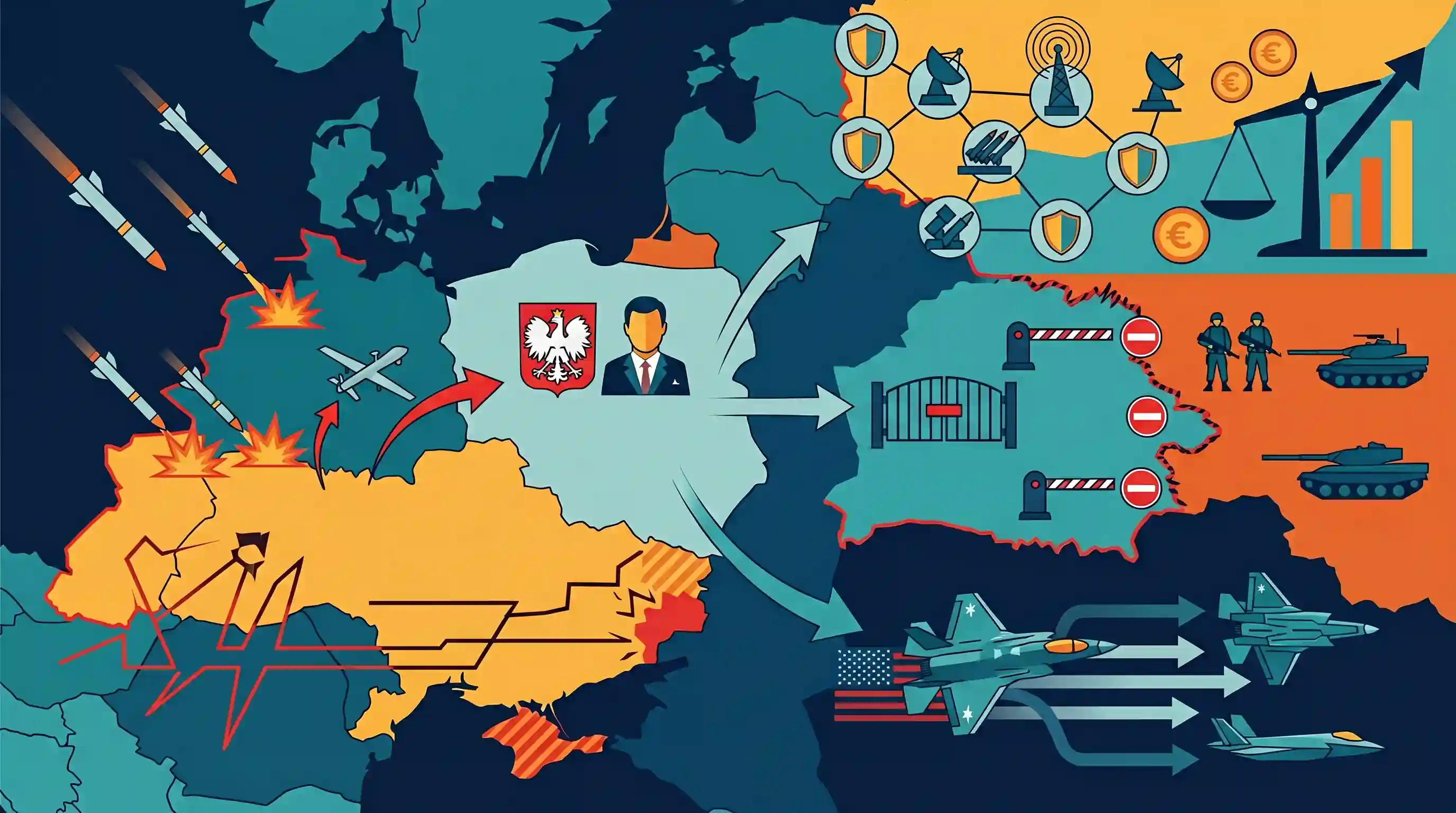
In response to an unidentified drone crossing into Polish airspace during a suspected Russian bombardment of Ukraine, Polish Prime Minister Donald Tusk has committed to a large-scale military modernisation program. The incident highlights the growing threat of conflict spillover into NATO territory. Consequently, Poland is significantly upgrading its defence posture, which includes proposing a 3 billion euro air defence network along its borders with Russia and Belarus, closing the Belarusian border amid ongoing joint military exercises, and awaiting the delivery of U.S. F-35 fighter jets. These measures reflect the intensifying geopolitical volatility in Eastern Europe and the evolving nature of modern border security challenges involving unmanned aerial vehicles (UAVs).
Key Points
- Polish Prime Minister Donald Tusk announced a major military modernisation initiative following a drone incursion into Poland's airspace, suspected to have occurred during Russian airstrikes on Ukraine.
- The airspace violation prompted Poland to enforce air traffic restrictions in its eastern regions and underscored the risks of the Russia-Ukraine conflict spilling over into NATO territory.
- Poland is reinforcing its border security, proposing a 3 billion euro air defence system along its frontiers with Russia and Belarus.
- Rising tensions have led Poland to plan the closure of its border with Belarus, coinciding with joint military exercises by Russian and Belarusian forces.
- As part of its defence upgrades, Poland expects to receive advanced U.S.-made F-35 fighter jets to bolster its aerial combat capabilities.
Important Terms
NATO

A 32-member transatlantic political and military alliance established in 1949. It operates on the principle of collective defense, where members agree to mutually protect each other against external aggression.
UPSC context
GS Paper II (International Relations): Global groupings and agreements involving or affecting India's interests. Tests understanding of regional security architectures.
Collective Defence (Article 5)
The core principle of the North Atlantic Treaty (Article 5) stating that an armed attack against one member is considered an attack against all, requiring collective assistance to restore security.
UPSC context
GS Paper II: International treaties and security. Tests knowledge of foundational military alliance mechanisms and international law.
East Shield (Tarcza Wschód)
Poland's $2.5 billion (10 billion PLN) defense program (2024–2028) aimed at fortifying its eastern borders with Russia and Belarus through physical barriers, digital surveillance, and anti-drone systems.
UPSC context
GS Paper III: Internal security and border management. Tests understanding of modern border fortification strategies against conventional and hybrid threats.
Unmanned Aerial Vehicles (UAVs)
Aircraft operated without a human pilot, used for surveillance or combat. They represent an 'asymmetric' threat in border management, often bypassing traditional radar to conduct reconnaissance or smuggling.
UPSC context
GS Paper III: Challenges to internal security through communication networks and technology. Directly tested in UPSC Mains 2023.
F-35 Lightning II
A fifth-generation, multi-role stealth fighter jet. It features advanced sensor fusion and network-centric capabilities, allowing it to function as a command node in integrated air defense systems.
UPSC context
GS Paper III: Science and Technology/Defense. Tests knowledge of emerging military technologies and their impact on regional power dynamics.
Hybrid Warfare
A military strategy blending conventional warfare with irregular tactics, cyberattacks, and sub-threshold provocations (like drone incursions) to achieve political objectives without triggering a full-scale war.
UPSC context
GS Paper III: Internal security and the role of non-state/state actors in creating challenges to national security.
Prelims Trap
"The Suwałki Gap is a territorial corridor linking mainland Russia to its Kaliningrad exclave."
The gap is NATO territory (border of Poland and Lithuania). It physically separates Russian-allied Belarus from Kaliningrad, making it a vulnerable chokepoint, not a Russian-held corridor.
Static Concepts Connected
What is the strategic significance of the Suwałki Gap in NATO-Russia dynamics?
- Strategic Location: A narrow 65-km land corridor connecting Poland to Lithuania, separating Belarus from the Russian exclave of Kaliningrad.
- NATO Chokepoint: It acts as the single land route connecting the Baltic states (Estonia, Latvia, Lithuania) to the rest of the NATO alliance.
- Vulnerability Factor: If seized by Russia or Belarus, the Baltic states would be entirely cut off from European allies by land, paralyzing NATO's collective defense capabilities.
How do Unmanned Aerial Vehicles (UAVs) challenge traditional border security frameworks?
- Asymmetric Penetration: Small, cheap drones can penetrate heavily guarded physical borders to drop payloads, weapons, or conduct ISR (Intelligence, Surveillance, and Reconnaissance).
- Detection Evasion: Low altitude flight paths, slow speeds, and small radar cross-sections make them virtually invisible to conventional, high-altitude air defense systems.
- Complex Countermeasures: Requires a layered integration of kinetic (lasers, nets) and non-kinetic (jamming, GPS spoofing) countermeasures, complicating border infrastructure budgets.
Cross-Topic Patterns
Asymmetric drone threats: India & Europe
Poland's 'Shield East' mirrors India's CIBMS push along its western border, where asymmetric rogue drones from Pakistan routinely drop contraband, necessitating similar integrated anti-drone radar networks.
Conflict mapping: The next frontier
Just as the Black Sea and Donbas regions were recently tested, the Suwałki Gap and Kaliningrad exclave represent the next logical iteration of UPSC's focus on conflict-driven European mapping.

Match-the-following pairs featuring critical Eastern European chokepoints (Suwałki Gap, Kaliningrad) are highly probable for 2026 Prelims.
Linked PYQs · 3
Linked PYQs · 3
- 2023MainsGS2
‘The expansion and strengthening of NATO and a stronger US-Europe strategic partnership works well for India.’ What is your opinion about this statement ? Give reasons and examples to support your answer.
- 2023MainsGS3
The use of unmanned aerial vehicles (UAVs) by our adversaries across the borders to ferry arms/ammunitions, drugs, etc., is a serious threat to the internal security. Comment on the measures being taken to tackle this threat.
- 2023PrelimsGS1
Consider the following countries: 1. Bulgaria 2. Czech Republic 3. Hungary 4. Latvia 5. Lithuania 6. Romania How many of the above-mentioned countries share a land border with Ukraine?
