Cauvery Water Allocation Consensus and Inter State Disputes
Source:The Hindu ↗
આ શા માટે મહત્વનું છે
It highlights the recurring challenges of cooperative federalism and inter-state water governance in India, especially under climate change stress, showcasing how regional political leaders leverage international water treaty precedents to challenge domestic water-sharing frameworks.
સારાંશ
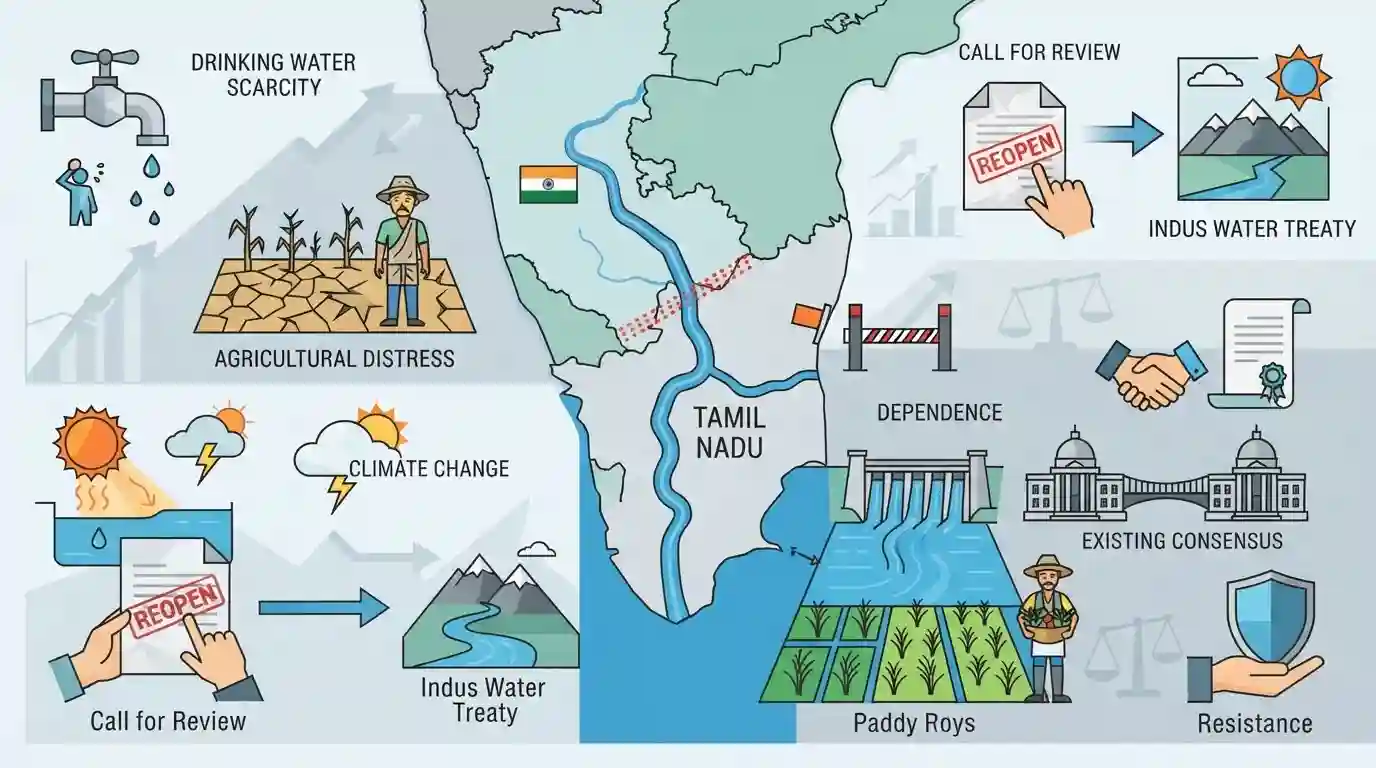
Karnataka has signaled an intent to reopen the consensus on Cauvery water allocation, drawing comparisons to the call for reviewing the Indus Water Treaty. The state highlights climate change, drinking water scarcity, and agricultural distress as grounds for revisiting long-standing inter-state water sharing arrangements with Tamil Nadu.
મુખ્ય મુદ્દા
- Karnataka has signaled its intent to revisit the Cauvery water allocation consensus, citing the example of the Indus Water Treaty's review.
- The state argues that water sharing arrangements must factor in changing climate realities, rainfall deficits, and drinking water priorities.
- Inter-state river water disputes between Karnataka and Tamil Nadu remain politically and socially sensitive, requiring institutional mechanisms like CWMA and judicial oversight.
મહત્વપૂર્ણ શબ્દો
Indus Water Treaty

A 1960 water-distribution treaty between India and Pakistan, brokered by the World Bank, governing the Indus river system. Its recent public scrutiny in domestic political discourse is sometimes cited by states seeking treaty reviews due to changing climatic realities.
UPSC context
Important for GS Paper II (International Relations / Federalism), testing bilateral treaties, geopolitical water security, and domestic parallels drawn in inter-state water disputes.
Cauvery Water Management Authority
A statutory, quasi-judicial body created in 2018 under the Ministry of Jal Shakti to implement the modified Cauvery Tribunal award, monitoring reservoir levels and regulating water sharing among basin states.
UPSC context
Crucial for GS Paper II (Polity and Governance / Statutory Bodies), examining federal dispute resolution mechanisms and institutional frameworks for water management.
Cauvery Water Disputes Tribunal Award
The final tribunal award delivered in 2007, later modified by the Supreme Court in 2018, allocating specific shares of the Cauvery river water among Karnataka, Tamil Nadu, Kerala, and Puducherry.
UPSC context
Important for GS Paper II (Inter-state Water Disputes and Judicial Pronouncements), testing cooperative federalism and legal frameworks governing shared natural resources.
Supreme Court of India
The apex judicial body in India that holds original jurisdiction under Article 131 for disputes between states and appellate jurisdiction over inter-state water dispute tribunal decisions.
UPSC context
Vital for GS Paper II (Indian Constitution, Judiciary, and Federal Dynamics), testing judicial review and adjudication of inter-state resource conflicts.
પ્રિલિમ્સ ટ્રેપ
Article 262 gives the Supreme Court original and exclusive jurisdiction to directly adjudicate all inter-state river water disputes.
Article 262 explicitly bars the Supreme Court's original jurisdiction in inter-state water disputes, though the SC can hear appeals under special leave or through tribunal monitoring mechanisms.
સંલગ્ન સ્થિર ખ્યાલો
What are the constitutional and statutory provisions for adjudicating inter-state river water disputes in India?
- Constitutional Basis: Article 262 empowers Parliament to legislate on the adjudication of disputes relating to waters of inter-state rivers and bar Supreme Court jurisdiction in such matters.
- Statutory Framework: ISRWD Act of 1956 empowers the Central Government to constitute ad-hoc tribunals for specific water disputes upon request by state governments.
- Recent Reforms: Tribunals Amendment Act of 2002 streamlines the process by setting strict timelines and creating a single Dispute Resolution Committee for preliminary negotiations.
આંતર-વિષય પેટર્ન
Federalism + Inter-State Water Sharing
Inter-state water disputes test the limits of cooperative federalism, contrasting regional agricultural demands with central judicial oversight and statutory bodies like CWMA.
Climate Change + Riparian Distress
Shifting monsoons and rainfall deficits tie traditional river water disputes directly to climate change adaptation and long-term food security planning.

Article 262 vs original jurisdiction of Supreme Court (Art 131) under the ISRWD Act is a high-yield conceptual trap for prelims.
સંલગ્ન PYQ · 2
સંલગ્ન PYQ · 2
- 2015MainsGS2
The concept of cooperative federalism has been increasingly emphasized in recent years. Highlight the drawbacks in the existing structure and the extent to which cooperative federalism would answer the shortcomings.
- 2020MainsGS3
Suggest measures to improve water storage and irrigation system to make its judicious use under depleting scenario.
