Endangered Species Trafficking and Wildlife Protection Enforcement
Source:Indian Express ↗
Why It Matters
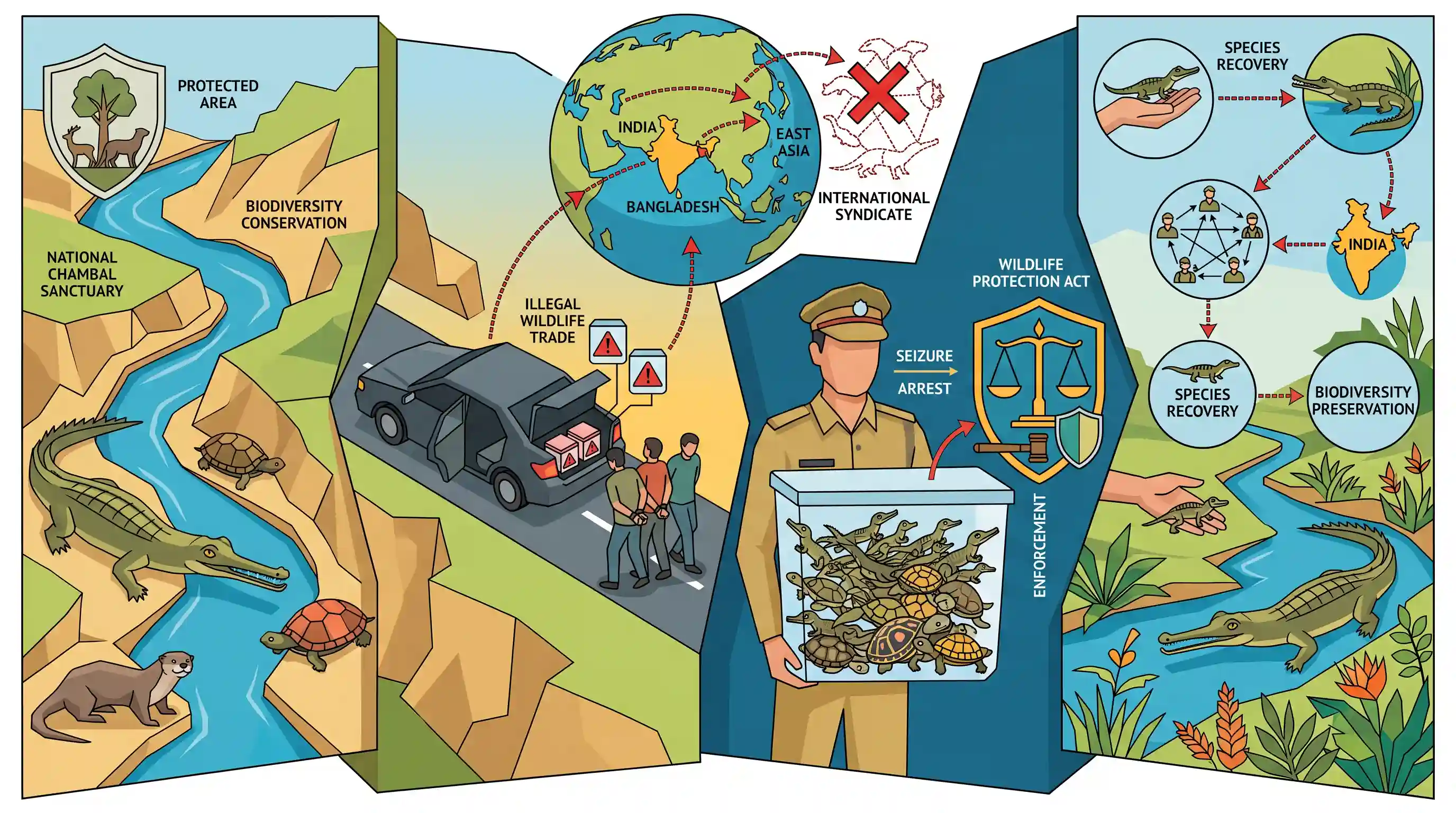
The event highlights the continuous threat of poaching and illegal wildlife trade targeting critically endangered species like gharials and roofed turtles. It reinforces the significance of the National Chambal Sanctuary and tests the efficacy of enforcement mechanisms under the Wildlife Protection Act, relevant for UPSC Environment and Ecology sections.
Summary
The Madhya Pradesh forest department arrested three members of an international wildlife trade syndicate and seized 30 gharial hatchlings along with multiple critically endangered turtles. The poachers were intercepted near the National Chambal Sanctuary, a primary habitat for the species. This seizure underscores the ongoing challenges of illegal wildlife trafficking and the critical need to enforce the Wildlife Protection Act to protect India's endangered biodiversity.
Key Points
- Three members of an international wildlife trade syndicate were arrested in Madhya Pradesh for trafficking endangered species.
- Authorities seized 30 gharial hatchlings, 14 red-crowned roofed turtles, and 19 critically-endangered three-striped roofed turtles.
- The interception occurred near the National Chambal Sanctuary, a critical habitat and breeding ground for these species.
- The incident highlights the persistent threat of organized poaching networks targeting Schedule I species protected under the Wildlife Protection Act.
Important Terms
Gharial

A fish-eating crocodile (Gavialis gangeticus) with a long snout, endemic to the Indian subcontinent. Found primarily in the Chambal River; it is an indicator of clean river health.
UPSC context
GS Paper 3: Conservation. Important for Prelims (IUCN status: Critically Endangered) and species-specific conservation programs like Project Crocodile.
National Chambal Sanctuary
A tri-state protected area (MP, Rajasthan, UP) along the Chambal River. It is India's only riverine sanctuary dedicated to protecting the Gharial, Gangetic Dolphin, and rare turtles.
UPSC context
GS Paper 3: Protected Areas. Tests knowledge of geographic location, river systems, and habitat-specific conservation efforts.
Wildlife Protection Act, 1972
India's 1972 legal framework protecting flora and fauna. The 2022 Amendment rationalized schedules from six to four, with Schedule I offering the highest level of protection and penalties.
UPSC context
GS Paper 3: Environmental Legislation. A core topic for both Prelims and Mains regarding legal protection for endangered species.
Red-crowned roofed turtle
A freshwater turtle (Batagur kachuga) endemic to South Asia, with its last viable population in the Chambal River. Known for the male's vibrant breeding colors.
UPSC context
GS Paper 3: Biodiversity. Often tested for its Critically Endangered status and specific habitat requirements in the Chambal basin.
Wildlife Crime Control Bureau (WCCB)
A statutory body under the MoEFCC established to combat organized wildlife crime. It coordinates with state police and international agencies like INTERPOL to stop illegal trade.
UPSC context
GS Paper 3: Security & Environment. Relevant for topics on illegal wildlife trafficking and institutional frameworks for conservation.
CITES
An international treaty (1975) regulating cross-border trade in wild animals and plants. India is a party and aligns its domestic laws (WPA) with CITES Appendices.
UPSC context
GS Paper 3: International Treaties. Tests understanding of global conservation governance and India’s international legal commitments.
Prelims Trap
"The National Chambal Sanctuary is located exclusively within the borders of Madhya Pradesh."
Aspirants often link it solely to MP due to news origins, but it is a unique tri-state protected area spanning MP, UP, and Rajasthan.
Static Concepts Connected
What makes the National Chambal Sanctuary ecologically distinct?
- Tri-state sanctuary: It is a unique tri-state protected riverine ecosystem co-managed by Madhya Pradesh, Uttar Pradesh, and Rajasthan.
- Gharial habitat: It serves as the primary natural habitat for the Critically Endangered Gharial to thrive and breed in the wild.
- Aquatic biodiversity: Its unpolluted waters also host the Ganges River Dolphin (National Aquatic Animal) and Critically Endangered freshwater turtles.
What does Schedule I status under the Wildlife Protection Act, 1972 entail?
- Highest legal protection: Placing a species (like the Red-crowned roofed turtle) in Schedule I grants it the exact same high level of legal protection as the Tiger.
- Strict hunting ban: It enforces an absolute prohibition on hunting, except in extreme cases like a direct threat to human life or incurable disease.
- Maximum penalties: Offences involving Schedule I species attract the highest prescribed monetary fines and rigorous imprisonment terms under Indian law.
Cross-Topic Patterns
Sand mining and riverine nesting habitats
Gharials and freshwater turtles critically depend on river sandbanks for basking and nesting. Unregulated sand mining in the Chambal basin acts as a threat multiplier alongside direct poaching.
Wildlife trafficking as transnational organized crime
International wildlife syndicates exploiting local sanctuaries link environmental conservation with border security. Poaching is increasingly driven by the global exotic pet market, necessitating transnational law enforcement cooperation.

Expect a 2026 prelims question pairing the IUCN status of Indian freshwater turtles with the tri-state geography of the Chambal ecosystem.
Linked PYQs · 4
Linked PYQs · 4
- 2017PrelimsGS1
If you want to see gharials in their natural habitat, which one of the following is the best place to visit?
- 2013PrelimsGS1
Consider the following fauna of India : 1. Gharial 2. Leatherback turtle 3. Swamp deer Which of the above is/are endangered?
- 2017PrelimsGS1
In India, if a species of tortoise is declared protected under Schedule I of the Wildlife (Protection) Act, 1972, what does it imply?
- 2022PrelimsGS1
With reference to Indian laws about wildlife protection, consider the following statements : 1. Wild animals are the sole property of the government. 2. When a wild animal is declared protected, such animal is entitled for equal protection whether it is found in protected areas or outside. 3. Apprehension of a protected wild animal becoming a danger to human life is sufficient ground for its capture or killing. Which of the statements given above is/are correct?
