PNGRB Proposals for CNG and Biogas Tax Rationalisation
Source:The Hindu ↗
Why It Matters
The pricing and taxation of cleaner fuels like CNG and CBG are crucial for India's energy transition and climate change mitigation strategies. Understanding the role of regulatory bodies like the PNGRB and mechanisms like APM allocations is key to analyzing India's infrastructure, energy policies, and fiscal impacts.
Summary
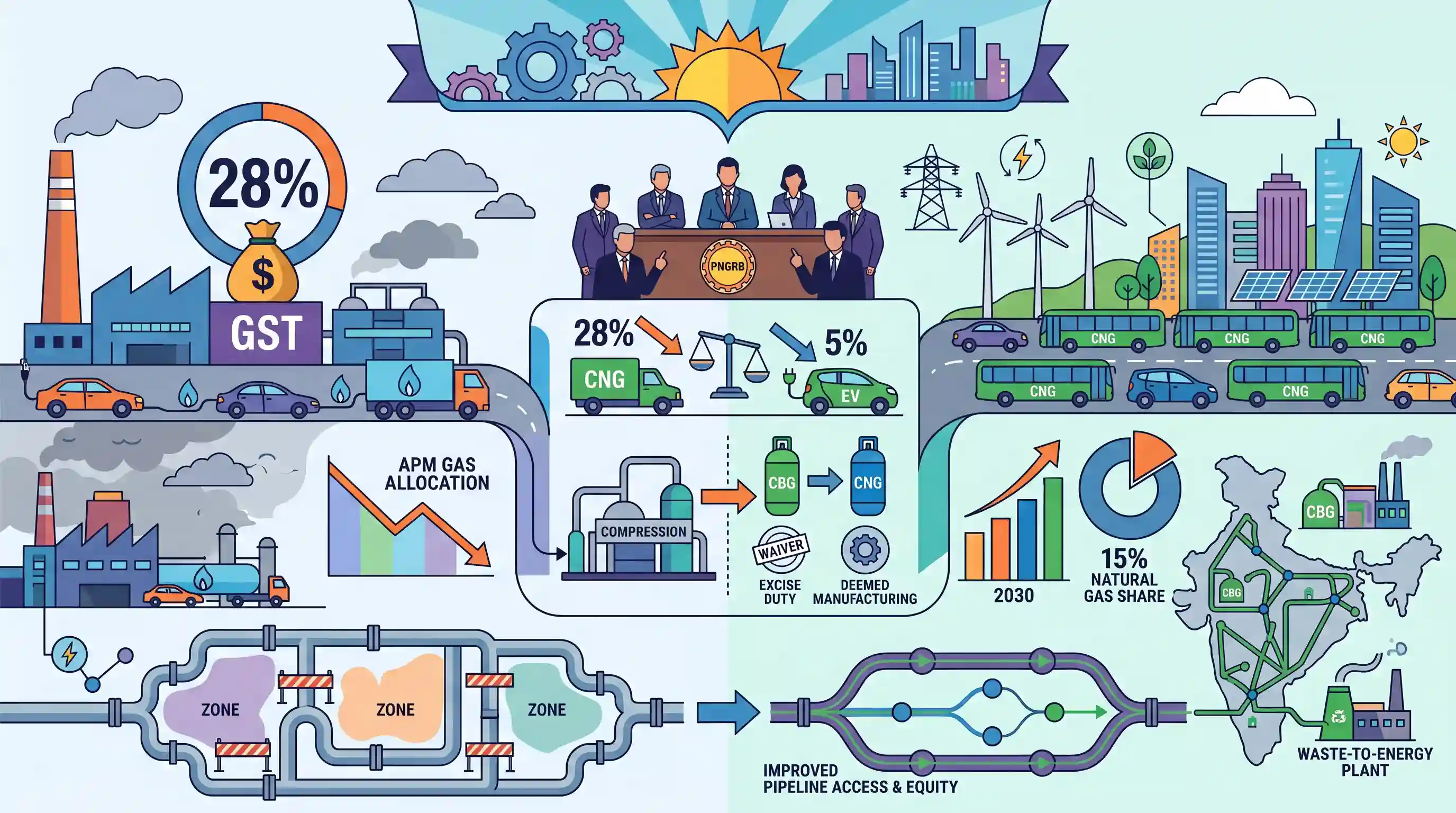
The Petroleum and Natural Gas Regulatory Board (PNGRB) has requested the government to reduce the Goods and Services Tax (GST) on Compressed Natural Gas (CNG) vehicles from 28% to 5%, matching the rate for electric vehicles. Additionally, the regulator proposed waiving the excise duty on the compression of natural gas and Compressed Biogas (CBG), currently treated as "deemed manufacturing." These tax reductions aim to keep CNG competitive as cheaper Administered Pricing Mechanism (APM) gas allocations are reduced. The move aligns with India's goal to increase natural gas's share in its energy mix to 15% by 2030. Concurrently, the PNGRB has simplified natural gas pipeline tariffs by reducing the Unified Tariff Zones from three to two to improve pipeline access and equity.
Key Points
- The PNGRB has urged the government to slash the GST rate on CNG vehicles from 28% to 5% to ensure parity with Electric Vehicles (EVs).
- PNGRB also recommends a complete waiver of the 14% excise duty levied on the compression of natural gas and Compressed Biogas (CBG).
- The tax waivers are intended to offset the price hike in CNG resulting from the consistent reduction in the Administered Pricing Mechanism (APM) gas allocation.
- Waiving the excise duty on natural gas compression would cost the exchequer around ₹6,500-₹7,000 crore annually, though it would bring significant environmental and health benefits.
- The PNGRB Board approved an amendment reducing the Unified Tariff Zones for natural gas pipelines from three to two, aiming to simplify tariffs and enhance regional access.
- The overarching goal is to facilitate the government's target of increasing the share of natural gas in India's primary energy mix to 15% by 2030 (currently at ~6%).
Important Terms
Administered Pricing Mechanism (APM)

A government-controlled pricing system for natural gas produced from legacy fields (nomination blocks). Prices are currently linked to the Indian crude basket with a defined floor and ceiling.
UPSC context
GS Paper 3: Economy and Infrastructure; relevant for understanding energy subsidies and market-linked pricing reforms.
Petroleum and Natural Gas Regulatory Board (PNGRB)
A statutory body established under the PNGRB Act, 2006, to regulate downstream activities including refining, transportation, and distribution of petroleum and natural gas.
UPSC context
GS Paper 2: Statutory/Regulatory Bodies; tests knowledge of sector-specific regulators and their administrative powers.
Compressed Biogas (CBG)
A renewable fuel produced through anaerobic decomposition of organic waste (biomass). It is chemically similar to natural gas and promoted under the SATAT scheme.
UPSC context
GS Paper 3: Environment and Energy; tests knowledge of sustainable transportation and waste-to-wealth initiatives.
Unified Tariff Zones
A simplified pricing structure that reduces geographical price disparities for gas transport. The 2025 reform consolidated three zones into two: <300km and >300km.
UPSC context
GS Paper 3: Infrastructure; critical for the 'One Nation, One Grid, One Tariff' vision.
Goods and Services Tax (GST)
A comprehensive tax on the supply of goods and services. For CNG vehicles, the current 28% rate is a point of policy debate regarding EV parity.
UPSC context
GS Paper 3: Indian Economy; tests understanding of indirect tax structures and sectoral tax incentives.
Prelims Trap
Natural gas is currently taxed under the Goods and Services Tax (GST) regime in India.
Under Article 279A(5), natural gas is temporarily outside GST (attracting Excise/VAT). The article discusses lowering GST on CNG vehicles, not the fuel itself.
Static Concepts Connected
What is the statutory mandate of the PNGRB?
- Establishment: Established under the PNGRB Act 2006 to regulate refining, processing, distribution, and marketing (downstream activities).
- Key Exclusion: Explicitly excludes upstream activities like the exploration and production of crude oil and natural gas.
- Appellate Body: Decisions of the PNGRB are appealed directly to the Appellate Tribunal for Electricity (APTEL).
What is Compressed Biogas (CBG) and the SATAT scheme?
- Composition: Primarily methane, possessing similar calorific value and properties to commercial fossil-fuel based CNG.
- Source: Produced from anaerobic decomposition of agricultural residue, cattle dung, and municipal solid waste.
- SATAT Initiative: The Sustainable Alternative Towards Affordable Transportation (SATAT) initiative promotes CBG to curb import bills.
Cross-Topic Patterns
Tax cascades in energy transition
Keeping natural gas outside GST creates stranded input tax credits, making CNG less competitive. Regulators thus propose duty waivers on vehicle compression to offset this constitutional tax hurdle.
APM gas allocation cuts vs LNG imports
Reduced cheap domestic Administered Pricing Mechanism (APM) gas forces reliance on imported LNG, directly impacting the economic viability of India’s push for a 15% gas-based economy by 2030.

Expect a 2026 question linking APM gas pricing, PNGRB's downstream mandate, and SATAT's role in India's 15% gas-economy target by 2030.
Linked PYQs · 4
Linked PYQs · 4
- 2019PrelimsGS1
Consider the following statements : 1. Petroleum and Natural Gas Regulatory Board (PNGRB) is the first regulatory body set up by the Government of India. 2. One of the tasks of PNGRB is to ensure competitive markets for gas. 3. Appeals against the decisions of PNGRB go before the Appellate Tribunals for Electricity. Which of the statements given above are correct?
- 2025PrelimsGS1
Consider the following activities : I. Production of crude oil II. Refining, storage and distribution of petroleum III. Marketing and sale of petroleum products IV. Production of natural gas How many of the above activities are regulated by the Petroleum and Natural Gas Regulatory Board in our country?
- 2019MainsGS3
Enumerate the indirect taxes which have been subsumed in the Goods and Services Tax (GST) in India. Also, comment on the revenue implications of the GST introduced in India since July 2017.
- 2013MainsGS3
Discuss the rationale for introducing Goods and Services Tax (GST) in India. Bring out critically the reasons for the delay in roll out for its regime.
