PNGRB proposes new gas pipeline rules to boost energy infrastructure
Source:The Hindu ↗
Why It Matters
Important for understanding regulatory reforms in India's energy sector, infrastructure financing, private investment incentives, and the strategic push toward a gas-based economy.
Summary
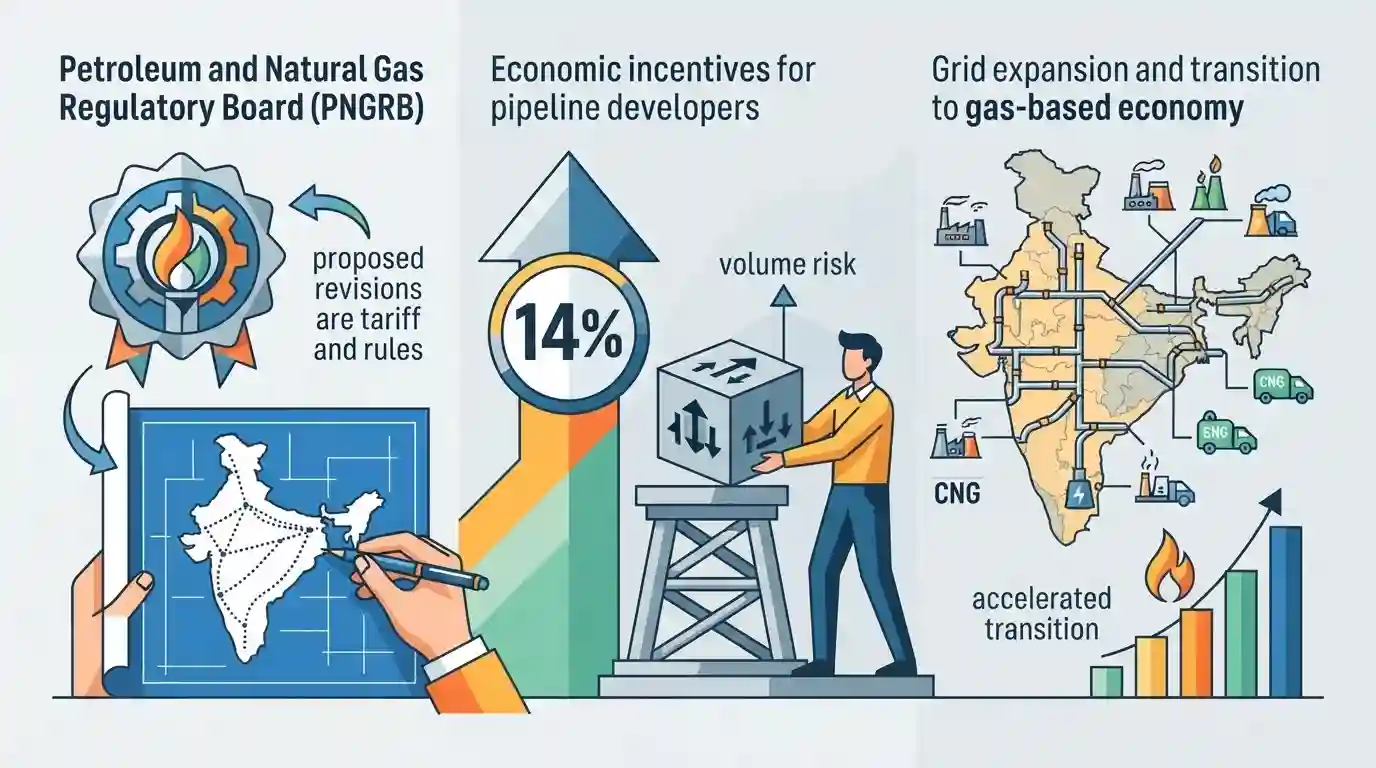
The Petroleum and Natural Gas Regulatory Board (PNGRB) has proposed comprehensive revisions to gas pipeline tariff and development rules in India. The revised framework offers a 14 percent return on capital to pipeline developers and shifts volume risk away from them, aiming to incentivize private investment, expand the national gas grid, and accelerate India's transition toward a gas-based economy.
Key Points
- The Petroleum and Natural Gas Regulatory Board (PNGRB) proposed new gas pipeline rules to attract investment in natural gas infrastructure.
- The framework proposes a 14 percent return for pipeline developers.
- It shifts volume risk from developers to consumers or market participants to derisk infrastructure expansion.
- Aims to boost the share of natural gas in India's energy basket towards achieving a gas-based economy.
Important Terms
Petroleum and Natural Gas Regulatory Board

A statutory regulatory body established under the PNGRB Act of 2006 to regulate downstream activities in the petroleum and natural gas sector and protect consumer interests.
UPSC context
GS Paper III (Economy/Infrastructure): Important statutory bodies, energy regulation, and regulatory governance in infrastructure sectors.
Petroleum and Natural Gas Regulatory Board Act
The 2006 parliamentary legislation that established the PNGRB to regulate the refining, processing, storage, transportation, distribution, and marketing of petroleum and natural gas.
UPSC context
GS Paper III (Polity/Economy): Statutory frameworks governing energy security, regulatory bodies, and market competition in India.
PNGRB
Abbreviation for the Petroleum and Natural Gas Regulatory Board, the apex regulator overseeing downstream oil and natural gas infrastructure and market policies in India.
UPSC context
GS Paper III (Infrastructure and Energy): Tests understanding of regulatory reforms, pipeline tariff policies, and gas-based economy transitions.
Prelims Trap
PNGRB regulates all activities across the entire oil and gas value chain including upstream exploration.
Aspirants often assume PNGRB regulates upstream oil and gas exploration, but its jurisdiction is strictly limited to downstream and midstream activities under the PNGRB Act, 2006.
Static Concepts Connected
What are the powers and functions of the Petroleum and Natural Gas Regulatory Board (PNGRB)?
- Statutory Origin: Statutory body established under the Petroleum and Natural Gas Regulatory Board Act, 2006.
- Mandate: Regulates refining, processing, storage, transportation, distribution, marketing, and sale of petroleum, petroleum products and natural gas.
- Core Objectives: Ensures uninterrupted and adequate supplies and protects consumer interests while enforcing fair trade practices.
- Jurisdiction Limit: Does NOT regulate upstream exploration and production (which falls under DGH and Ministry of Petroleum & Natural Gas).
Cross-Topic Patterns
Gas Grid Tariffs & Highway HAM Models
Shifting volume risk mirrors hybrid annuity model (HAM) in highways, combining public policy goals with assured private returns.

PNGRB's statutory powers + 14% return tariff restructuring likely to be tested via statement-based prelims questions.
Linked PYQs · 2
Linked PYQs · 2
- 2025PrelimsGS1
Consider the following activities : I. Production of crude oil II. Refining, storage and distribution of petroleum III. Marketing and sale of petroleum products IV. Production of natural gas How many of the above activities are regulated by the Petroleum and Natural Gas Regulatory Board in our country?
- 2019PrelimsGS1
Consider the following statements : 1. Petroleum and Natural Gas Regulatory Board (PNGRB) is the first regulatory body set up by the Government of India. 2. One of the tasks of PNGRB is to ensure competitive markets for gas. 3. Appeals against the decisions of PNGRB go before the Appellate Tribunals for Electricity. Which of the statements given above are correct?
