PNC Infratech secures 3483 crore NHAI projects amid scrutiny
Source:newsgram ↗
Why It Matters
The awarding of high-value infrastructure projects to entities with active CBI corruption probes and recent technical failures highlights systemic governance challenges in public procurement. It brings attention to the NHAI's Hybrid Annuity Mode (HAM) and the quality control mechanisms of UP's expressway projects, crucial topics for UPPSC GS3 and UP Special sections.
Summary
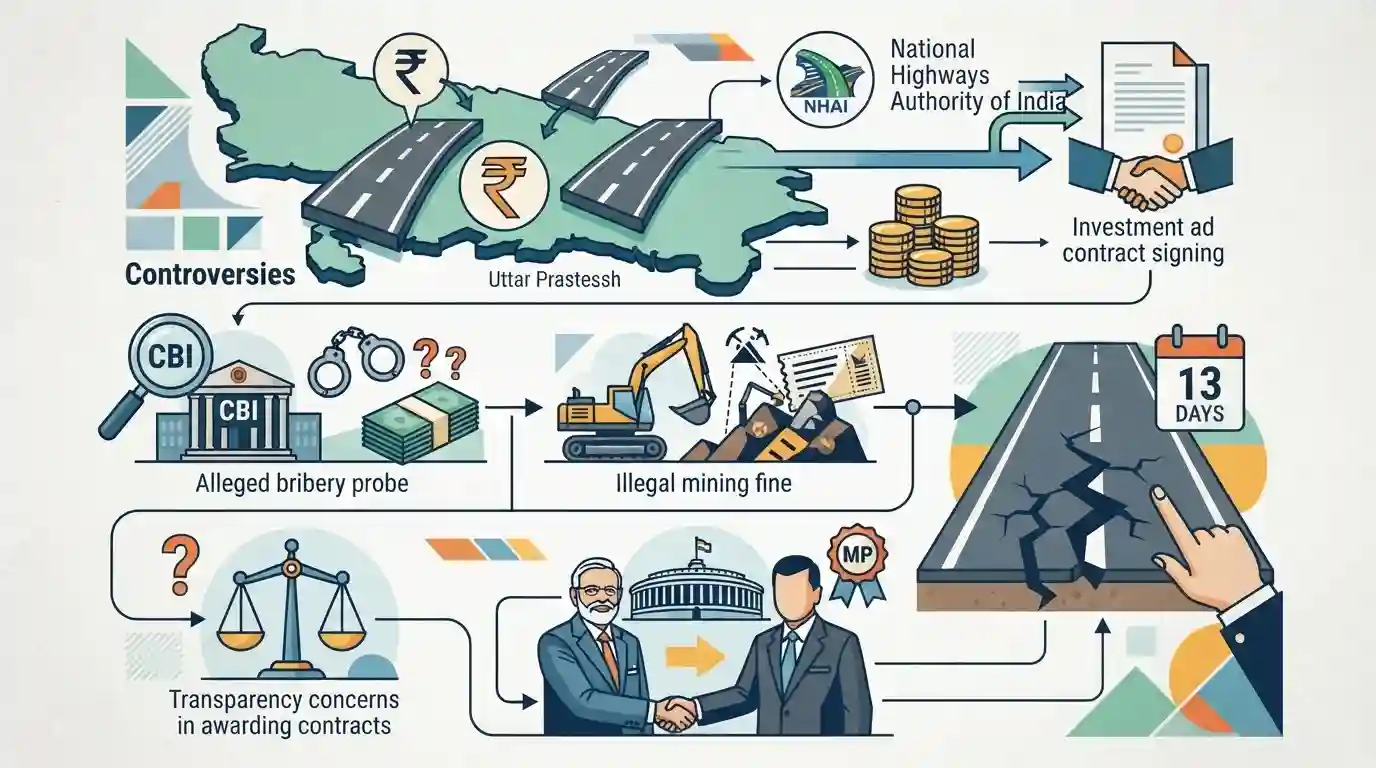
PNC Infratech has secured two major National Highways Authority of India (NHAI) highway projects in Uttar Pradesh worth ₹3,483 crore, despite a track record of severe controversies. The firm is currently under a Central Bureau of Investigation (CBI) probe for alleged bribery and was recently fined for illegal mining in Madhya Pradesh. Furthermore, the company faces criticism for poor infrastructure quality after the Kanpur-Lucknow Expressway developed cracks within 13 days of its inauguration. The firm's political connections, being headed by brothers of a sitting Member of Parliament, have also raised concerns regarding transparency in the awarding of government infrastructure contracts.
Key Points
- PNC Infratech was awarded two NHAI highway construction projects in Uttar Pradesh worth ₹3,483 crore under the Hybrid Annuity Mode (HAM).
- The company faces severe scrutiny over recent construction failures, notably cracks appearing on the Kanpur-Lucknow Expressway just 13 days after its inauguration.
- The firm and its directors are under an active CBI investigation for allegedly bribing NHAI officials to clear project bills.
- PNC Infratech was also recently fined ₹247 crore for illegal mining operations in Madhya Pradesh.
Important Terms
Hybrid Annuity Mode (HAM)

A Public-Private Partnership (PPP) model where the government pays 40% of the project cost during construction, and the developer funds 60%, recovering it via fixed annuity payments without toll-collection risks.
UPSC context
Core to GS-3 (Investment Models). Tests comprehension of infrastructure financing, risk distribution, and how HAM resolves flaws in EPC and BOT models.
National Highways Authority of India (NHAI)
A statutory body under the Ministry of Road Transport and Highways, responsible for developing, maintaining, and managing India's national highway network.
UPSC context
Relevant for GS-3 (Infrastructure). Tests knowledge of statutory bodies, PPP frameworks, and road asset management in India.
Central Bureau of Investigation (CBI)
India's premier investigating agency, operating under the Ministry of Personnel, Public Grievances and Pensions. It investigates major corruption cases, economic offenses, and multi-state crimes.
UPSC context
Relevant for GS-2 (Governance). Tests understanding of anti-corruption frameworks, institutional autonomy, and oversight of public-private contracts.
Kanpur-Lucknow Expressway
A newly inaugurated 63-km access-controlled expressway in Uttar Pradesh. It recently faced severe scrutiny and toll suspension after developing massive cracks and sinking within 13 days of opening.
UPSC context
Useful for GS-3 (Infrastructure) and UPPSC. Acts as a case study for governance, public works accountability, and infrastructure quality control.
PNC Infratech
A major Indian infrastructure company currently facing severe scrutiny, including a CBI bribery probe and NHAI penalties for poor construction quality on the Kanpur-Lucknow Expressway.
UPSC context
Relevant to GS-2 and GS-4 (Ethics). Illustrates issues of crony capitalism, corporate governance, and corruption in public procurement.
Prelims Trap
"In Hybrid Annuity Mode (HAM) projects, the private developer bears the traffic and revenue collection risk."
In HAM, the government (NHAI) bears the traffic and revenue collection risks. The private developer is insulated from toll fluctuations and receives a fixed annuity payment.
Static Concepts Connected
What are the key features of the Hybrid Annuity Mode (HAM)?
- Funding Split: The government pays 40% of the project cost during construction; the developer arranges the remaining 60%, repaid as annuity.
- Risk Allocation: The government (NHAI) bears traffic and revenue risks, unlike the BOT-Toll model.
- O&M Responsibility: The private developer remains responsible for operations and maintenance (O&M) during the annuity period.
What are the debarment rules under the General Financial Rules (GFR) 2017?
- Authority to Debar: Procuring entities (like NHAI) can debar bidding firms for breaching the code of integrity, including bribery or severe execution failures.
- Time Limits: Debarment for breach of integrity typically lasts up to two years, while conviction for corruption offenses can trigger up to a three-year ban.
Cross-Topic Patterns
Public Procurement & Integrity Pacts
The inability to easily disqualify contractors under CBI probe exposes structural weaknesses in the General Financial Rules (GFR) and the practical enforcement of Integrity Pacts in public procurement.
Investment Models vs Governance Checks
Showcases the tension in GS-3 between aggressively scaling infrastructure via HAM and the lack of stringent quality or governance checks on politically connected contractors.

HAM features (traffic risk, funding) and General Financial Rules (GFR) debarment clauses are prime multi-statement candidates for 2026.
Linked PYQs · 3
Linked PYQs · 3
- 2011UPPSC_PRELIMSGS1
The main source of fund for the National Highway Authority of India is
- 2022UPPSC_PRELIMSGS1
Consider the following cities of Uttar Pradesh and arrange them in descending order in terms of their population. I. Ghaziabad II. Kanpur III. Agra IV. Lucknow Select the correct answer from the code given below :
- 2025UPPSC_PRELIMSGS1
BHARATPOL', an online portal for International Police Co-operation has been developed by which of the following?
