India Pursues Multilateral Diplomacy at SCO and BRICS Summits
Source:The Hindu ↗
কেন এটি গুরুত্বপূর্ণ
This topic is central to the UPSC Mains GS Paper II curriculum, particularly regarding India's multi-alignment strategy, its engagement with Eurasian and Global South coalitions (SCO, BRICS), and its campaign for UN reforms. For the Prelims, the factual aspects of these groupings (members, key institutions like NDB and RATS, and recent summit locations) are frequently tested.
সারসংক্ষেপ
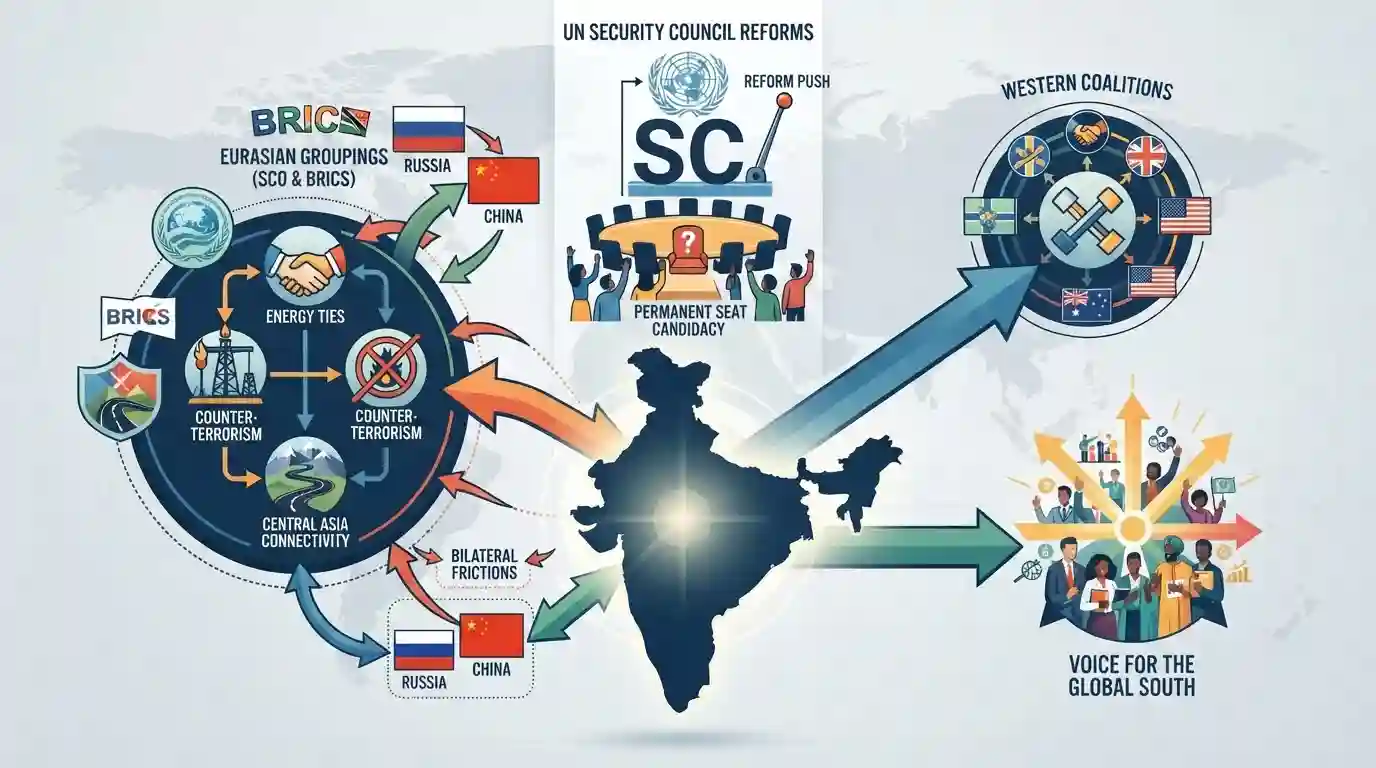
This article highlights the geopolitical and strategic significance of India's participation in multilateral summits like the Shanghai Cooperation Organisation (SCO) and BRICS, coupled with its persistent diplomatic push for UN Security Council (UNSC) reforms. India's foreign policy is defined by a delicate multi-alignment strategy—actively engaging with Eurasian groupings (dominated by Russia and China) to secure energy ties, counter-terrorism cooperation, and connectivity in Central Asia, while simultaneously partnering with Western coalitions. Through these forums, India projects itself as a voice for the Global South, advocates for reform in global financial and political architectures, and seeks international backing for its UNSC permanent seat candidacy, even as it navigates deep-seated bilateral frictions with China and Pakistan.
মূল বিষয়
- Strategic Autonomy and Multi-Alignment: India’s active engagement in the SCO and BRICS summits underscores its commitment to a foreign policy of multi-alignment, balancing relationships with Western allies (e.g., G7, Quad) and Eurasian powers.
- SCO as a Gateway to Central Asia: The SCO serves as a crucial platform for India to deepen political, economic, and strategic ties with Central Asian Republics (CARs), which are vital for India's energy security and regional connectivity.
- Security and Counter-Terrorism Cooperation: Through the SCO's Regional Anti-Terrorist Structure (RATS), India collaborates on regional security, intelligence sharing, and countering the 'three evils' of terrorism, separatism, and extremism, particularly in relation to the stability of Afghanistan.
- BRICS and Global Governance Reform: BRICS remains a central pillar for India to champion the interests of the Global South, advocate for reformed multilateralism, and shape non-Western economic institutions like the New Development Bank (NDB).
- UNSC Reform Advocacy: India utilizes these high-level multilateral forums to mobilize consensus and secure formal support from member nations for its long-standing bid for a permanent seat in the UN Security Council.
- Navigating Bilateral Frictions: India’s participation requires delicate diplomatic balancing to manage bilateral standoffs with China (such as over the LAC) and Pakistan (over cross-border terrorism) within a cooperative multilateral framework.
গুরুত্বপূর্ণ শব্দ
United Nations Security Council (UNSC)

One of the six principal organs of the United Nations, established in 1945, charged with maintaining international peace and security and authorized to issue legally binding resolutions.
UPSC context
GS Paper II (International Relations). Tests knowledge of global governance, multilateral institutions, and India's advocacy for permanent seat reforms.
Shanghai Cooperation Organisation (SCO)
A permanent Eurasian intergovernmental political, economic, and security alliance founded in 2001 in Shanghai to maintain peace, security, and stability in the region.
UPSC context
GS Paper II (International Relations). Tests regional security architecture, Eurasian geopolitics, and India's balancing act between Western and Eastern blocks.
BRICS
An intergovernmental organization comprising Brazil, Russia, India, China, South Africa, and expanded to represent emerging economies aiming to champion Global South interests and reform global governance.
UPSC context
GS Paper II (International Relations). Tests South-South cooperation, multipolar world order, and the transition from Western-dominated financial institutions.
International North-South Transport Corridor (INSTC)
A 7,200-km multimodal transit network connecting India, Iran, Azerbaijan, and Russia to move freight between the Indian Ocean and Caspian Sea, bypassing Pakistan.
UPSC context
GS Paper II (International Relations). Tests trade route diversification, physical connectivity with Central Asia, and strategic foreign infrastructure investments.
Chabahar Port Agreement
A strategic bilateral and trilateral framework between India, Iran, and Afghanistan securing Indian operational rights at the Shahid Beheshti terminal to bypass land-route blocks.
UPSC context
GS Paper II (Bilateral Relations). Tests connectivity, counterbalancing China's Gwadar port, Act West policy, and navigating geopolitical sanctions.
New Development Bank (NDB)
A multilateral development bank established in 2014 by BRICS countries to mobilize resources for infrastructure and sustainable development projects, offering equal voting without vetos.
UPSC context
GS Paper II & III (Global Institutions & Economics). Tests alternative global financial architecture, development financing, and local currency promotion.
Regional Anti-Terrorist Structure (RATS)
A permanent, specialized organ of the Shanghai Cooperation Organisation headquartered in Tashkent, designed to coordinate member-state collaboration against terrorism, separatism, and extremism.
UPSC context
GS Paper II (Internal Security & IR). Tests security coordination, Eurasian counter-terrorism frameworks, and intelligence sharing mechanisms.
প্রিলিমস ফাঁদ
Membership of the New Development Bank (NDB) is strictly restricted to the core member nations of the BRICS grouping.
UPSC tests institutional rules. NDB membership is open to any UN member state; countries like Bangladesh, Egypt, and UAE are members without historical BRICS status.
সংযুক্ত স্থির ধারণা
What are the permanent organs of the Shanghai Cooperation Organisation (SCO)?
- Beijing Secretariat: Serves as the primary administrative body of the SCO, coordinating organizational activities, consensus-building, and documentation.
- Tashkent RATS: Headquartered in Tashkent, Uzbekistan, it coordinates member states' joint efforts against the "three evils" of terrorism, separatism, and extremism.
How does the voting and shareholding structure of the New Development Bank (NDB) operate?
- Equal voting rights: Unlike the Bretton Woods institutions, no single member nation holds veto power; all founding members have equal voting rights.
- Shareholding floor: The capital share of the five founding BRICS members cannot collectively fall below 55% of the total subscribed shares.
আন্তঃবিষয় প্যাটার্ন
Eurasian connectivity vs Western sanctions
India's operationalization of Chabahar and INSTC requires balancing trade with sanction-hit Iran and Russia while maintaining deep economic partnerships with the US.
Multi-alignment vs strategic autonomy
India's simultaneous active presence in the China-dominated SCO and the US-led Quad tests its diplomatic capacity to maintain independent strategic choices.

Multi-statement questions on Eurasian transit corridors (INSTC, Ashgabat) and non-Western financial bodies (NDB) are highly probable.
সংযুক্ত PYQ · 5
সংযুক্ত PYQ · 5
- 2021MainsGS2
Critically examine the aims and objectives of SCO. What importance does it hold for India?
- 2023MainsGS2
‘Virus of Conflict is affecting the functioning of the SCO’ In the light of the above statement point out the role of India in mitigating the problems.
- 2015MainsGS2
Discuss the impediments India is facing in its pursuit of a permanent seat in UN Security Council.
- 2022PrelimsGS1
Consider the following: 1. Asian Infrastructure Investment Bank 2. Missile Technology Control Regime 3. Shanghai Cooperation Organisation India is a member of which of the above?
- 2025PrelimsGS1
Consider the following statements with regard to BRICS : I. 16th BRICS Summit was held under the Chairship of Russia in Kazan. II. Indonesia has become a full member of BRICS. III. The theme of the 16th BRICS Summit was Strengthening Multiculturalism for Just Global Development and Security. Which of the statements given above is/are correct?
