Evolution of India Middle East Policy toward Realpolitik
Source:Indian Express ↗
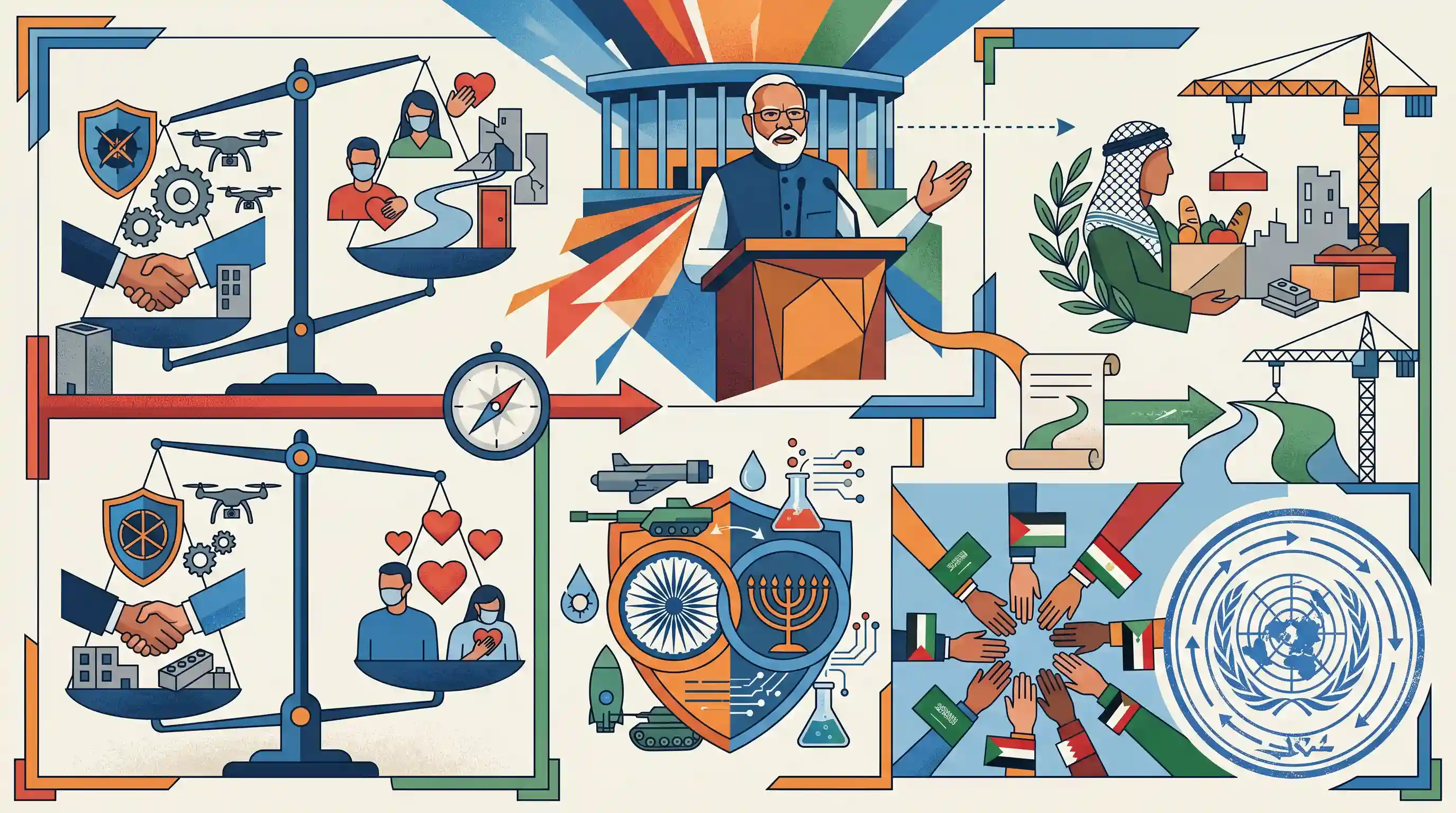
Why It Matters
This editorial marks a critical inflection point in India's foreign policy approach to West Asia (the Middle East), demonstrating the transition from de-hyphenation to active strategic realpolitik. It is highly relevant for GS Paper 2 (International Relations) questions regarding India-Israel ties, India's stance on the Israel-Palestine conflict, and changing geopolitical alliances in the Middle East.
Summary
The editorial analyzes Prime Minister Narendra Modi's 2026 visit to Israel and his address to the Knesset as a defining moment for India's Middle East foreign policy. It highlights a definitive shift from historical 'moralpolitik'—often influenced by domestic political considerations—to a pragmatic 'realpolitik' that prioritizes national strategic interests, including counter-terrorism. While deepening its strategic partnership with Israel, India continues to support the Palestinian cause by endorsing the US Gaza peace plan and signaling readiness to aid in Gaza's reconstruction. This policy recalibration mirrors profound global shifts, evidenced by Arab states joining the Board of Peace and the Gaza Stabilisation Force, and the unanimous adoption of UNSC Resolution 2803, underscoring the growing obsolescence of India's traditional performative moral approach.
Key Points
- PM Modi's address to the Knesset marks a clear shift in India's Middle East policy from historically ideology-driven 'moralpolitik' to pragmatism and 'realpolitik'.
- India is elevating its strategic partnership with Israel, driven by shared interests such as countering terrorism and extremism.
- Instead of abandoning the Palestinian cause, India has endorsed the US (Trump's) Gaza peace plan, signaling a readiness to transition from rhetoric to actively contributing to Gaza's reconstruction and peace.
- The global diplomatic landscape is shifting significantly, with key Arab and Islamic nations engaging with the Gaza peace plan and joining entities like the Board of Peace and the Gaza Stabilisation Force.
- The unanimous adoption of UNSC Resolution 2803 reflects a broader international pivot towards realpolitik regarding the Palestinian issue, making India's previous domestic moral burden increasingly untenable.
Important Terms
UNSC Resolution 2803

Adopted in November 2025, it endorses the 'Comprehensive Plan to End the Gaza Conflict,' authorizing transitional governance and a multinational force to stabilize the region under international supervision.
UPSC context
GS-II: International Relations. Tests awareness of multilateral peace-building frameworks and India’s stance on UN-mandated regional security solutions.
Board of Peace
A US-led international organization established in 2026 to oversee Gaza’s administration, reconstruction, and economic recovery, involving major Arab states and the United States.
UPSC context
GS-II: Regional Groupings. Tests understanding of emerging international governance models in West Asia and India’s pragmatic engagement with them.
Gaza Stabilisation Force
A multinational peacekeeping unit authorized by the UN to oversee demilitarization, protect humanitarian corridors, and maintain security in Gaza during its transitional phase.
UPSC context
GS-II/III: Security & Diplomacy. Tests knowledge of international peacekeeping missions and India's strategic interest in West Asian stability.
Gaza peace plan
The 2025 'Comprehensive Plan to End the Gaza Conflict,' a US-backed multilateral agreement detailing a phased approach to ceasefire, reconstruction, and eventual Palestinian statehood.
UPSC context
GS-II: West Asia Policy. Tests awareness of major diplomatic peace initiatives and India’s balanced support for regional peace and Palestinian rights.
Knesset
The unicameral national legislature of Israel; PM Modi’s 2026 address marks a historic milestone in India-Israel bilateral relations and high-level political engagement.
UPSC context
GS-II: Bilateral Relations. Tests knowledge of diplomatic milestones and the political systems of India’s key strategic partners.
Prelims Trap
India joined the Gaza Stabilisation Force by committing peacekeeping troops to the Board of Peace.
India explicitly opted for 'Observer' status in the Board of Peace to maintain strategic autonomy, actively refusing to commit troops to non-UN military missions.
Static Concepts Connected
What is India's 'De-hyphenation' policy regarding Israel and Palestine?
- Independent Ties: Treating diplomatic relations with Israel and Palestine as independent, mutually exclusive tracks.
- End of Zero-Sum: Discarding the historical zero-sum approach where engagement with Israel was weighed against solidarity with the Palestinian cause.
- Pragmatic Balancing: Balancing deep strategic, defense, and tech ties with Israel alongside continued developmental and humanitarian aid to Palestine.
How do UN Peacekeeping operations differ from independent multinational forces?
- UN Mandate: UN operations require explicit UN Security Council authorization, funding, and command structures.
- Coalition Forces: Multinational forces (like the US-led Board of Peace) are ad-hoc coalitions outside formal UN command, often formed for specific regional interventions.
- India's Stance: India historically contributes heavily to UN Blue Helmet missions but strictly avoids joining non-UN military alliances or interventions.
Cross-Topic Patterns
I2U2, IMEC and Israel Normalization
The deepening of Israel ties directly bolsters geo-economic initiatives like IMEC and I2U2, linking India's food, tech, and energy security directly to ongoing Arab-Israeli normalization.
Domestic Politics and Foreign Policy
India's departure from an ideology-driven foreign policy—historically constrained by domestic electoral considerations—marks a broader maturation of strategic autonomy and independent multi-alignment.

UNSC Res 2803 and India's 'Observer' status in the US-led Gaza Board of Peace are highly likely multi-statement Prelims targets in 2026.
Linked PYQs · 4
Linked PYQs · 4
- 2018MainsGS2
“India’s relations with Israel have, of late, acquired a depth and diversity, which cannot be rolled back.” Discuss.
- 2025MainsGS2
"Energy security constitutes the dominant kingpin of India's foreign policy, and is linked with India's overarching influence in Middle Eastern countries.” How would you integrate energy security with India's foreign policy trajectories in the coming years?
- 2017MainsGS2
The question of India's Energy Security constitutes the most important part of India's economic progress. Analyze India's energy policy cooperation with West Asian countries.
- 2025MainsGS3
Terrorism is a global scourge. How has it manifested in India? Elaborate with contemporary examples. What are the counter measures adopted by the State? Explain.
