Model Code Violations Alleged Over State Broadcast of PM Speech
Source:The Hindu ↗
Why It Matters
Highlights the ongoing debate surrounding the enforcement of the Model Code of Conduct (MCC) on high constitutional functionaries and the misuse of state broadcasting resources, which are critical to maintaining a level playing field and ensuring free and fair elections.
Summary
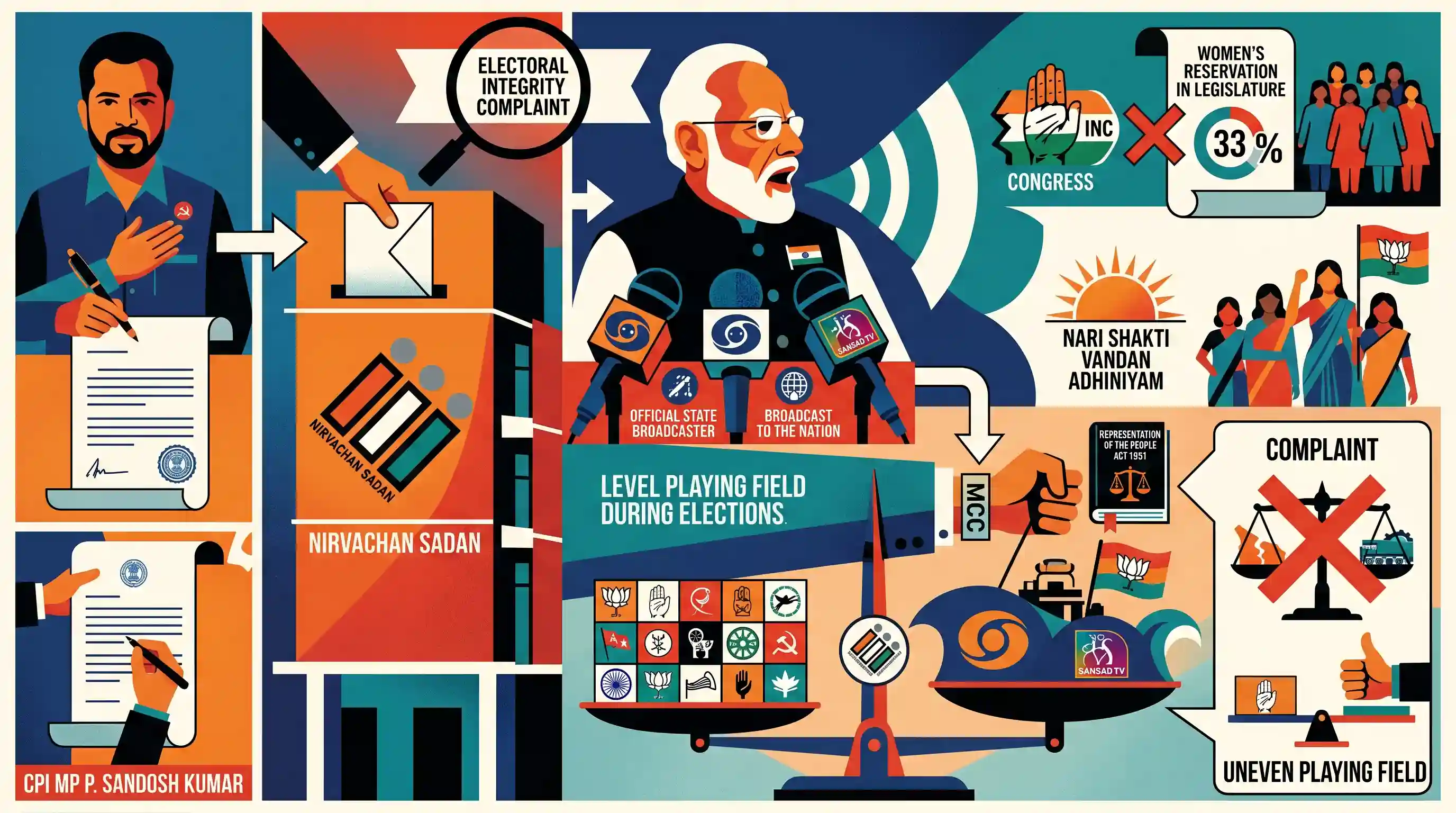
CPI MP P. Sandosh Kumar has written to the Election Commission of India (ECI), alleging that Prime Minister Narendra Modi violated the Model Code of Conduct (MCC) and the Representation of the People Act, 1951. The complaint relates to the PM's speech, broadcast on public platforms like Doordarshan and Sansad TV, where he accused the Congress of previously blocking the Constitution Amendment Bill for women's reservation (Nari Shakti Vandan Adhiniyam). The MP asserts that using government-owned broadcasters for partisan political messaging violates the MCC's requirement for a level playing field during elections.
Key Points
- A CPI MP filed a complaint with the Election Commission of India alleging the Prime Minister violated the Model Code of Conduct (MCC).
- The complaint centers on the PM's speech being broadcast on state-owned platforms like Doordarshan and Sansad TV, which the MP claims disrupts the level playing field.
- The PM's address accused the Congress and its allies of committing the 'sin of foeticide' by failing to pass the Constitution Amendment Bill for women's reservation.
- The opposition claims the broadcast violates the Representation of the People Act, 1951 by using public infrastructure for partisan political campaigning.
Important Terms
Model Code of Conduct (MCC)

A set of non-statutory guidelines issued by the Election Commission of India to regulate the conduct of political parties and candidates during elections, ensuring free and fair polling.
UPSC context
GS II: Governance/Elections. Essential for questions on electoral integrity and the powers of the Election Commission.
Election Commission of India (ECI)
A permanent, independent constitutional body established under Article 324 to superintend, direct, and control elections to Parliament, State Legislatures, and the offices of President and Vice-President.
UPSC context
GS II: Constitutional Bodies. Core topic for electoral reforms and institutional autonomy.
Representation of the People Act, 1951
The legislation that provides for the actual conduct of elections, qualifications/disqualifications of members, corrupt practices, and electoral offences; it is the statutory basis for election management.
UPSC context
GS II: Salient features of RPA. Frequently tested in Prelims (disqualifications) and Mains (electoral reforms).
Nari Shakti Vandan Adhiniyam
The 106th Constitutional Amendment Act (2023) which reserves one-third of seats for women in the Lok Sabha and State Legislative Assemblies for a 15-year period.
UPSC context
GS II: Social Justice/Polity. Significant for topics on women's empowerment and legislative representation.
Level Playing Field
A democratic principle ensuring that all political parties and candidates have an equal opportunity to compete, preventing the ruling party from misusing official machinery or public resources.
UPSC context
GS II: Elections. A key concept in debates over electoral fairness and the misuse of state power.
Prelims Trap
"The Model Code of Conduct is explicitly defined and enforced as a statutory provision under the Representation of the People Act, 1951."
The MCC is a consensus-driven, non-statutory code. While the ECI invokes specific statutes like the RPA or IPC for overlapping violations, the MCC itself is not a statute.
Static Concepts Connected
What constitutes a 'Corrupt Practice' under Section 123 of RPA, 1951?
- Bribery & Undue Influence: Direct or indirect interference with the free exercise of any electoral right by a candidate or their agent.
- Appeal to Identity: Appealing to vote or refrain from voting on the grounds of religion, race, caste, community, or language.
- Government Assistance: Obtaining or procuring assistance from specific classes of government servants (e.g., gazetted officers, police) to further election prospects.
What are the key provisions of the 106th Constitutional Amendment Act (Nari Shakti Vandan Adhiniyam)?
- 33% Reservation: Mandates one-third of total seats for women in the Lok Sabha, State Legislative Assemblies, and the NCT of Delhi Assembly.
- Delimitation Prerequisite: The reservation will only come into effect after an electoral delimitation exercise based on the first Census published post-enactment.
- 15-Year Sunset Clause: The reservation mandate will cease to have effect 15 years from its commencement, unless extended by parliamentary law.
Cross-Topic Patterns
MCC enforcement via RPA Section 123
ECI leverages statutory provisions of the RPA (like defining government assistance as a corrupt practice) to enforce the non-statutory MCC against the party in power during campaigns.
Delimitation freeze and 106th CAA
The operationalization of the 106th CAA is structurally dependent on the post-2026 delimitation exercise, closely linking federal parliamentary seat allocation debates with gender representation in GS2.
State Broadcasters and Level Playing Field
The controversy highlights the tension between Prasar Bharati's statutory autonomy and ECI's Part VII MCC guidelines, which forbid the ruling party from monopolizing state broadcasting.

A multi-statement question on RPA's 'corrupt practices' vs. MCC violations, focusing on misuse of state media, is highly probable in 2026.
Linked PYQs · 3
Linked PYQs · 3
- 2022MainsGS2
Discuss the role of the Election Commission of India in the light of the evolution of the Model Code of Conduct.
- 2019MainsGS2
“The reservation of seats for women in the institutions of local self-government has had a limited impact on the patriarchal character of the Indian Political Process.” Comment.
- 2023MainsGS2
Discuss the contribution of civil society groups for women's effective and meaningful participation and representation in state legislatures in India.
