Supreme Court Mandates Judicial Member in PMLA Benches
Source:The Hindu ↗
Why It Matters
It directly affects the composition and functioning of quasi-judicial bodies under key anti-money laundering frameworks, upholding the doctrine of separation of powers and protection of property rights.
Summary
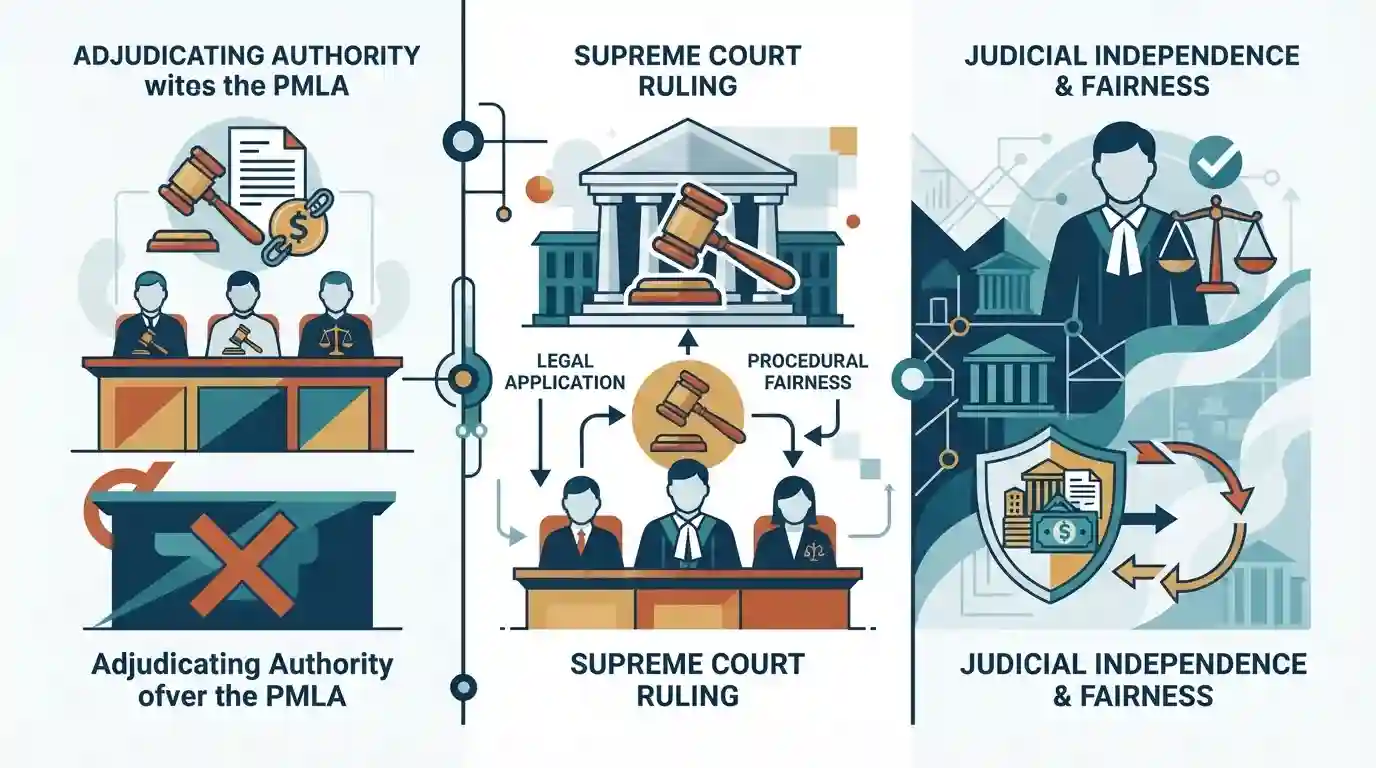
The Supreme Court has ruled that benches of the Adjudicating Authority under the Prevention of Money Laundering Act (PMLA) responsible for property attachment must have at least one judicial member. The ruling reinforces principles of judicial independence, procedural fairness, and proper legal application in statutory bodies handling sensitive economic offenses and asset confiscations.
Key Points
- The Supreme Court ruled that Benches of the Adjudicating Authority under the Prevention of Money Laundering Act (PMLA) adjudicating property attachment must include at least one judicial member.
- The court emphasized that questions involving adjudication of rights, property attachments, and legal interpretations require judicial mind and expertise.
- This ensures adherence to constitutional safeguards, judicial independence, and fairness in handling sensitive economic offenses and property confiscations.
Important Terms
Prevention of Money Laundering Act (PMLA)

A key economic legislation enacted to prevent money laundering and provide for the confiscation of property derived from, or involved in, money laundering offenses.
UPSC context
GS Paper II (Statutory Bodies) and GS Paper III (Internal Security, Prevention of Money Laundering). Tests understanding of economic offenses and legal frameworks.
Adjudicating Authority under PMLA
A specialized statutory body established under the PMLA to decide whether a provisional attachment of property made by the Enforcement Directorate should be confirmed.
UPSC context
GS Paper II (Tribunals and Statutory Bodies, Separation of Powers). Tests knowledge of quasi-judicial bodies and administrative justice under economic laws.
Supreme Court of India
The apex constitutional court of India, responsible for interpreting laws and safeguarding fundamental rights, ensuring executive and statutory bodies act within constitutional bounds.
UPSC context
GS Paper II (Indian Judiciary, Judicial Review, Separation of Powers). Tests understanding of the Supreme Court's role in maintaining procedural fairness and judicial independence.
Static Concepts Connected
What is the composition and role of the Adjudicating Authority under the PMLA?
- Composition: Consists of a Chairperson and two other members appointed by the Central Government.
- Mandate: Decides whether the attached property is involved in money laundering within 180 days of receiving the reference from the investigating officer.
- Appellate Mechanism: Appeals against the orders of the Adjudicating Authority lie before the Appellate Tribunal under PMLA, and further to the High Court.
Cross-Topic Patterns
PMLA Adjudication vs. Tribunalisation of Justice
The Supreme Court's insistence on a judicial mind in executive tribunals mirrors landmark jurisprudence on the separation of powers and tribunalization of justice (Madras Bar Association line of judgments).

PMLA statutory bench composition + separation of powers will likely feature as a statement-based Prelims or Mains GS-2 question.
Linked PYQs · 3
Linked PYQs · 3
- 2025MainsGS2
Comment on the need of administrative tribunals as compared to the court system. Assess the impact of the recent tribunal reforms through rationalization of tribunals made in 2021.
- 2018MainsGS2
How far do you agree with the view that tribunals curtail the jurisdiction of ordinary courts? In view of the above, discuss the constitutional validity and competency of the tribunals in India.
- 2023MainsGS2
“Constitutionally guaranteed judicial independence is a prerequisite of democracy.” Comment.
