Patna Municipal Corporation Strike: Urban Sanitation and Labor Demands
Source:lokmat-times ↗
Why It Matters
The article highlights systemic challenges in urban governance and the direct impact of labor disputes on essential public services. Sanitation and public health are core constitutional responsibilities of local self-governments (12th Schedule, 74th Amendment), making this a highly relevant example for BPSC questions on municipal functions, urban waste management, and administrative efficiency.
Summary
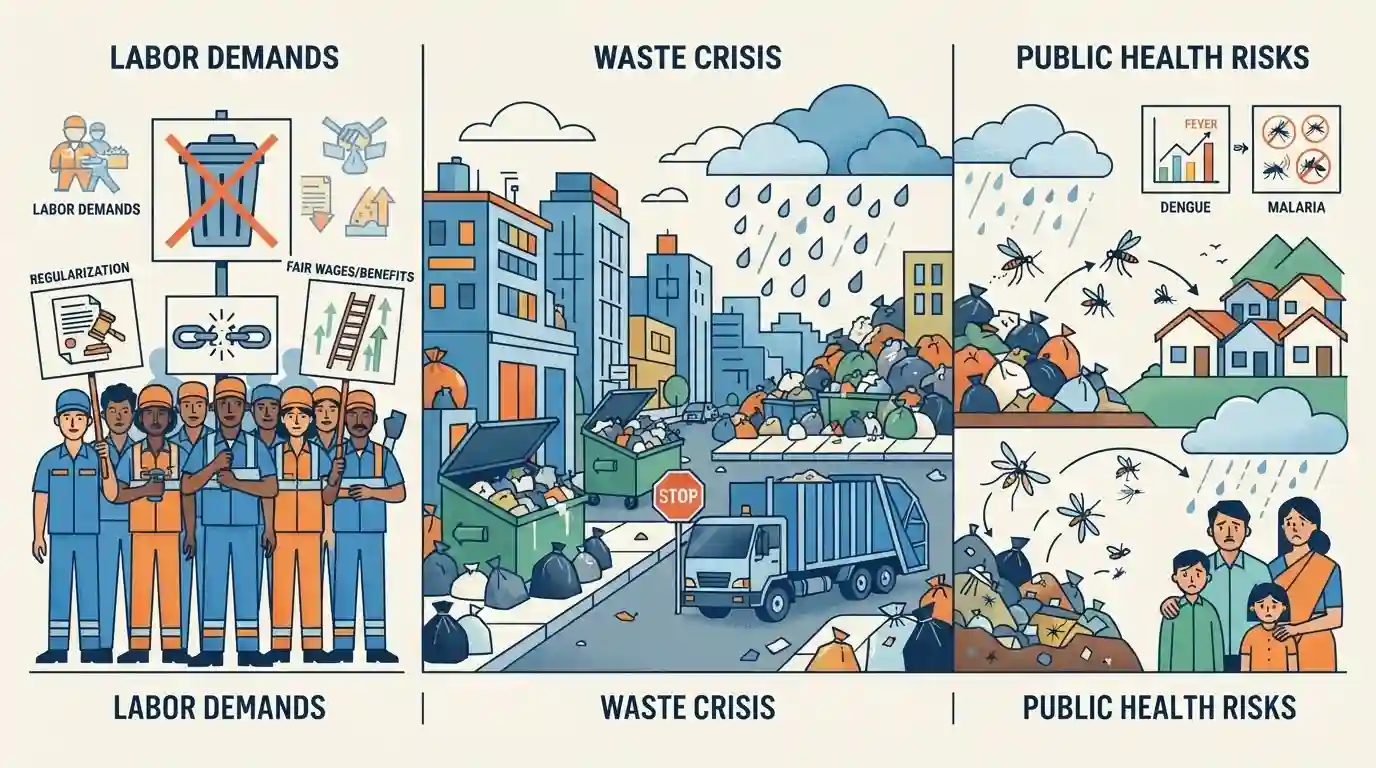
An indefinite strike by approximately 8,000 employees of the Patna Municipal Corporation (PMC) has severely crippled the city's sanitation and waste management systems. The workers, comprising permanent, daily-wage, and outsourced staff, are demanding the regularisation of daily wagers, an end to the outsourcing system, and the restoration of career progression benefits (ACP/MACP). The halt in door-to-door garbage collection and street sweeping has led to rapid accumulation of waste across Patna, which generates 1,200 tonnes of garbage daily. Amid the monsoon season, the piling waste raises serious public health concerns, particularly regarding outbreaks of vector-borne diseases like dengue and malaria.
Key Points
- An indefinite strike by 8,000 Patna Municipal Corporation (PMC) employees has brought the city's sanitation system and door-to-door garbage collection to a standstill.
- The striking workforce includes permanent, daily-wage, and outsourced employees organized under the Municipal Corporation Employees' Joint Coordination Committee.
- Their primary demands include the regularisation of daily-wage workers, abolition of the current outsourcing system, and restoration of ACP and MACP career progression benefits.
- Patna generates approximately 1,200 tonnes of waste daily (60% wet and 40% dry), and the uncollected garbage poses severe public health risks, such as dengue and malaria, during the ongoing monsoon season.
Important Terms
Modified Assured Career Progression (MACP)

An administrative scheme providing financial upgradations to government employees at 10, 20, and 30 years of service to mitigate stagnation caused by lack of promotional avenues.
UPSC context
GS Paper II (Governance/Civil Services Reforms); tests knowledge of administrative incentives, labor welfare, and personnel management.
Assured Career Progression (ACP)
A legacy career progression scheme providing two financial upgradations (at 12 and 24 years of service) to stagnant government employees, subsequently replaced by the MACP scheme.
UPSC context
GS Paper II (Public Administration/Civil Service Reforms); tests understanding of evolution in public personnel compensation structures.
Patna Municipal Corporation (PMC)
The urban local body responsible for municipal administration, solid waste management, and public health in Patna, functioning under decentralized local governance.
UPSC context
GS Paper II (Governance/Local Self-Government); tests knowledge of the 74th Constitutional Amendment Act and urban administration challenges.
Municipal Corporation Employees' Joint Coordination Committee
A collective union of permanent, daily-wage, and outsourced municipal workers advocating for labor welfare, service regularisation, and salary parity in urban local bodies.
UPSC context
GS Paper II (Governance/Pressure Groups); tests understanding of public sector trade unions, labor rights, and administrative negotiations.
Prelims Trap
Sanitation and public order are both core municipal functions designated under the 12th Schedule of the Constitution.
The 12th Schedule includes public health, sanitation, and solid waste management, but strictly excludes public order, which remains a State List subject.
Static Concepts Connected
What are the core civic responsibilities of Municipalities under the 12th Schedule?
- Constitutional mandate: Added by the 74th Constitutional Amendment Act (1992) under Article 243W, containing 18 functional items for urban local bodies.
- Sanitation & Health: Entry 6 explicitly designates public health, sanitation conservancy, and solid waste management as core municipal responsibilities.
- Key Exclusions: While public utility services are included, "Maintenance of Public Order" is strictly excluded and remains within the State Government's domain.
How do the Solid Waste Management Rules 2026 upgrade previous segregation guidelines?
- 4-Stream Segregation: Mandates a stricter 4-stream waste segregation system at source, replacing the older 3-stream model from 2016.
- New Categories: Waste must now be separated into wet waste, dry waste, sanitary waste, and special care waste before being handed to municipal workers.
Cross-Topic Patterns
ULB financial capacity vs. Outsourcing trends
The push to abolish outsourcing for sanitation workers highlights the broader GS2 theme of underfunded municipalities heavily relying on precarious contract labor to fulfill their constitutional duties.
Monsoon urban health + Solid waste failures
Uncollected waste during monsoons exacerbates vector-borne disease outbreaks (dengue, malaria), bridging urban governance failures with GS2/GS3 public health crises and climate vulnerabilities.

Prelims 2026 may test the 12th Schedule alongside the new Solid Waste Management Rules 2026 (4-stream segregation mandate).
Linked PYQs · 3
Linked PYQs · 3
- 2017BPSC_PRELIMSGS1
Which one of the following functions is not the concern of Local Self-Government?
- 2022BPSC_PRELIMSGS1
Biodegradable wastes can usually be converted into useful substance with the help of
- 2023BPSC_PRELIMSGS1
The urbanization of the State has increased very rapidly in the last ten years. According to the 2011 Census, the level of urbanization in Bihar was just __ percent, which has increased to __ percent at present.
