Electric Mobility Expansion Under Public Private Partnership Model
Source:Indian Express ↗
Why It Matters
The rollout of e-buses under the PM-eBus Sewa Scheme serves as an important case study for India's transition to green mobility and sustainable urban transport. It demonstrates the practical application of Public-Private Partnerships (via the hiring model) to overcome capital expenditure barriers in municipal infrastructure. Furthermore, it highlights inclusive governance through Divyangjan-friendly accessibility features and enhanced passenger safety in public transport systems.
Summary
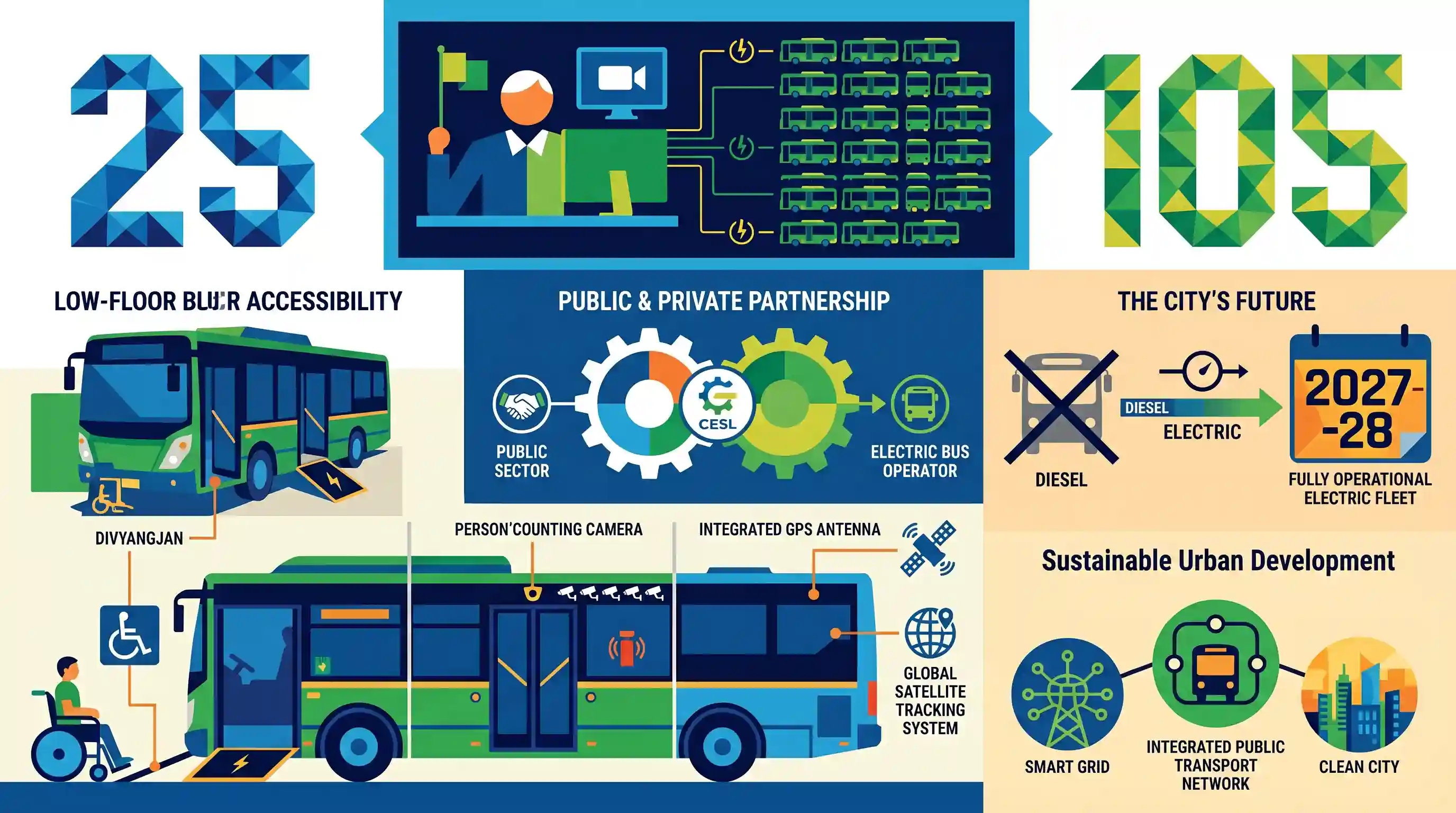
Prime Minister Narendra Modi recently flagged off 25 new electric buses for Chandigarh as part of the PM-eBus Sewa Scheme, pushing the city's operational EV fleet to 105. Sanctioned by the Ministry of Housing and Urban Affairs, the initiative is a significant step toward green mobility and sustainable urban transport. The e-buses are procured and operated under a Public-Private Partnership (PPP) hiring model facilitated by Convergence Energy Services Limited (CESL). The UT administration plans to completely phase out diesel buses in the Tricity region by FY 2027-28. The modern buses feature accessibility improvements for Divyangjan, along with advanced safety and tracking mechanisms.
Key Points
- Prime Minister Narendra Modi virtually flagged off 25 electric buses for Chandigarh under the PM-eBus Sewa Scheme.
- The Ministry of Housing and Urban Affairs has sanctioned a total of 428 electric buses for Chandigarh.
- The administration aims to replace all diesel buses in the Tricity region with electric buses by the end of FY 2027-28, targeting a total fleet of 508 e-buses.
- The buses operate on a 'hiring model' (a Public-Private Partnership) managed by CESL, where the private operator handles procurement, maintenance, and operation, while the government collects fare revenue.
- The e-buses are Divyangjan-friendly, featuring kneeling mechanisms and power-operated ramps, and are equipped with advanced safety features like AIS-140 GPS, CCTV, and panic buttons.
Important Terms
PM-eBus Sewa Scheme

A 2023 Union Cabinet initiative to deploy 10,000 electric buses in 169 cities, prioritizing those without organized bus services and supporting operations for 10 years.
UPSC context
GS Paper II: Government Schemes; GS Paper III: Infrastructure and Environment (Green Mobility). Measures urban transport sustainability and scheme implementation.
Ministry of Housing and Urban Affairs (MoHUA)
The apex Indian government body responsible for urban planning, housing, and urban transport infrastructure, including missions like PM-eBus Sewa and Smart Cities.
UPSC context
GS Paper II: Statutory/Executive bodies; GS Paper III: Urbanization and Sustainable Development. Tests knowledge of institutional roles in urban governance.
Convergence Energy Services Limited (CESL)
A subsidiary of Energy Efficiency Services Limited (EESL) under the Ministry of Power that aggregates demand for electric vehicles and charging infrastructure across India.
UPSC context
GS Paper III: Energy, Environment, and Infrastructure. Focuses on public-sector-led demand aggregation for green energy transition.
State Transport Authority (STA)
A statutory body established under Sections 68-70 of the Motor Vehicles Act, 1988, to regulate transport policy, coordinate permit issuance, and oversee Regional Transport Authorities.
UPSC context
GS Paper II: Statutory bodies and regulatory frameworks. Important for understanding the legal governance of transport and licensing in India.
PPP Hiring Model
A Public-Private Partnership arrangement where private operators provide, maintain, and run buses (e.g., e-buses) while the government pays a fixed fee per kilometer operated.
UPSC context
GS Paper III: Infrastructure and Investment Models. Tests understanding of risk-sharing and efficiency in public utility delivery.
Prelims Trap
"PM-eBus Sewa is an initiative implemented by the Ministry of Heavy Industries."
Aspirants often confuse PM-eBus Sewa with FAME or PM E-DRIVE. PM-eBus is administered by MoHUA for urban mobility, whereas broader EV subsidies fall under the Ministry of Heavy Industries.
Static Concepts Connected
How does the Gross Cost Contract (GCC) model function in urban transport PPPs?
- Capital Risk: The private operator bears the upfront cost of procuring the electric buses and maintaining the fleet infrastructure.
- Revenue Risk: The public transport authority collects passenger fare revenue and bears the ridership risk.
- Fixed Remuneration: The government pays the private operator a pre-determined, fixed rate per kilometer operated, ensuring steady cash flow.
What is a Payment Security Mechanism (PSM) in infrastructure?
- Risk Mitigation: It guarantees timely payments to private contractors, shielding them from the poor financial health of state entities like STUs or DISCOMs.
- SECI Precedent: Originally pioneered by the Solar Energy Corporation of India to de-risk renewable projects, it is now adapted for e-mobility.
Cross-Topic Patterns
AIS-140 standard bridges transport and NavIC
The AIS-140 mandate for commercial vehicles bridges urban transport safety with India's indigenous space technology (NavIC), reflecting UPSC's focus on practical governance applications of space tech.
SECI's Payment Security applied to E-Buses
The Payment Security Mechanism (PSM) that scaled India's solar sector is being transplanted to de-risk electric bus PPPs against financially ailing State Transport Undertakings.

Expect a prelims question contrasting PM-eBus Sewa (MoHUA/GCC model) with PM E-DRIVE (Heavy Industries/subsidy model) in 2026.
Linked PYQs · 3
Linked PYQs · 3
- 2023MainsGS3
The adoption of electric vehicles is rapidly growing worldwide. How do electric vehicles contribute to reducing carbon emissions and what are the key benefits they offer compared to traditional combustion engine vehicles?
- 2022MainsGS3
Why is Public Private Partnership (PPP) required in infrastructural projects ? Examine the role of PPP model in the redevelopment of Railway Stations in India.
- 2019MainsGS1
How is efficient and affordable urban mass transport key to the rapid economic development of India?
