Global Energy Price Shocks and Fiscal Deficit Pressures
Source:Indian Express ↗
Why It Matters
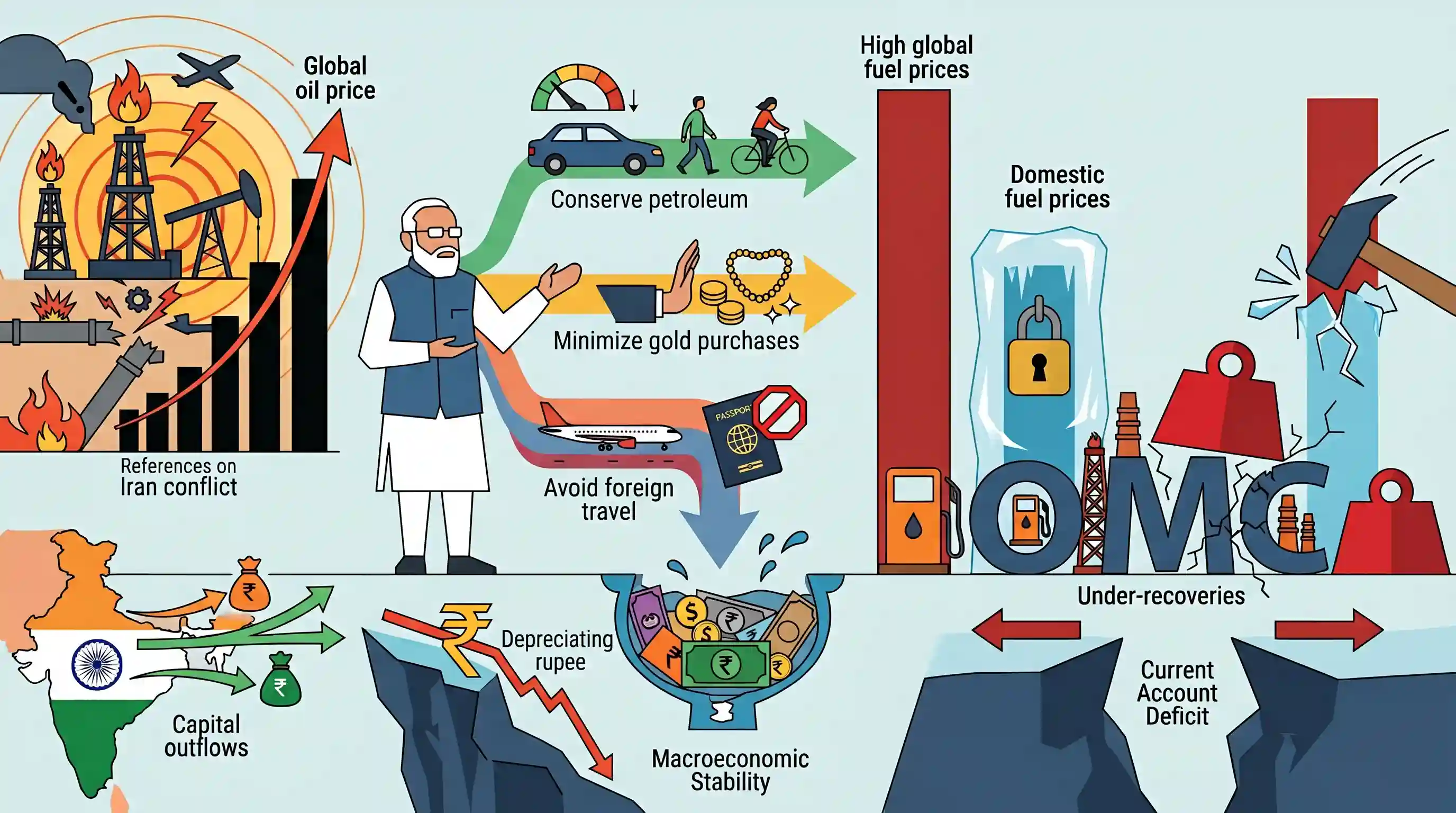
It highlights the vulnerability of the Indian economy to external geopolitical shocks (Iran war) and illustrates the fiscal trade-offs between shielding consumers from inflation and protecting the financial health of state-owned enterprises (OMCs) and macroeconomic fundamentals (forex, currency value).
Summary
Amidst a severe global energy supply shock caused by the Iran war, Prime Minister Narendra Modi has appealed to citizens to conserve petroleum products, minimize gold purchases, and avoid foreign travel to protect India's foreign exchange reserves. While several Asian and Western economies have already raised fuel prices or imposed rationing, India has so far frozen retail prices, forcing Oil Marketing Companies (OMCs) to absorb immense monthly under-recoveries of Rs 30,000 crore. The editorial warns that artificially suppressing domestic fuel prices while facing capital outflows and a depreciating rupee is fiscally perilous, advocating for necessary price adjustments to pass the global energy costs on to consumers.
Key Points
- The Prime Minister urged citizens to reduce fuel consumption, minimize gold purchases, and postpone foreign travel to preserve India's foreign exchange reserves amidst an ongoing energy shock.
- The global energy supply shock, triggered by the Iran war, has led to a falling rupee and continuous FPI withdrawals, straining macroeconomic stability.
- To manage the crisis, the government has prioritized gas for domestic use, raised export levies on diesel and aviation fuel, and increased LPG production.
- Despite soaring crude prices, retail fuel prices have remained unchanged, causing Oil Marketing Companies (OMCs) to face massive under-recoveries estimated at Rs 30,000 crore per month.
- The editorial argues that delaying the pass-through of global prices to consumers is fiscally unsustainable and that pump prices must begin to reflect international realities.
Important Terms
Oil Marketing Companies (OMCs)

State-owned or private entities (e.g., IOCL, BPCL, HPCL) responsible for refining, marketing, and distributing petroleum products to retail and bulk consumers.
UPSC context
GS-3 Energy/Infrastructure; tests understanding of energy security and the fiscal impact of fuel pricing mechanisms.
Under-recoveries
The revenue shortfall incurred by OMCs when retail fuel prices are kept lower than international parity prices, often to shield consumers from global price shocks.
UPSC context
GS-3 Fiscal Policy; tests knowledge of subsidy regimes and the trade-off between fiscal health and inflation management.
Current Account Deficit (CAD)
The shortfall when a country’s total imports of goods, services, and transfers exceed its total exports. For India, oil and gold are major contributors.
UPSC context
GS-3 External Sector; tests ability to analyze balance of payments and factors affecting macroeconomic stability.
Foreign Exchange (Forex) Reserves
Assets (foreign currencies, gold, SDRs) held by the RBI to stabilize the rupee, support trade, and cushion the economy against external shocks.
UPSC context
GS-3 External Sector; tests understanding of currency stability and the RBI’s role in managing external sector resilience.
Foreign Portfolio Investors (FPIs)
Foreign entities or individuals investing in Indian financial assets like stocks and bonds (generally <10% equity) without direct management control.
UPSC context
GS-3 Capital Markets; tests knowledge of "hot money" volatility and its impact on the rupee and market stability.
Prelims Trap
Petrol and diesel prices in India are fully deregulated and strictly determined by market forces.
While officially deregulated since 2010/2014, OMCs frequently freeze retail prices during global shocks or elections under informal government cues, leading to massive under-recoveries.
Static Concepts Connected
What are the typical components driving India's Current Account Deficit (CAD)?
- Crude Oil Imports: With over 85% import dependence, petroleum crude forms the largest component of India's import bill and trade deficit.
- Gold Imports: High domestic demand for gold acts as a massive drain on forex reserves, frequently prompting the government to hike import duties during crises.
- Invisibles Surplus: Remittances and software services exports (invisibles) run a surplus and partially offset the goods trade deficit, though often fall short during severe oil shocks.
What are 'Under-recoveries' and 'Windfall Taxes' in the petroleum sector?
- Under-recoveries: The revenue loss incurred by Oil Marketing Companies (OMCs) when they are forced to sell fuel at retail prices below the international crude procurement cost.
- Windfall Taxes: A Special Additional Excise Duty levied by the government on domestic crude producers and refiners to capture super-normal profits earned during global price spikes.
Cross-Topic Patterns
Energy shocks and CAD management
Spikes in crude prices historically prompt the RBI and Government to curb gold imports and overseas spending to protect forex reserves, linking energy security directly to CAD management.
Middle East crises & Imported Inflation
Geopolitical conflicts in the Middle East create supply bottlenecks, leading to imported inflation that forces the RBI to tighten monetary policy, ultimately restricting domestic growth.

Expect a multi-statement question linking OMC under-recoveries, windfall taxes, and imported inflation mechanics in the 2026 Prelims.
Linked PYQs · 5
Linked PYQs · 5
- 2025MainsGS2
"Energy security constitutes the dominant kingpin of India's foreign policy, and is linked with India's overarching influence in Middle Eastern countries.” How would you integrate energy security with India's foreign policy trajectories in the coming years?
- 2017MainsGS2
The question of India's Energy Security constitutes the most important part of India's economic progress. Analyze India's energy policy cooperation with West Asian countries.
- 2019PrelimsGS1
Which one of the following is not the most likely measure the Government/RBI takes to stop the slide of Indian rupee?
- 2022PrelimsGS1
With reference to the Indian economy, consider the following statements: 1. If the inflation is too high, Reserve Bank of India (RBI) is likely to buy government securities. 2. If the rupee is rapidly depreciating, RBI is likely to sell dollars in the market. 3. If interest rates in the USA or European Union were to fall, that is likely to induce RBI to buy dollars. Which of the statements given above are correct?
- 2025PrelimsGS1
Consider the following activities : I. Production of crude oil II. Refining, storage and distribution of petroleum III. Marketing and sale of petroleum products IV. Production of natural gas How many of the above activities are regulated by the Petroleum and Natural Gas Regulatory Board in our country?
