India Mediterranean Diplomacy and Strategic Corridor Nodes
Source:The Hindu ↗
Why It Matters
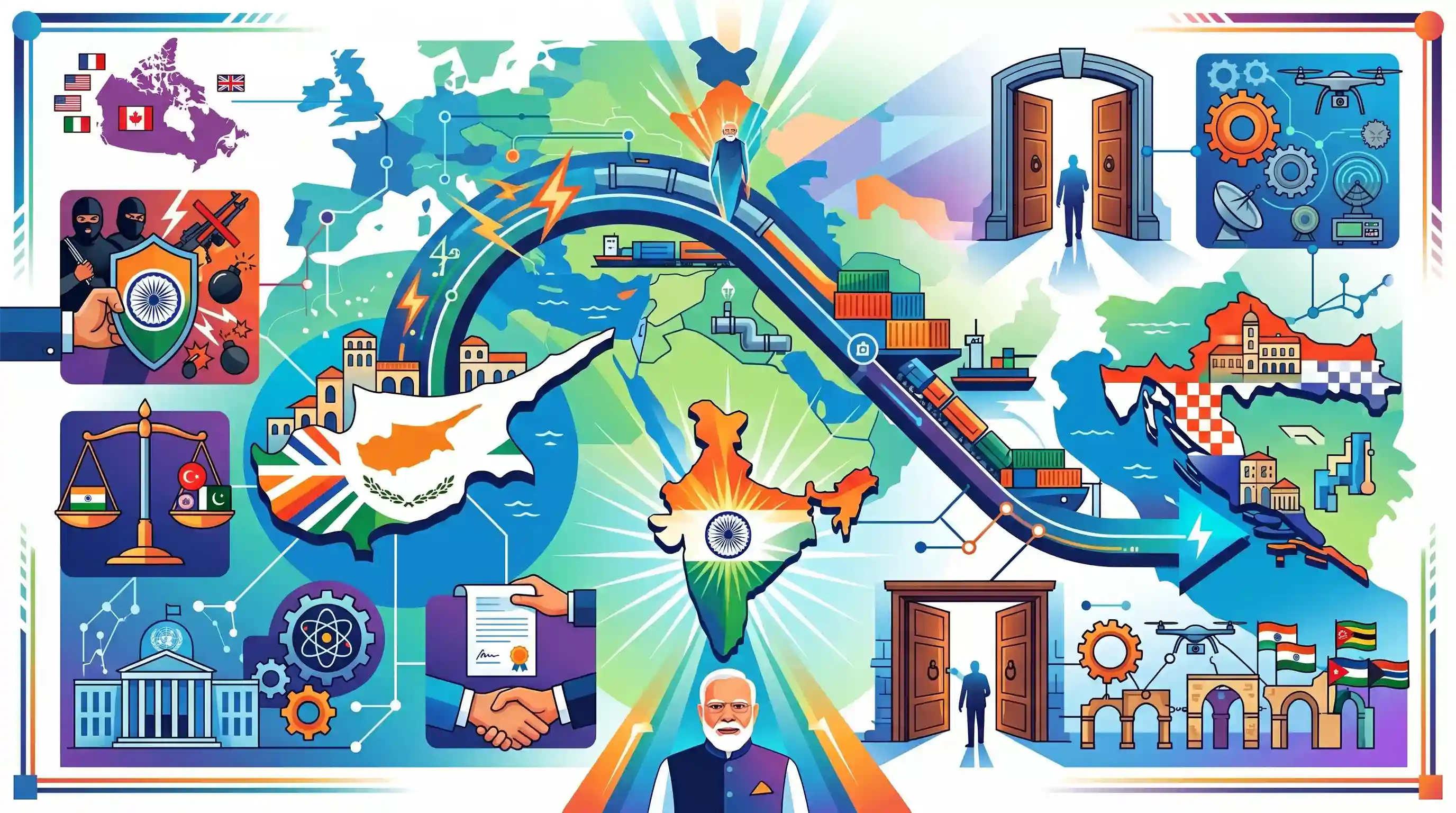
Demonstrates India's strategic push into the Mediterranean and Europe, utilizing bilateral diplomacy to counter hostile axes (Türkiye-Pakistan), secure essential nodes for IMEC, and leverage historical goodwill (NAM).
Summary
Prime Minister Narendra Modi is scheduled to visit Cyprus and Croatia around his G-7 summit trip to Canada. The visits aim to strengthen India's Mediterranean and European outreach. Cyprus offers key diplomatic support on issues like cross-border terrorism, Kashmir, and India's global aspirations (UNSC, NSG), while serving as a strategic counterweight to Türkiye's alignment with Pakistan. The Croatia trip marks the first-ever Indian PM visit since its 1991 formation, highlighting growing defense tech ties and historical Non-Aligned Movement connections. Crucially, both nations are eyed as pivotal nodes for the India-Middle East-Europe Economic Corridor (IMEC).
Key Points
- PM Modi will make the first-ever Indian Prime Ministerial visit to Croatia, honoring deep cultural ties (Indology at Zagreb University) and historical Non-Aligned Movement (NAM) connections.
- Cyprus will assume the Presidency of the Council of the EU in early 2026, making it a critical strategic partner for India in Europe.
- Cyprus consistently supports India on UN issues, cross-border terrorism (strongly condemning the Pahalgam attack), and key strategic groups (NSG, IAEA, UNSC).
- The visit to Nicosia acts as a strategic signal to Türkiye—which recently aided Pakistan in Operation Sindoor—while India reaffirms its backing for a UNSC-aligned resolution to the Cypriot territorial dispute.
- Both Cyprus and Croatia offer vital maritime access points (e.g., Adriatic ports) for the successful operationalization of the India-Middle East-Europe Economic Corridor (IMEC).
Important Terms
India-Middle East-Europe Economic Corridor (IMEC)

A proposed multimodal connectivity project linking India, the Middle East, and Europe via ship-to-rail transit. It aims to boost trade, digital connectivity, and clean energy while offering a strategic alternative to China's BRI.
UPSC context
GS Paper II (International Relations) and GS Paper III (Infrastructure). Tests knowledge of global connectivity initiatives and India's strategic geoeconomic interests.
Operation Sindoor
A tri-service military strike launched by India on May 7, 2025, targeting nine terror camps in Pakistan/PoJK. It was a retaliatory response to the April 22 terror attack in Pahalgam.
UPSC context
GS Paper III (Internal Security). Tests understanding of India's counter-terrorism doctrine and evolution of military responses to cross-border threats.
Non-Aligned Movement (NAM)
An international forum of 120+ developing nations not formally aligned with major power blocs. Founded in 1961, it emphasizes sovereignty and strategic autonomy; India is a key founding member.
UPSC context
GS Paper II (International Relations). Tests knowledge of historical foreign policy foundations and India's leadership in the Global South.
United Nations Security Council (UNSC)
The UN organ responsible for international peace and security. India seeks a permanent seat in an expanded council, with support from nations like Cyprus and G4 partners.
UPSC context
GS Paper II (Important International Institutions). Tests understanding of global governance reforms and India's diplomatic bid for permanent membership.
Nuclear Suppliers Group (NSG)
An elite 48-member group regulating global nuclear trade to prevent proliferation. India seeks membership to enhance its clean energy security and participate in global nuclear rule-making.
UPSC context
GS Paper II (International Relations) and GS Paper III (Energy). Tests knowledge of nuclear diplomacy and export control regimes.
G-7
An informal forum of seven advanced economies (Canada, France, Germany, Italy, Japan, UK, US). India is frequently invited as an outreach partner to represent the Global South's priorities.
UPSC context
GS Paper II (Global Groupings). Tests understanding of high-level multilateral diplomacy and India's role in global economic decision-making.
Council of the European Union
A legislative body of the EU representing member states' governments. Cyprus will hold its rotating Presidency in 2026, offering India a strategic window for EU-level diplomatic engagement.
UPSC context
GS Paper II (Regional Groupings). Tests knowledge of EU governance and India's bilateral-to-regional diplomatic strategies.
ISKCON
A global religious organization promoting Vedic culture. In Croatia, it serves as a significant node of cultural contact and Indology, complementing growing defense and technological ties.
UPSC context
GS Paper II (International Relations - Soft Power). Tests understanding of cultural diplomacy and the role of the Indian diaspora/cultural organizations abroad.
Prelims Trap
Both Cyprus and Croatia serve as vital Adriatic Sea access points for IMEC.
Cyprus is an island nation in the Eastern Mediterranean, while Croatia borders the Adriatic Sea. UPSC often swaps these regional seas in mapping questions.
Static Concepts Connected
What was Yugoslavia's role in the founding of NAM?
- Founding Trio: Josip Broz Tito of Yugoslavia, alongside India's Nehru and Egypt's Nasser, was a primary architect of the movement.
- First Summit: The inaugural Non-Aligned Movement (NAM) conference was hosted in Belgrade, Yugoslavia, in 1961.
- Successor States: Croatia, having emerged from the breakup of Yugoslavia in 1991, inherits this historical diplomatic capital with India.
What is the geographical significance of the Adriatic Sea?
- Mediterranean Arm: It is the northernmost arm of the Mediterranean Sea, separating the Italian Peninsula from the Balkan Peninsula.
- Key Ports: Croatian ports like Rijeka and Split sit on the Adriatic, offering deep-water maritime access for European trade.
- Strategic Gateway: It provides a strategic entry point into Central and Eastern European markets, bypassing heavily congested Western European maritime routes.
Cross-Topic Patterns
Strategic counterweight to Türkiye
India's deepening ties with Cyprus and Greece act as a direct strategic check against the Türkiye-Pakistan nexus and their anti-India stance on Kashmir.
IMEC's alternative European nodes
Focusing on Croatian Adriatic ports integrates Central and Eastern Europe (CEE) into IMEC, reducing India's over-reliance on traditional Western European trade gateways.

Map-pairing questions linking IMEC port nodes (e.g., Piraeus, Rijeka) with their respective seas (Mediterranean, Adriatic) are highly likely.
Linked PYQs · 3
Linked PYQs · 3
- 2023MainsGS2
‘The expansion and strengthening of NATO and a stronger US-Europe strategic partnership works well for India.’ What is your opinion about this statement ? Give reasons and examples to support your answer.
- 2024MainsGS2
‘Terrorism has become a significant threat to global peace and security.’ Evaluate the effectiveness of the United Nations Security Council's Counter Terrorism Committee (CTC) and its associated bodies in addressing and mitigating this threat at the international level.
- 2016MainsGS2
Increasing cross-border terrorist attacks in India and growing interference in the internal affairs of several member-states by Pakistan are not conducive for the future of SAARC (South Asian Association for Regional Cooperation)." Explain with suitable examples.
