Government launches health and nutrition campaign for women
Source:The Hindu ↗
Why It Matters
The article is significant for UPSC aspirants as it details a major new government health and nutrition initiative converging two key ministries. It provides excellent fodder for GS Paper 2 answers on health policy, maternal care, and tackling malnutrition, and serves as highly probable factual material for Prelims regarding scheme objectives and targeted diseases (like anaemia and sickle cell disease).
Summary
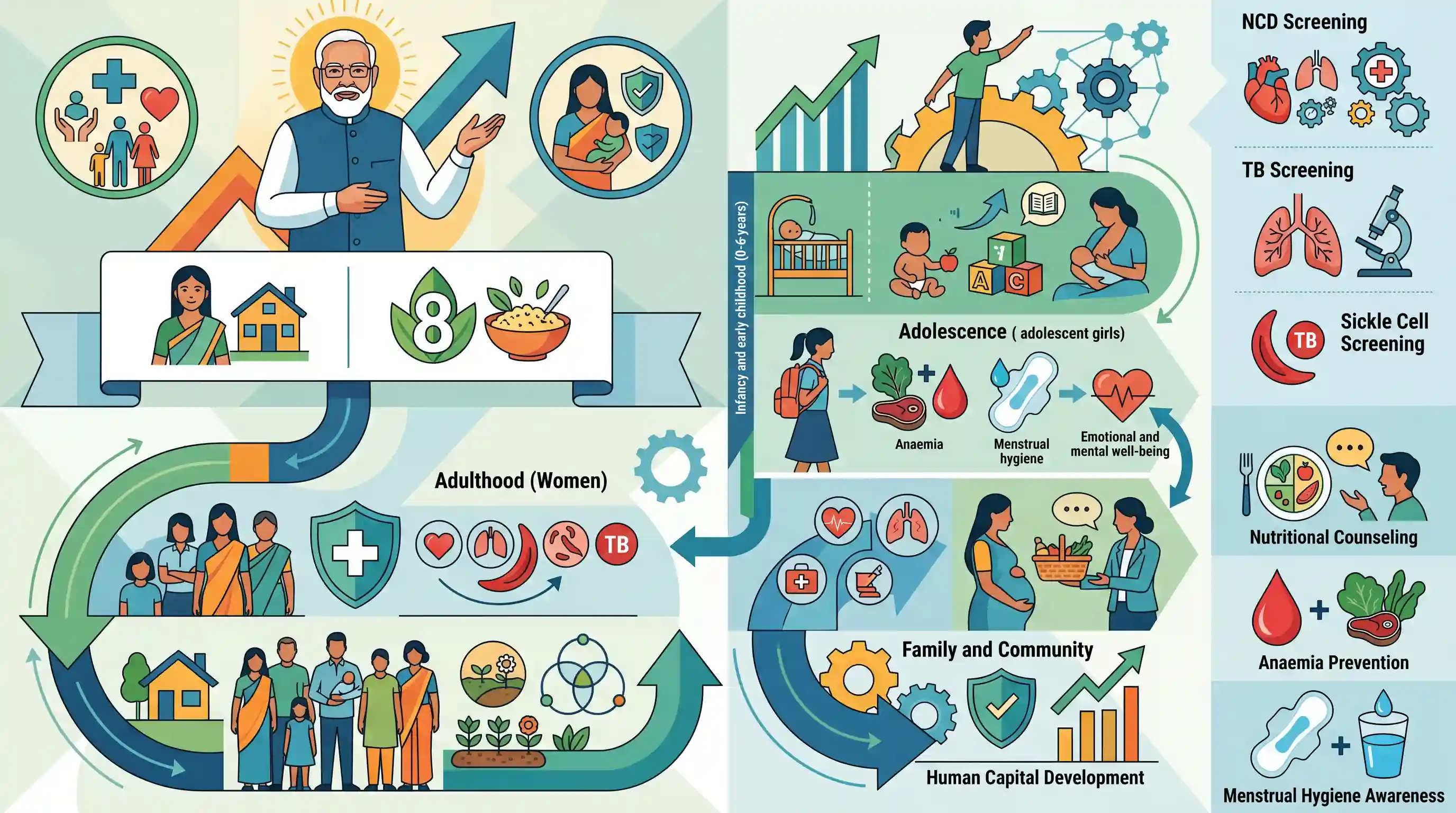
The Prime Minister will launch the 'Swasth Nari, Sashakt Parivar Abhiyaan' and the eighth 'Poshan Maah' on September 17. This joint initiative by the Ministry of Health and Family Welfare (MoHFW) and the Ministry of Women and Child Development (MoWCD) aims to provide holistic healthcare and nutritional services. The campaign focuses on women, adolescent girls, and children, integrating medical screening for NCDs, TB, and sickle cell disease with nutritional counseling, anaemia prevention, and menstrual hygiene awareness. This inter-ministerial convergence highlights a life-cycle approach to improving human capital and health outcomes.
Key Points
- The Prime Minister is set to launch 'Swasth Nari, Sashakt Parivar Abhiyaan' alongside the eighth 'Poshan Maah' on September 17.
- The initiative represents a convergence between the Ministry of Health and Family Welfare (MoHFW) and the Ministry of Women and Child Development (MoWCD) to improve maternal, child, and adolescent health.
- MoHFW will focus on screening for non-communicable diseases (NCDs), tuberculosis, sickle cell disease, and promoting voluntary blood donation.
- MoWCD will mobilize women and adolescent girls through anganwadi centres, leading campaigns on anaemia prevention, nutritional counseling, and menstrual hygiene.
Important Terms
Swasth Nari Sashakt Parivar Abhiyaan

A nationwide 2025 health initiative jointly led by the Health and WCD ministries. It provides community-level screening for NCDs, TB, and sickle cell disease, emphasizing women’s wellness as family empowerment.
UPSC context
GS-II: Government policies and Health; tests understanding of inter-ministerial convergence and preventive healthcare strategies for women.
Poshan Maah
Observed every September under Poshan Abhiyaan, this month-long campaign promotes community mobilization (Jan Andolan) to improve nutrition awareness. The 2025 edition focused on obesity, anaemia, and "Poshan Bhi Padhai Bhi."
UPSC context
GS-II: Welfare schemes and Nutrition; relevant for questions on behavioral change and community participation in public health.
Poshan Abhiyaan
India’s flagship National Nutrition Mission (launched 2018) aiming to reduce stunting, under-nutrition, and anaemia. It employs a technology-driven (Poshan Tracker) and multi-ministerial approach to achieve time-bound nutritional targets.
UPSC context
GS-II: Poverty and hunger; critical for understanding India’s strategy to meet SDG-2 (Zero Hunger) and nutritional security.
Mission Saksham Anganwadi and Poshan 2.0
An integrated nutrition support program merging Poshan Abhiyaan, Anganwadi Services, and Scheme for Adolescent Girls. It focuses on strengthening nutritional content, delivery, and outreach through revamped Anganwadi infrastructure.
UPSC context
GS-II: Social Justice; tests knowledge of restructured welfare frameworks and the efficiency of large-scale service delivery systems.
Life-cycle Approach
A holistic healthcare strategy addressing nutritional and medical needs at every stage of life—from the first 1,000 days (conception to age two) through childhood, adolescence, and adulthood.
UPSC context
GS-II: Health and Human Capital; key for discussing long-term development and breaking the intergenerational cycle of malnutrition.
Jan Andolan
A "People's Movement" strategy used in flagship missions to transform government schemes into mass mobilizations. It relies on community participation and social-behavioral change communication (SBCC).
UPSC context
GS-II: Governance; important for analyzing the role of public participation and civil society in successful policy implementation.
Prelims Trap
"The Swasth Nari, Sashakt Parivar Abhiyaan is exclusively implemented by the Ministry of Women and Child Development."
Aspirants often assume that Anganwadi/Poshan-related initiatives are solely under the Ministry of Women and Child Development. This specific Abhiyaan is a joint MoWCD-MoHFW initiative.
Static Concepts Connected
What is the 'Life-Cycle Approach' to addressing malnutrition?
- Definition: Targeting nutritional interventions across all crucial developmental stages—infancy, childhood, adolescence, pregnancy, and lactation.
- Intergenerational cycle: Recognizing that an undernourished adolescent girl becomes an undernourished mother, leading to a low-birth-weight baby. Interventions aim to break this vicious cycle.
- Key interventions: Provides targeted care like Iron-Folic Acid (IFA) for teens, institutional delivery for pregnant women, and exclusive breastfeeding promotion for infants.
What is Sickle Cell Disease (SCD) and whom does it primarily affect?
- Genetic disorder: An autosomal recessive genetic blood disorder that mutates hemoglobin, causing red blood cells to become rigid, sticky, and crescent or sickle-shaped.
- Clinical impact: The abnormal cells block blood flow, leading to severe pain crises, chronic anaemia, organ damage, and frequent infections.
- Tribal prevalence: In India, it is highly endemic predominantly among tribal populations across Central, Western, and Southern states.
Cross-Topic Patterns
Tribal Health + Genetic Disorders
Integrating Sickle Cell screening into mainstream women's health campaigns links standard nutrition drives directly to the National Sickle Cell Anaemia Elimination Mission targeting tribal belts.
Inter-ministerial Governance Convergence
UPSC frequently tests scheme overlaps. The functional merger of MoHFW (health screening) and MoWCD (anganwadi mobilization) represents a shift away from siloed welfare administration.

Expect a multi-statement question combining Poshan 2.0's life-cycle approach, Anaemia Mukt Bharat targets, and Sickle Cell genetics.
Linked PYQs · 4
Linked PYQs · 4
- 2024MainsGS2
Poverty and malnutrition create a vicious cycle, adversely affecting human capital formation. What steps can be taken to break the cycle ?
- 2020MainsGS2
In order to enhance the prospects of social development, sound and adequate health care policies are needed particularly in the fields of geriatric and maternal health care. Discuss.
- 2023PrelimsGS1
Consider the following statements in the context of interventions being undertaken under Anaemia Mukt Bharat Strategy: 1. It provides prophylactic calcium supplementation for pre-school children, adolescents and pregnant women. 2. It runs a campaign for delayed cord clamping at the time of child-birth. 3. It provides for periodic deworming to children and adolescents. 4. It addresses non-nutritional causes of anaemia in endemic pockets with special focus on malaria, hemoglobinopathies and fluorosis. How many of the statements given above are correct?
- 2023PrelimsGS1
Consider the following statements in relation to Janani Suraksha Yojana: 1. It is a safe motherhood intervention of the State Health Departments. 2. Its objective is to reduce maternal and neonatal mortality among poor pregnant women. 3. It aims to promote institutional delivery among poor pregnant women. 4. Its objective includes providing public health facilities to sick infants up to one year of age. How many of the statements given above are correct?
