PM SVANidhi Fortnight Drive Implemented Across Madhya Pradesh
Source:visionmp ↗
Why It Matters
PM SVANidhi is a flagship central scheme providing a critical social safety net and economic integration for the informal urban sector. Understanding Madhya Pradesh's leading role, its focus on digital inclusion, and the structural loan details (collateral-free, tranche-based) is crucial for MPPSC Prelims questions related to state governance, economy, and social justice.
Summary
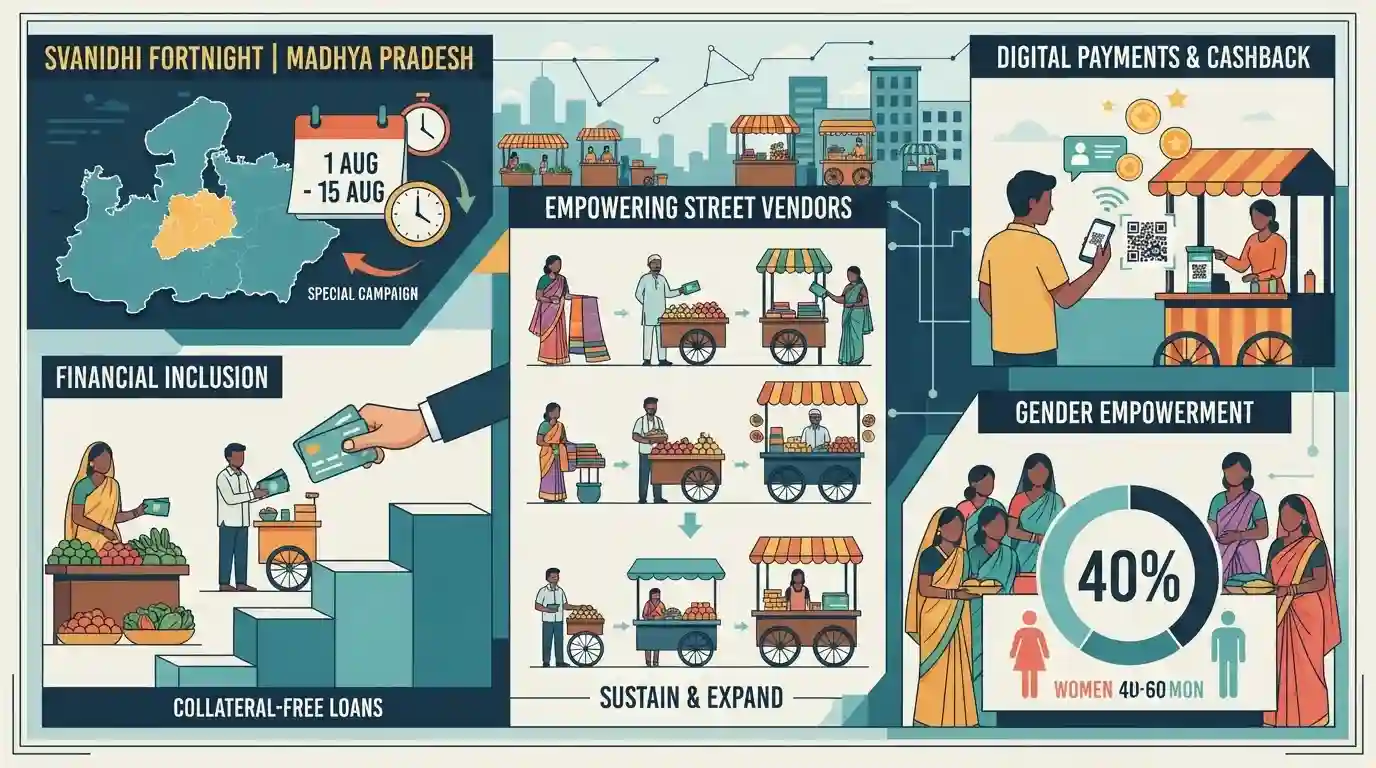
A special PM SVANidhi fortnight begins in Madhya Pradesh on August 1, 2026, aimed at bolstering financial inclusion for street vendors. The state leads the nation in implementing the scheme, which provides collateral-free microcredit in tranches to help vendors sustain and expand their livelihoods. Notably, the scheme promotes digital payments through cashback rewards and has achieved significant gender empowerment, with women constituting 40% of the state's beneficiaries.
Key Points
- A special PM SVANidhi fortnight drive is being conducted across Madhya Pradesh from August 1 to 15, 2026.
- Madhya Pradesh is ranked first in the country for the successful implementation of the PM SVANidhi scheme.
- The scheme provides collateral-free microloans to street vendors in three phases: an initial working capital of ₹10,000 (now sometimes stated as ₹15k based on enhancements), followed by ₹20,000, and up to ₹50,000 upon timely repayment.
- About 40% of the beneficiaries under the PM SVANidhi scheme in Madhya Pradesh are women, indicating strong gender-inclusive financial support.
- The scheme also offers cashback incentives for digital transactions, encouraging the formalization and digitization of micro-businesses.
Important Terms
PM SVANidhi Scheme

A micro-credit scheme launched by MoHUA in 2020 to provide street vendors with collateral-free working capital loans. It incentivizes digital transactions and timely repayments to promote formal financial integration.
UPSC context
GS Paper 2 & 3: Welfare Schemes, Financial Inclusion, and Urban Development. Tests scheme features and vulnerability impacts.
Financial Inclusion
The process of ensuring access to affordable financial services (credit, savings, insurance) for vulnerable and low-income groups, often leveraging digital platforms to integrate them into the formal economy.
UPSC context
GS Paper 3: Inclusive Growth and Economy. Tests digital banking, poverty alleviation, and related government interventions.
Urban Local Bodies (ULBs)
The third tier of government in India responsible for administering urban areas, granted constitutional status by the 74th Amendment Act, 1992. Examples include Municipal Corporations and Municipal Councils.
UPSC context
GS Paper 2: Local Governance and Devolution of Powers. Tests the 74th Amendment, urban administration, and decentralized execution of schemes.
Ministry of Housing and Urban Affairs (MoHUA)
The central ministry responsible for formulating policies, sponsoring programs, and coordinating activities regarding urban development, housing, and poverty alleviation in India. Administers PM SVANidhi.
UPSC context
GS Paper 2: Governance and Policy. Important for identifying the nodal ministry of urban welfare and development schemes.
Prelims Trap
PM SVANidhi is a Centrally Sponsored Scheme administered by the Ministry of MSME.
It is actually a Central Sector Scheme (100% Union funded) under the Ministry of Housing and Urban Affairs (MoHUA), though SIDBI implements it.
Static Concepts Connected
How do Central Sector Schemes differ from Centrally Sponsored Schemes?
- Funding source: Central Sector schemes are 100% funded by the Union government, whereas Centrally Sponsored Schemes involve a shared funding ratio (e.g., 60:40 or 90:10) with states.
- Implementation agency: Central Sector schemes are typically implemented directly by central ministries or agencies, while Sponsored schemes are executed by State governments.
What is the role of SIDBI in the Indian economy?
- Apex institution: SIDBI is the principal financial institution for the promotion, financing, and development of the Micro, Small and Medium Enterprises (MSME) sector in India.
- Scheme implementation: It acts as the project management agency and IT administrator for various government micro-credit initiatives, including PM SVANidhi and PM Vishwakarma.
Cross-Topic Patterns
Financial Inclusion + Local Governance
PM SVANidhi leverages Urban Local Bodies for vendor identification, directly linking the 74th Amendment's decentralization mandate to targeted grassroots financial inclusion.
Credit Access + Digital Public Infrastructure
The scheme couples microcredit with cashback incentives for digital transactions, accelerating UPI adoption among the informal sector and expanding the formal digital economy.

Expect a 2026 Prelims question testing PM SVANidhi's Central Sector status, MoHUA as the nodal ministry, and SIDBI's implementation role.
Linked PYQs · 4
Linked PYQs · 4
- 2025MPPSC_PRELIMSGS1
What is the main goal of the Udayam Kranti Yojna?
- 2023MPPSC_PRELIMSGS1
When was the Small Industries Development Bank of India (SIDBI) established?
- 2025MPPSC_PRELIMSGS1
The objective of "Mukhyamantri Ladli Behna Yojana" implemented in entire Madhya Pradesh, in addition to economic self-reliance is:
- 2023MPPSC_PRELIMSGS1
Which of the following is not an E–procurement portal?
