PM SHRI Scheme and Navodaya Vidyalaya Planned for West Bengal
Source:etv-bharat ↗
Why It Matters
Questions related to Centrally Sponsored Schemes, especially in education (like PM SHRI, Kendriya Vidyalaya, and Navodaya Vidyalaya), are common in competitive exams. The implementation of central schemes in states and center-state cooperation on such subjects are also pertinent for Indian Polity and Governance.
Summary
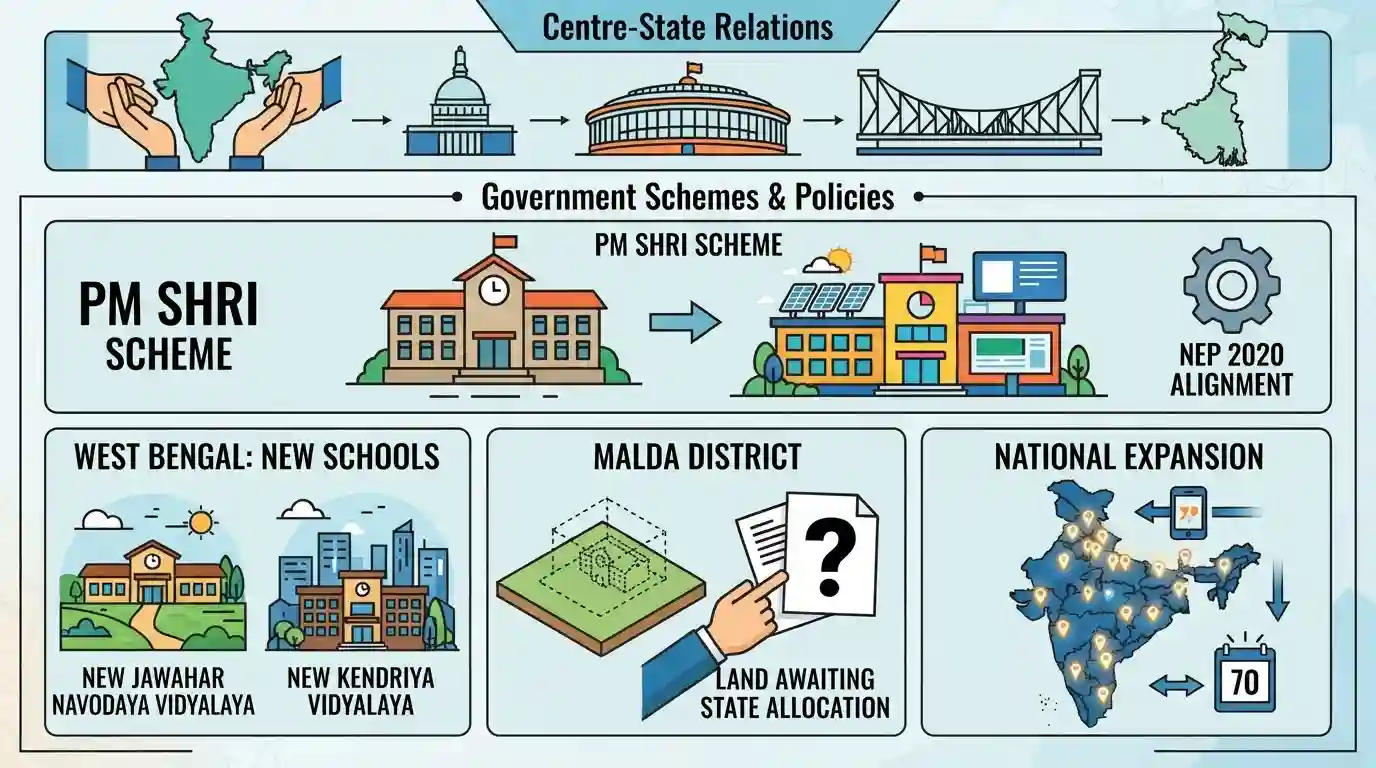
The West Bengal government has agreed to implement the PM SHRI (Prime Minister Schools for Rising India) scheme, a central initiative aimed at upgrading existing schools to align with the National Education Policy (NEP) 2020. Union Minister of State for Education Sukanta Majumdar announced this development, alongside plans to establish a new Jawahar Navodaya Vidyalaya in Malda district and a new Kendriya Vidyalaya in Raiganj. Furthermore, the Union government intends to set up 70 new Kendriya Vidyalayas across the country. The implementation of the Navodaya Vidyalaya in Malda awaits land allocation by the state government.
Key Points
- The PM SHRI (Prime Minister Schools for Rising India) scheme is set to be implemented in West Bengal following the state government's agreement.
- A new Jawahar Navodaya Vidyalaya is planned for Malda district, pending the state government's allocation of 10-15 acres of land.
- A new Kendriya Vidyalaya will be established in Raiganj, Uttar Dinajpur district, which will operate temporarily from a polytechnic college until a permanent facility is built.
- The Union government plans to establish 70 new Kendriya Vidyalayas across India, adding to the existing network of over 1,250 KVs.
- The PM SHRI scheme aims to upgrade existing schools to serve as model schools reflecting the objectives of the National Education Policy (NEP) 2020.
Important Terms
PM SHRI Scheme

A centrally sponsored scheme upgrading over 14,500 government schools into model institutions. They showcase the National Education Policy 2020 by focusing on modern infrastructure, digital integration, and holistic, competency-based learning.
UPSC context
Important for WBCS Paper VI (Government Schemes). Tests knowledge of current central education initiatives and state implementations.
National Education Policy (NEP) 2020
India's modern educational reform replacing the 10+2 system with a 5+3+3+4 framework. It shifts focus from rote memorization to holistic, multidisciplinary learning, foundational literacy, and skill development.
UPSC context
Highly relevant for WBCS Paper VI (HRD). Evaluates candidates' understanding of modern structural reforms in India's education sector.
Kendriya Vidyalaya
A system of central government schools following a uniform CBSE curriculum. They aim to provide uninterrupted, quality education to the children of transferable central government employees, including defence personnel.
UPSC context
Pertinent to WBCS Paper VI (Education). Illustrates institutional measures by the Union government to support its transferable workforce.
Jawahar Navodaya Vidyalaya
Fully residential, co-educational central schools offering free, high-quality modern education to talented children, predominantly from rural areas, regardless of their socio-economic backgrounds.
UPSC context
Key for WBCS Paper VI (HRD). Tests knowledge of inclusive education initiatives targeting rural empowerment and talent nurturing.
Union Ministry of Education
The central government ministry responsible for the formulation and implementation of education policies in India, overseeing school reforms, higher education, and centrally sponsored schemes like PM SHRI.
UPSC context
Relevant to WBCS Paper V (Polity) and Paper VI. Highlights the administrative body managing Centre-State educational frameworks.
Prelims Trap
The PM SHRI scheme involves the construction of new model schools across India.
PM SHRI does NOT involve building new schools. It is exclusively an upgrade scheme for existing schools managed by the Centre, States, UTs, or local bodies to showcase NEP 2020.
Static Concepts Connected
What are the key Constitutional provisions related to Education in India?
- Concurrent List: Transferred from the State List to the Concurrent List via the 42nd Amendment (1976), allowing joint Centre-State initiatives.
- Article 21A: Inserted by the 86th Amendment (2002), making free and compulsory elementary education a fundamental right.
- DPSP Article 45: Directs the State to provide early childhood care and education for all children until the age of six.
What distinguishes a Centrally Sponsored Scheme from a Central Sector Scheme?
- Funding Share: Sponsored schemes have shared funding (e.g., 60:40 Centre-State), whereas Sector schemes are 100% funded by the Union government.
- Implementation Agency: Sponsored schemes (like PM SHRI) are implemented by State governments; Sector schemes are executed directly by Central agencies.
Cross-Topic Patterns
Federal Tussles over Scheme Implementation
States often resist Centrally Sponsored Schemes over branding and funding ratios. West Bengal's recent agreement to implement PM SHRI reflects ongoing Centre-State negotiations within India's federal structure.
North Bengal Geography Mapping
The new KV in Raiganj (Uttar Dinajpur) and JNV in Malda highlight regional development. Aspirants must map Raiganj (Kulik Bird Sanctuary) and Malda (Gour ruins) for WBCS Geography.

Expect a question merging PM SHRI's focus (upgrading existing schools, not new ones) with Education's Concurrent List status (42nd CAA).
Linked PYQs · 1
Linked PYQs · 1
- 2021WBCS_PRELIMSGS1
Sabooj-Sathi is a scheme for distribution of Bicycles to students of Government/Government Aided Schools/Madrasahs reading in
