Implementation Challenges in the National Midday Meal Scheme
Source:The Hindu ↗
Why It Matters
The effectiveness of the PM POSHAN scheme is a prime case study for GS2 questions on the performance of welfare schemes, governance deficits, and the intertwined issues of poverty, hunger, and education in India.
Summary
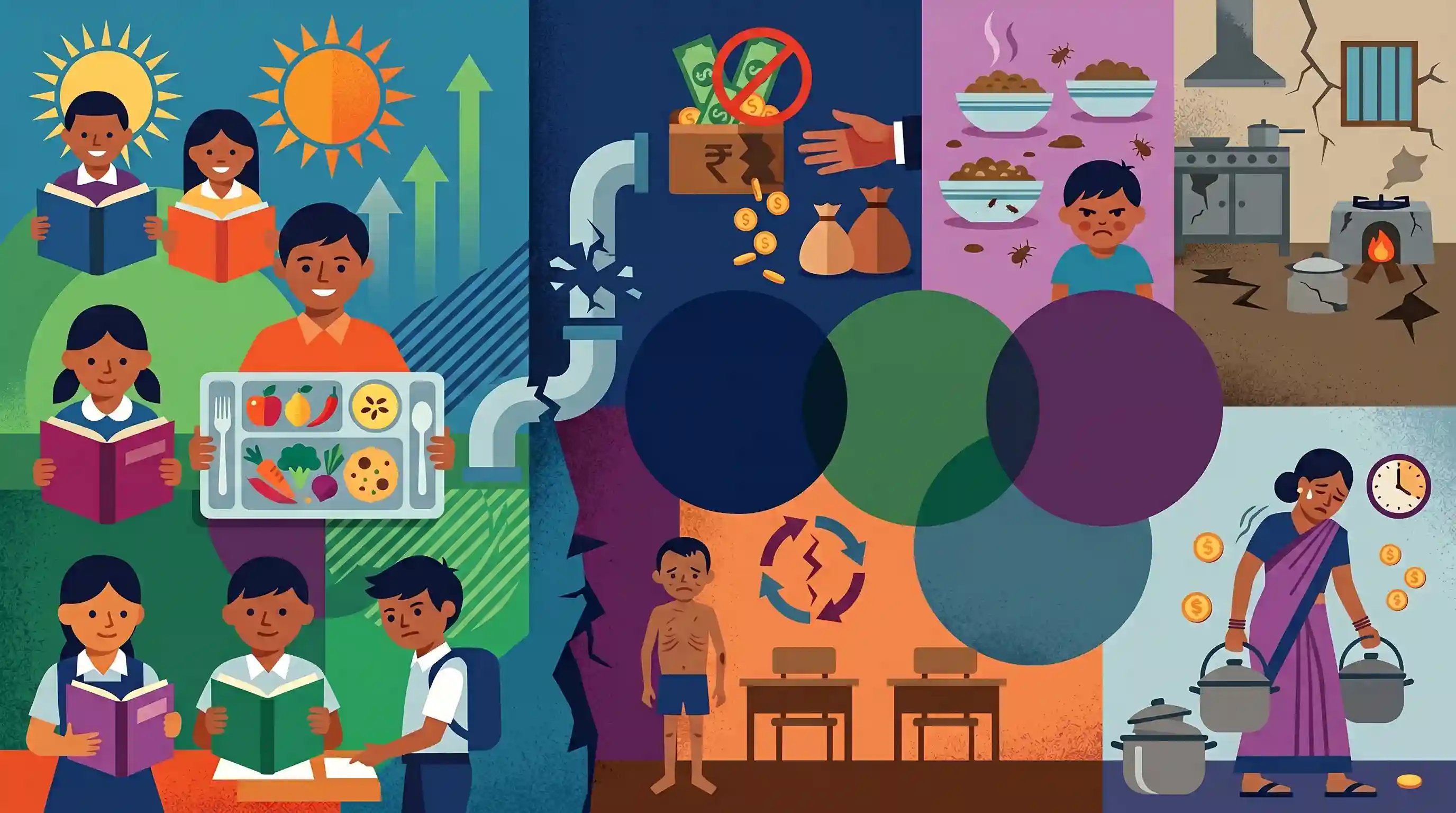
The article provides a critical evaluation of the PM POSHAN (formerly Mid-Day Meal) scheme, contrasting its ambitious nutritional and educational goals with the grim realities of its implementation on the ground. Despite its mandate to combat child malnutrition and improve school attendance, the program struggles with systemic governance issues such as irregular fund allocations, substandard food quality, inadequate kitchen infrastructure, and poorly compensated staff. These implementation bottlenecks highlight the broader challenges of executing welfare schemes for vulnerable sections in India, demonstrating how administrative inefficiencies can hinder efforts to break the vicious cycle of poverty, hunger, and poor human capital formation.
Key Points
- PM POSHAN (formerly the Mid-Day Meal scheme) aims to ensure nutritional security for schoolchildren while simultaneously boosting school enrollment and retention.
- The scheme faces severe ground-level implementation challenges, including delayed fund disbursals, infrastructural deficits like absent or unhygienic kitchens, and supply chain leakages.
- Poor quality of ingredients and drastically underpaid cooks/helpers undermine the scheme's capacity to deliver promised nutritional standards.
- The gap between policy intent and actual execution perpetuates the vicious cycle of poverty and malnutrition, negatively impacting human capital formation.
- Effective reform requires decentralized monitoring, active community/parental involvement through School Management Committees, and timely financial transfers.
Important Terms
PM POSHAN Scheme

A flagship school-feeding program (formerly Mid-Day Meal) providing hot cooked meals to children in classes 1-8, aiming to improve nutritional status and school enrollment.
UPSC context
GS Paper 2: Welfare schemes for vulnerable sections; tests knowledge of implementation gaps and nutritional governance.
National Food Security Act (NFSA), 2013
A 2013 law providing legal entitlement to subsidized foodgrains; it mandates nutritional support for children and women, making school meals a statutory right.
UPSC context
GS Paper 2: Governance; GS Paper 3: Food Security. Crucial for rights-based welfare analysis.
Centrally Sponsored Scheme (CSS)
A welfare program funded jointly by the Union and States (often 60:40) but implemented by State governments, requiring fiscal coordination for effective delivery.
UPSC context
GS Paper 2: Federalism; GS Paper 3: Budgeting. Key to understanding the financial hurdles in scheme execution.
Social Audit
A community-based monitoring process where stakeholders verify government implementation and expenditures to ensure transparency, accountability, and quality control at the grassroots.
UPSC context
GS Paper 2: Governance and Transparency. Tests mechanisms for citizen oversight in public service delivery.
Mid-Day Meal Scheme
The world's largest school feeding initiative launched in 1995 to enhance enrollment and nutrition, rebranded as PM POSHAN in 2021 with an expanded scope.
UPSC context
GS Paper 2: Social Justice; Health & Education. Important for historical context of India's nutritional policies.
Stunting and Wasting
Stunting (low height-for-age) and Wasting (low weight-for-height) are metrics for chronic and acute undernutrition, used to evaluate the effectiveness of school meal programs.
UPSC context
GS Paper 2: Issues relating to hunger and health. Essential for interpreting National Family Health Survey (NFHS) data.
Prelims Trap
PM POSHAN scheme is restricted only to students of Classes I to VIII.
In 2021, the scheme was revamped to expand coverage to pre-primary students (Balvatikas) in government and aided schools, making the 'only Class I-VIII' claim incorrect.
Static Concepts Connected
How does the NFSA 2013 legally secure children's nutritional rights?
- Legal Entitlement: Guarantees a free, hot cooked midday meal meeting prescribed nutritional norms for children aged 6 to 14 years.
- Food Security Allowance: Legally binds state governments to pay beneficiaries a 'Food Security Allowance' if they fail to provide the mandated meal.
What is the mandate of School Management Committees (SMCs) under the RTE Act?
- Composition: Must comprise at least 75% parents or guardians (with 50% women), ensuring direct community stakeholder oversight.
- Core Functions: Monitor daily school operations, formulate the School Development Plan, and oversee the utilization of government grants like PM POSHAN.
Cross-Topic Patterns
Fortified Rice & Millets Integration
Linking decentralized procurement of millets (Shree Anna) and fortified rice to PM POSHAN connects agrarian policy with the fight against hidden hunger.
Social Audits in Welfare Delivery
Implementation deficits in PM POSHAN parallel MGNREGA bottlenecks, reinforcing the need for statutory social audits (like Meghalaya's model) to ensure localized accountability.

Expect a Mains question linking governance bottlenecks in PM POSHAN and ICDS directly to India's unrealized demographic dividend.
Linked PYQs · 4
Linked PYQs · 4
- 2024MainsGS2
Poverty and malnutrition create a vicious cycle, adversely affecting human capital formation. What steps can be taken to break the cycle ?
- 2019MainsGS2
Performance of welfare schemes that are implemented for vulnerable sections is not so effective due to absence of their awareness and active involvement at all stages of policy process. Discuss.
- 2019MainsGS2
There is a growing divergence in the relationship between poverty and hunger in India. The shrinking of social expenditure by the government is forcing the poor to spend more on non-food essential items squeezing their food-budget. - Elucidate.
- 2018PrelimsGS1
With reference to the provisions made under the National Food Security Act, 2013, consider the following statements : 1. The families coming under the category of 'below poverty line (BPL)' only are eligible to receive subsidised food grains. 2. The eldest woman in a household, of age 18 years or above, shall be the head of the household for the purpose of issuance of a ration card. 3. Pregnant women and lactating mothers are entitled to a 'take-home ration' of 1600 calories per day during pregnancy and for six months thereafter. Which of the statements given above is/are correct?
