Critical mineral supply chains and bilateral resource diplomacy
Source:Indian Express ↗
Why It Matters
This article links several crucial UPSC dimensions: the shift from purely diplomatic ties to high-tech resource diplomacy ('nickel diplomacy'), maritime connectivity (Andaman and Nicobar to Aceh), and security architecture (BrahMos missile exports). It encapsulates how resource security is reshaping bilateral foreign policies in the Indo-Pacific.
Summary
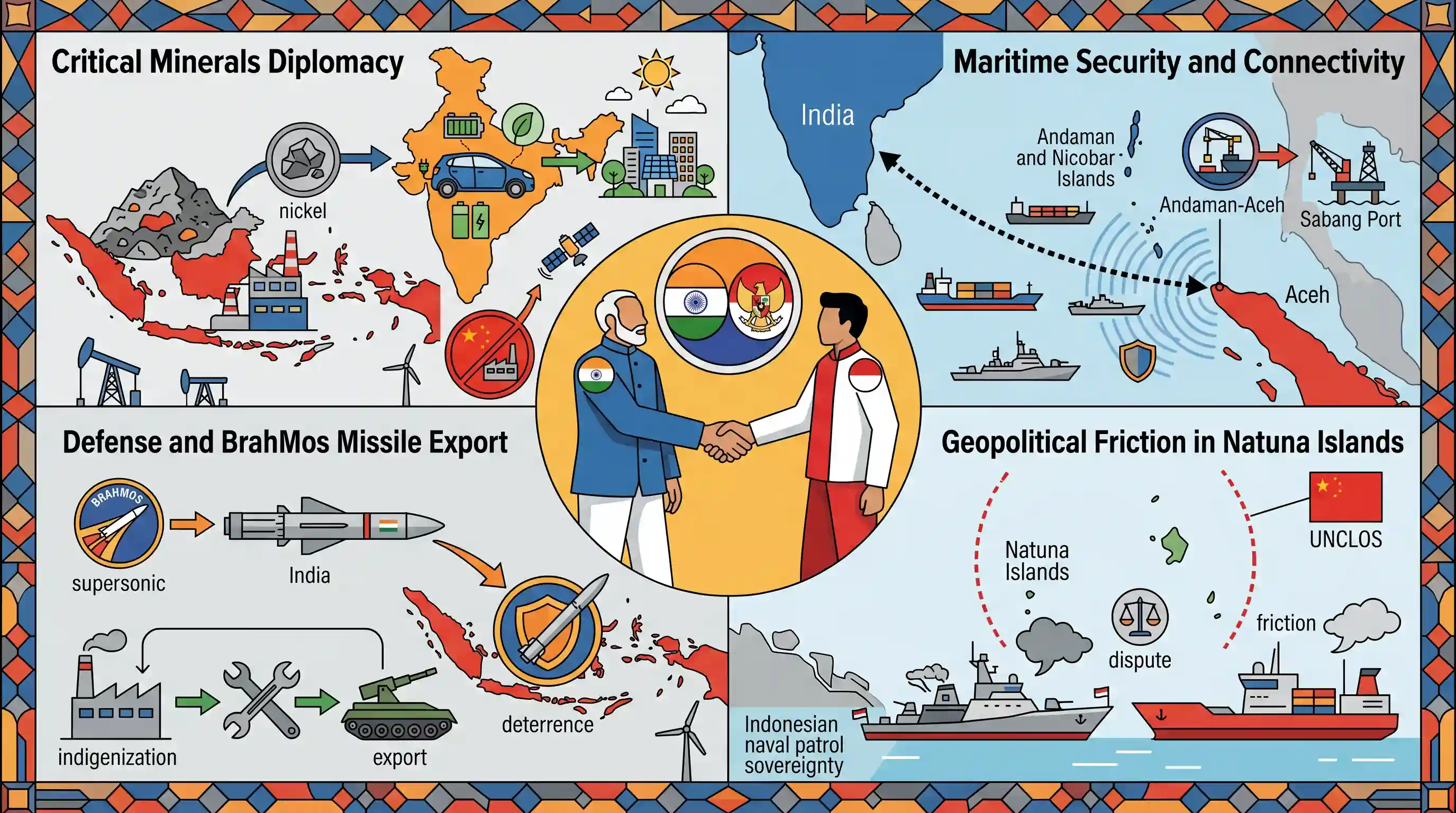
Prime Minister Narendra Modi's visit to Indonesia (July 2026) highlights India's pivot towards 'nickel diplomacy' and intensified maritime-defense cooperation in the Indo-Pacific. With Indonesia holding the world's largest nickel reserves, India seeks to secure critical mineral supply chains for its electric vehicle and green transition to balance China's downstream processing dominance. Strategic themes also include the potential export of BrahMos missiles to Indonesia, reviving Andaman-Aceh maritime connectivity (via Sabang Port), and navigating geopolitical friction over China's maritime claims in the Natuna Islands.
Key Points
- Prime Minister Narendra Modi’s visit to Indonesia (July 6–8, 2026) initiates a six-day Indo-Pacific tour, following President Prabowo Subianto's 2025 visit to India.
- Nickel and Critical Minerals Diplomacy: Indonesia holds the world’s largest nickel reserves along with cobalt, bauxite, and rare earths. India needs to secure a robust commercial presence in Indonesia's nickel-processing value chains to support its clean energy and EV transitions.
- Countering Chinese Dominance: China currently dominates Indonesia’s downstream nickel-processing infrastructure. India must rapidly scale up joint ventures and upstream equity partnerships to offer a viable alternative.
- Strategic Maritime Security: India and Indonesia share a maritime boundary in the Andaman Sea. Initiatives to link the Andaman and Nicobar Islands with Indonesia's Aceh Province (including Sabang Port) are strategically vital to secure the western entrance of the Malacca Strait.
- Defence Cooperation and BrahMos: Bilateral talks include Indonesia's potential acquisition of the BrahMos supersonic cruise missile. This mirrors India's defense exports to the Philippines and burnishes India's status as a reliable, non-aligned defense supplier.
- Trade Targets: Although bilateral trade has a target of USD 100 billion by 2030, India currently faces a USD 20 billion trade deficit with Indonesia.
- Geopolitical Balance: China's 'Nine-Dash Line' overlaps Indonesia's EEZ around the Natuna Islands, providing strategic convergence for India and Indonesia to push for a free and open Indo-Pacific and uphold ASEAN centrality.
Important Terms
Act East Policy

India’s strategic initiative launched in 2014, upgrading the 'Look East Policy', to promote multi-dimensional economic, strategic, security, and cultural relations with Southeast and East Asia, ensuring regional stability and connectivity.
UPSC context
GS Paper II (IR). Tests neighborhood policy, Indo-Pacific diplomacy, and strategic posturing to counter regional hegemony.
Comprehensive Strategic Partnership 2018
The elevated bilateral framework signed during PM Modi's 2018 visit to Indonesia, expanding cooperation in maritime security, defense, trade, critical minerals, and people-to-people ties between the two countries.
UPSC context
GS Paper II (IR). Tests India-Indonesia strategic synergy, maritime security in the Strait of Malacca, and critical mineral partnerships.
ASEAN
A regional intergovernmental organization of Southeast Asian nations promoting economic growth, social progress, regional peace, and strategic alignment, serving as the core of India’s Indo-Pacific outlook.
UPSC context
GS Paper II (IR). Tests the significance of ASEAN centrality, trade agreements, and maritime security in the Indo-Pacific.
BRICS
An intergovernmental organization originally comprising Brazil, Russia, India, China, and South Africa, which expanded to include members like Egypt, Ethiopia, Iran, the UAE, and Indonesia to amplify Global South cooperation.
UPSC context
GS Paper II (IR). Tests regional geopolitics, multilateral financial architectures, and transition toward a multipolar, decentralized global order.
Indian Ocean Rim Association (IORA)
An intergovernmental organization established in 1997 comprising 23 coastal states bordering the Indian Ocean, focusing on maritime security, trade facilitation, blue economy, and sustainable regional development.
UPSC context
GS Paper II (IR). Tests India's leadership in the Indian Ocean, SAGAR initiative, and non-traditional maritime challenges.
The Energy and Resources Institute (TERI)
An independent Indian research institute focused on sustainable development, energy efficiency, climate change, and critical minerals supply chain security through applied research and policy advocacy.
UPSC context
GS Paper III (Environment). Tests clean energy transition, critical mineral security, and environmental policy research frameworks.
Prelims Trap
India's nickel diplomacy with Indonesia focuses on securing agreements to import raw nickel ore for processing in domestic Indian refineries.
Indonesia banned raw nickel ore exports in 2020 to enforce domestic downstreaming; India must invest in local Indonesian processing rather than importing raw ore.
Static Concepts Connected
What is the Andaman and Nicobar Command (ANC)?
- Unified structure: Established in 2001 in Port Blair, it remains India's only operational tri-service theater command, integrating Army, Navy, Air Force, and Coast Guard.
- Strategic choke-point: Guards the western entrance of the Malacca Strait, a critical global maritime choke point, monitoring Chinese naval transits into the Indian Ocean.
What is resource nationalism in trade economics?
- Economic protectionism: State-led policies asserting national control over local natural resources, limiting raw extraction to ensure the domestic economy captures industrial value-add.
- Downstream mandates: Involves export bans on raw materials (like Indonesia's nickel ore ban) to force foreign firms to construct local processing and refining infrastructure.
Cross-Topic Patterns
Critical minerals + Act East diplomacy
India is shifting Act East focus from historical-cultural ties to economic-security imperatives, integrating critical mineral security (nickel, cobalt) directly into bilateral defense and maritime frameworks.
BrahMos + Indo-Pacific deterrence
Exporting BrahMos missiles to ASEAN nations establishes India as a credible, non-aligned defense supplier, offering Southeast Asian partners asymmetric deterrence options without forcing them to choose superpowers.

Indonesia's nickel export ban and Sabang's geography will likely link critical mineral supply chains with maritime security in 2026 exams.
Linked PYQs · 5
Linked PYQs · 5
- 2025PrelimsGS1
In the context of electric vehicle batteries, consider the following elements : I. Cobalt II. Graphite III. Lithium IV. Nickel How many of the above usually make up battery cathodes?
- 2023PrelimsGS1
About three-fourths of world's cobalt, a metal required for the manufacture of batteries for electric motor vehicles, is produced by
- 2014MainsGS2
With respect to the South China sea, maritime territorial disputes and rising tension affirm the need for safeguarding maritime security to ensure freedom of navigation and over flight throughout the region. In this context, discuss the bilateral issues between India and China.
- 2011PrelimsGS1
Between India and East Asia, the navigation-time and distance can be greatly reduced by which of the following? 1. Deepening the Malacca straits between Malaysia and Indonesia. 2. Opening a new canal across the Kra isthmus between the Gulf of Siam and Andaman Sea. Which of the statements given above is/are correct?
- 2014PrelimsGS1
Which one of the following pairs of islands is separated from each other by the "Ten Degree Channel?"
