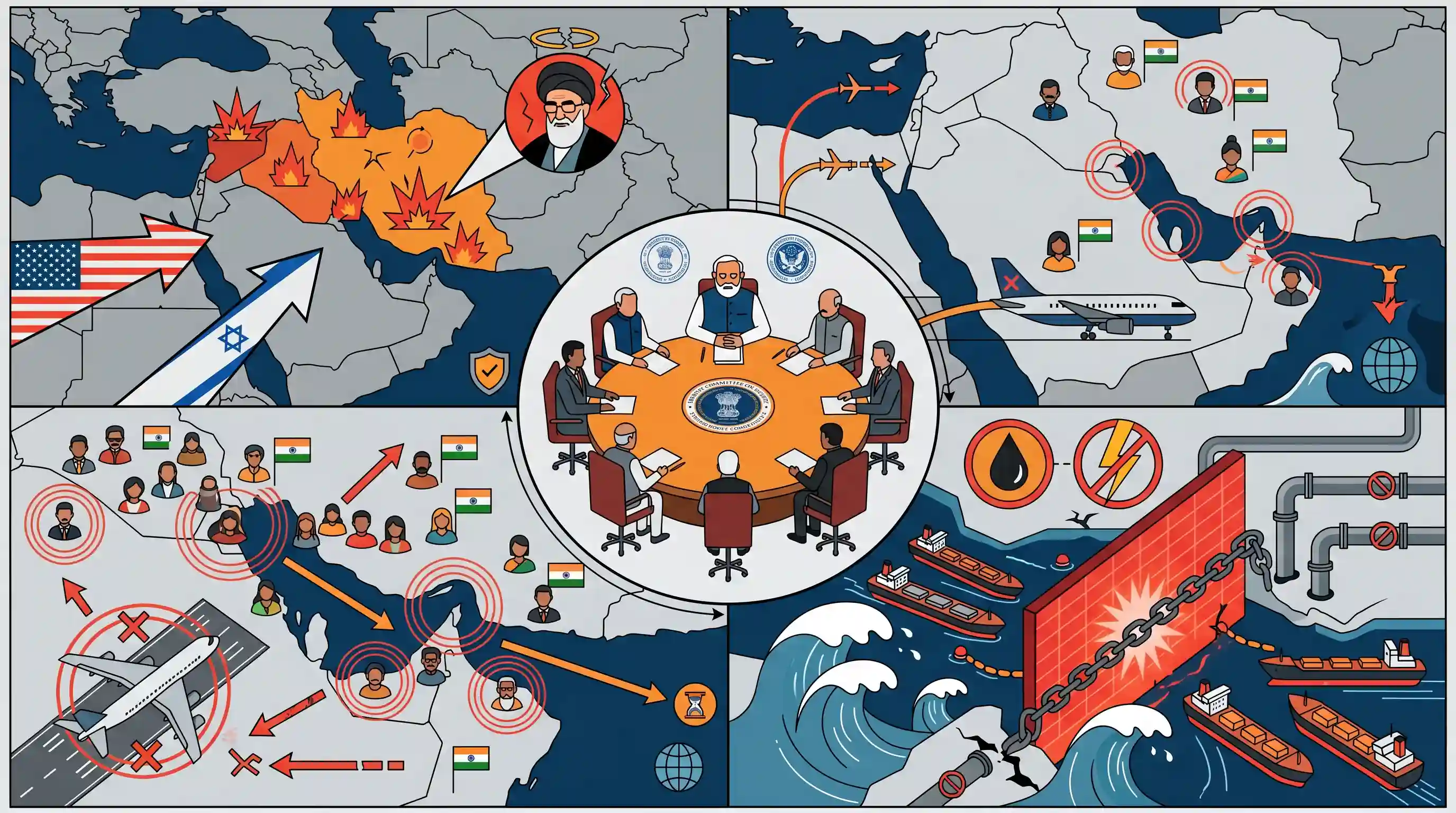
Cabinet Committee on Security review on West Asia crisis
Source:The Hindu ↗
Why It Matters
The West Asian region is critical to India for three primary reasons: energy security, the safety of a massive diaspora, and substantial remittances. The disruption of the Strait of Hormuz and the broader Iran-Israel conflict test India's strategic autonomy and crisis management capabilities, making it a highly probable topic for both Prelims (geography/mapping) and Mains (IR/energy security).
Summary
Prime Minister Narendra Modi convened a meeting of the Cabinet Committee on Security (CCS) following severe escalation in West Asia, initiated by US-Israel strikes that resulted in the death of Iran's Supreme Leader, Ayatollah Ali Khamenei. The emergency meeting addressed crucial national security implications, particularly the safety of approximately nine million Indian nationals across the Gulf and West Asia amidst widespread airspace closures and disrupted flights. Furthermore, the committee evaluated the significant threat to India's energy security stemming from Iran's closure of the Strait of Hormuz, a vital chokepoint for global oil shipments.
Key Points
- PM Modi chaired a Cabinet Committee on Security (CCS) meeting in response to the fresh Iran-Israel conflict triggered by US-Israel strikes that killed Iranian Supreme Leader Ayatollah Ali Khamenei.
- The safety and potential evacuation of the vast Indian diaspora—over nine million living in the Gulf and West Asia—was a primary focus amidst severe airspace closures.
- Iran's closure of the Strait of Hormuz, a critical chokepoint for Indian oil carriers, raises immense risks for India's energy security and global oil shipping.
- The rapid escalation involving the U.S. and Israel introduces deep geopolitical volatility, forcing India to balance strategic partnerships while securing its citizens and energy lifelines.
Important Terms
Cabinet Committee on Security (CCS)

The apex decision-making body on India's national security, defense, and strategic affairs. Chaired by the Prime Minister, it includes the Ministers of Defence, Home Affairs, Finance, and External Affairs.
UPSC context
GS Paper II (Executive) and GS III (Security). Tests knowledge of India's highest security governance and crisis-management mechanisms.
Strait of Hormuz
A strategic maritime chokepoint connecting the Persian Gulf and the Gulf of Oman. It handles roughly 20% of global oil and 35% of global liquefied natural gas (LNG) trade.
UPSC context
GS Paper I (Geography) and GS II (IR). Tests understanding of global maritime trade routes and geopolitical vulnerabilities.
Energy Security
The uninterrupted availability of energy sources at an affordable price. It is critical for India, which imports approximately 85% of its crude oil requirements.
UPSC context
GS Paper III (Infrastructure/Energy). Focuses on resource management, strategic autonomy, and economic stability amidst global supply chain disruptions.
Indian Diaspora
Non-resident Indians (NRIs) and Persons of Indian Origin (PIOs) living abroad. In West Asia, this group numbers roughly 9 million and is India's largest source of remittances.
UPSC context
GS Paper II (International Relations). Tests knowledge of the diaspora's role in foreign policy, remittances, and citizen safety during regional conflicts.
Ministry of External Affairs (MEA)
The government department responsible for India's foreign relations, diplomatic missions, and citizen welfare abroad. It coordinates evacuations and international policy during global crises.
UPSC context
GS Paper II (Governance/IR). Tests the role of executive ministries in implementing foreign policy and managing international strategic interests.
Prelims Trap
"The National Security Advisor (NSA) is an ex-officio member of the Cabinet Committee on Security (CCS)."
The CCS is strictly a ministerial body. It consists only of the Prime Minister and the Ministers of Defence, Home, Finance, and External Affairs. The NSA advises but is not a member.
Static Concepts Connected
What is the composition and mandate of the Cabinet Committee on Security (CCS)?
- Composition: Chaired by the Prime Minister, with the Ministers of Home Affairs, Defence, Finance, and External Affairs as its regular members.
- Mandate: It is the apex executive body responsible for all critical decisions regarding national security, defense expenditure, internal security, and strategic foreign policy.
Why is the Strait of Hormuz critical to global geography and trade?
- Geographic Location: It is a narrow maritime chokepoint situated between Iran to the north and Oman (Musandam Peninsula) to the south.
- Waterways Connected: It serves as the sole sea passage connecting the oil-rich Persian Gulf to the Gulf of Oman and the Arabian Sea.
- Energy Security: Crucial for India, as a significant portion of its heavy crude oil import dependency (almost 90% overall) flows directly through this vulnerable strait.
Cross-Topic Patterns
Gulf remittances and Current Account Deficit
The Gulf diaspora accounts for roughly 40% of India's inward remittances, serving as a vital macroeconomic shock absorber for India's Current Account Deficit during global energy crises.
Strategic De-hyphenation in West Asia
India balances its geopolitical standing by separating strategic defense and tech relations with Israel/US from its crucial energy and connectivity imperatives with Iran (e.g., Chabahar Port) and Arab states.

Expect a 2026 prelims map question pairing West Asian chokepoints (Hormuz, Bab-el-Mandeb) with bordering countries and water bodies.
Linked PYQs · 5
Linked PYQs · 5
- 2025MainsGS2
"Energy security constitutes the dominant kingpin of India's foreign policy, and is linked with India's overarching influence in Middle Eastern countries.” How would you integrate energy security with India's foreign policy trajectories in the coming years?
- 2017MainsGS2
The question of India's Energy Security constitutes the most important part of India's economic progress. Analyze India's energy policy cooperation with West Asian countries.
- 2018MainsGS2
“India’s relations with Israel have, of late, acquired a depth and diversity, which cannot be rolled back.” Discuss.
- 2024PrelimsGS1
Consider the following statements : Statement-I : Sumed pipeline is a strategic route for Persian Gulf oil and natural gas shipments to Europe. Statement-II : Sumed pipeline connects the Red Sea with the Mediterranean Sea. Which one of the following is correct in respect of the above statements?
- 2024PrelimsGS1
What are the duties of the Chief of Defence Staff (CDS) as Head of the Department of Military Affairs? 1. Permanent Chairman of Chiefs of Staff Committee 2. Exercise military command over the three Service Chiefs 3. Principal Military Advisor to Defence Minister on all tri-service matters Select the correct answer using the code given below:
