India Oman Strategic Relations and Maritime Security Partnerships
Source:Indian Express ↗
Why It Matters
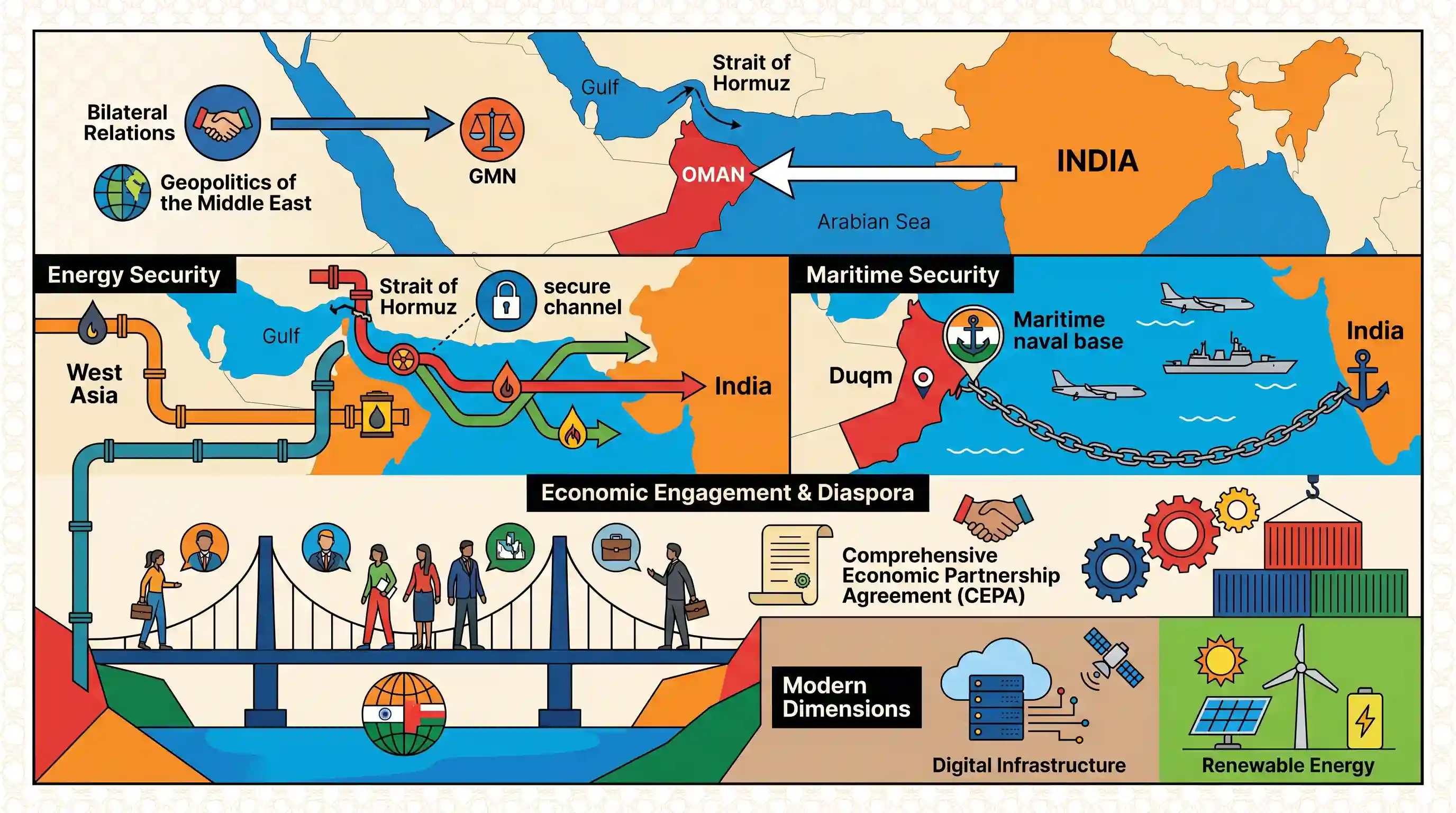
Oman represents a crucial nexus for India's foreign policy in the Middle East due to its strategic geography, reliable energy partnership, and military access. Understanding this dynamic is important for questions on India's 'Link West' policy, maritime security in the Indian Ocean, and securing energy supply chains.
Summary
The article highlights the strategic depth of India-Oman bilateral relations, emphasizing Oman's role as a critical partner in the Gulf region. Oman's geographic location near the Strait of Hormuz makes it pivotal for India's energy and maritime security. The alliance encompasses strong defense cooperation, notably Indian naval access to the Port of Duqm, vast diaspora connections, and growing economic engagements like the anticipated Comprehensive Economic Partnership Agreement (CEPA). The evolving partnership is increasingly integrating modern dimensions such as digital infrastructure and renewable energy, thereby reinforcing India's broader geopolitical footprint in West Asia.
Key Points
- Oman is one of India's oldest strategic partners in the Gulf, functioning as a vital pillar for India's West Asia outreach.
- Oman's geostrategic location near the Strait of Hormuz is critical for securing India's energy imports and maritime supply routes.
- Defense cooperation is a cornerstone of the relationship, highlighted by India's access to the Port of Duqm, which bolsters its naval presence in the western Indian Ocean.
- Economic and people-to-people ties are robust, driven by a large Indian diaspora and ongoing negotiations for a Comprehensive Economic Partnership Agreement (CEPA).
- The partnership is expanding into contemporary domains such as space exploration, renewable energy, and digital public infrastructure (UPI/RuPay).
Important Terms
Comprehensive Economic Partnership Agreement (CEPA)

A wide-ranging trade agreement covering goods, services, and investments. India's anticipated CEPA with Oman aims to provide duty-free market access and enhance labor mobility for Indian professionals.
UPSC context
GS Paper-II (International Relations) & GS Paper-III (Economy); tests bilateral trade frameworks and India's 'Connect West' policy.
Gulf Cooperation Council (GCC)
A regional union of six Arab states: Saudi Arabia, UAE, Qatar, Kuwait, Oman, and Bahrain. It is India's largest trading partner bloc and a key source of energy and remittances.
UPSC context
GS Paper-II (International Relations); critical for West Asian geopolitics, energy diplomacy, and diaspora welfare.
Port of Duqm
A strategic deep-water port on Oman's southeastern coast. India has secured naval access and a specific economic zone here to project influence and secure maritime trade routes.
UPSC context
GS Paper-II (Strategic Interests); relevant to India's maritime strategy and countering regional influence (e.g., China's String of Pearls).
Strait of Hormuz
A critical maritime chokepoint between Oman and Iran. Roughly 20% of global oil and nearly half of India's crude oil imports pass through this narrow waterway.
UPSC context
GS Paper-I (Geography) & GS Paper-II (Security); tests knowledge of global maritime chokepoints and energy transit risks.
SAGAR (Security and Growth for All in the Region)
India's strategic vision for the Indian Ocean, focusing on cooperative maritime security, economic growth, and regional stability through partnerships with littoral states like Oman.
UPSC context
GS Paper-II (Foreign Policy); central to India's role as a 'net security provider' in the IOR.
Energy Security
Ensuring the uninterrupted availability of energy at an affordable price. In the India-Oman context, it involves securing maritime lanes and diversifying energy sources in the Gulf.
UPSC context
GS Paper-III (Economy/Infrastructure); a core strategic objective involving external dependencies and domestic resilience.
Prelims Trap
Oman controls the Bab-el-Mandeb strait and is India's first CEPA partner in the Middle East.
Oman controls the Strait of Hormuz, not the Bab-el-Mandeb (controlled by Yemen/Djibouti). Additionally, the UAE, not Oman, was India's first CEPA partner in the region.
Static Concepts Connected
What are the critical maritime chokepoints in the Middle East region?
- Strait of Hormuz: A 33-km wide maritime passage connecting the Persian Gulf to the Gulf of Oman; shared and controlled by Oman and Iran.
- Bab-el-Mandeb: Connects the Red Sea to the Gulf of Aden and Arabian Sea; bordered by Yemen on the Arabian Peninsula, and Djibouti and Eritrea in Africa.
- Suez Canal: An artificial sea-level waterway in Egypt connecting the Mediterranean Sea to the Red Sea, enabling direct shipping between Europe and Asia.
How does a CEPA differ from a standard Free Trade Agreement (FTA)?
- Broader Scope: While FTAs largely focus on reducing tariffs on goods, a CEPA comprehensively covers trade in goods, services, investments, and broad economic partnership.
- Regulatory Alignment: CEPAs typically entail deeper bilateral integration, including customs cooperation, mutual recognition of standards, and intellectual property rights (IPR) protections.
Cross-Topic Patterns
Port of Duqm & Maritime Counter-Strategy
India's naval access to Oman's Port of Duqm serves as a direct strategic counterweight to China's presence in Gwadar (Pakistan) and Djibouti, securing vital sea lines in the Western Indian Ocean.
DPI Export as Soft Power
Integrating UPI and RuPay in Oman mirrors India's recent digital agreements with Singapore, UAE, and France, cementing Digital Public Infrastructure (DPI) as a core pillar of India's contemporary foreign policy.

Expect a multi-statement Prelims question mapping Middle East ports (Duqm, Chabahar) against adjacent chokepoints (Hormuz).
Linked PYQs · 2
Linked PYQs · 2
- 2025MainsGS2
"Energy security constitutes the dominant kingpin of India's foreign policy, and is linked with India's overarching influence in Middle Eastern countries.” How would you integrate energy security with India's foreign policy trajectories in the coming years?
- 2017MainsGS2
The question of India's Energy Security constitutes the most important part of India's economic progress. Analyze India's energy policy cooperation with West Asian countries.
