Political Push for Restoration of Statehood in Jammu and Kashmir
Source:The Hindu ↗
Why It Matters
The debate over J&K's Statehood touches upon core constitutional concepts such as federalism, the rights of elected regional governments vis-a-vis the Union, and the legal evolution of Jammu & Kashmir's status post-2019. For UPSC, this is a prime example of asymmetric federalism, Union Territory administration dynamics, and the operational reality of the J&K Reorganisation Act, 2019.
Summary
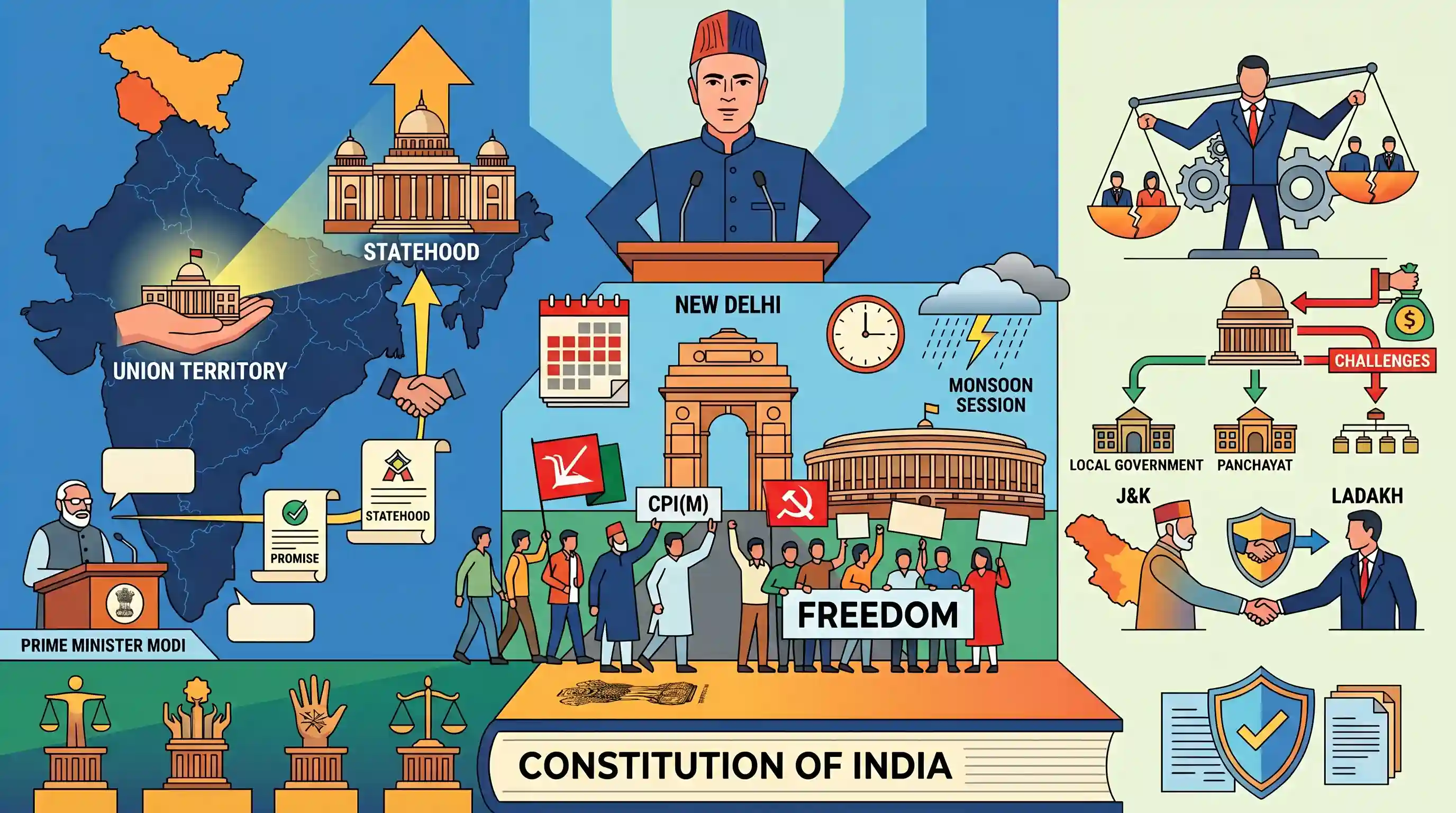
Jammu and Kashmir Chief Minister Omar Abdullah is leading a political push to hold the Union Government accountable to its promise of restoring J&K's Statehood. Pointing to Prime Minister Narendra Modi's public campaign commitments, Abdullah argued that assurances from the highest office must translate into concrete action. To press this demand, the ruling National Conference (NC), with the backing of the CPI(M), has organized a protest in New Delhi on July 20, 2026, to coincide with the start of Parliament's Monsoon Session. The protest highlights the federal and constitutional tension in J&K, where an assembly was democratically elected in late 2024 but continues to operate under the constrained executive framework of a Union Territory, contrasting with the Centre's willingness to discuss Article 371-style safeguards for neighboring Ladakh.
Key Points
- Jammu and Kashmir Chief Minister Omar Abdullah has urged that Prime Minister Narendra Modi's repeated promise to restore J&K's Statehood (often referred to as 'Modi's promise') must carry weight and be followed by legislative action rather than being indefinitely delayed.
- The ruling National Conference (NC), supported by the CPI(M), has announced a major sit-in protest at New Delhi's Jantar Mantar on July 20, 2026, coinciding with the opening day of the Monsoon Session of Parliament, to demand the restoration of full Statehood and constitutional guarantees.
- Omar Abdullah highlighted an apparent asymmetry in the Centre's treatment: while the Union Government has engaged in dialogue and considered Article 371 safeguards for Ladakh following protests, the democratic mandate of J&K's elected government remains constrained under Union Territory status.
- The CPI(M) backed the protest, describing the August 5, 2019 decision to abrogate Articles 370 and 35-A without consulting local stakeholders as an 'unprecedented assault' that continues to fuel widespread public discontent and disillusionment.
- Following the 2019 reorganization, J&K became a Union Territory with a legislature; elections were held in late 2024, bringing the NC to power, but the elected government operates with diminished powers compared to a full state.
Important Terms
Jammu and Kashmir Reorganisation Act, 2019

An Act of the Parliament of India that bifurcated the state of Jammu and Kashmir into two Union Territories—Jammu & Kashmir and Ladakh—and revoked its special status.
UPSC context
GS Paper II: Functions and responsibilities of the Union and States, federal structure, and legislative changes impacting regional administration.
Article 370
A temporary constitutional provision that granted special autonomous status to Jammu and Kashmir, allowing it to have its own constitution, flag, and internal administrative autonomy until 2019.
UPSC context
GS Paper II: Indian Constitution—historical evolution, federalism, significant provisions, and the constitutional integration of states.
Article 35-A
A provision introduced in 1954 via Presidential Order that empowered the Jammu and Kashmir legislature to define permanent residents and grant them exclusive rights in property, employment, and scholarships.
UPSC context
GS Paper II: Fundamental rights, special constitutional provisions, gender bias debates, and federal dynamics prior to its 2019 repeal.
Article 371
A set of constitutional provisions (Articles 371 to 371-J) that grant special powers, safeguards, and administrative privileges to specific states, reflecting India's model of asymmetric federalism.
UPSC context
GS Paper II: Asymmetric federalism, accommodating regional aspirations, protecting cultural identities, and constitutional safeguards for backward regions.
Jammu & Kashmir National Conference
A major regional political party in Jammu and Kashmir, founded in 1932 by Sheikh Muhammad Abdullah, historically advocating for the state's autonomy and restoration of statehood.
UPSC context
GS Paper II: Regional political parties, their role in federalism, coalition politics, and expressing regional and democratic aspirations in India.
Prelims Trap
The Legislative Assembly of the Union Territory of Jammu and Kashmir, like that of Delhi, lacks legislative power over 'Land'.
Under Section 32 of the Jammu and Kashmir Reorganisation Act, 2019, the J&K Assembly retains power over 'Land' (State List Entry 18). It is only barred from 'Police' and 'Public Order', unlike Delhi's Assembly which is barred from all three.
Static Concepts Connected
Can Parliament convert a State into a Union Territory under Article 3?
- Article 3 scope: Allows Parliament to form new States, alter areas, boundaries, or names, but does not explicitly mention converting an entire State into a UT.
- SC 2023 view: In its 2023 verdict, the Supreme Court left this broad constitutional question open, relying instead on the Centre's assurance of restoring J&K's statehood.
How do legislative powers of Delhi and Jammu & Kashmir Union Territories differ?
- Delhi limitations: Article 239AA explicitly debars Delhi from legislating on Public Order, Police, and Land (Entries 1, 2, and 18 of the State List).
- J&K scope: Under the 2019 Reorganisation Act, J&K is modeled on Puducherry (Art 239A), excluding only Police and Public Order, meaning it retains power over Land.
Cross-Topic Patterns
Asymmetric federalism and Article 371
The contrast between J&K's UT status and potential Article 371 safeguards for Ladakh highlights India's asymmetric federal structure, balancing national security concerns with local ethno-cultural aspirations.
Executive-legislative friction in UTs
The tussle over the Lieutenant Governor's expanded administrative powers in J&K mirrors executive-legislative conflicts in Delhi, testing constitutional boundaries of representative governance.

Article 3 limits on downgrading states to UTs and legislative differences between Delhi and J&K UTs will likely be tested in 2026.
Linked PYQs · 3
Linked PYQs · 3
- 2025MainsGS2
Discuss the nature of Jammu and Kashmir Legislative Assembly after the Jammu and Kashmir Reorganization Act, 2019. Briefly describe the powers and functions of the Assembly of the Union Territory of Jammu and Kashmir.
- 2016MainsGS2
To what extent is Article 370 of the Indian Constitution, bearing marginal note "Temporary provision with respect to the State of Jammu and Kashmir", temporary? Discuss the future prospects of this provision in the context of Indian polity.
- 2022MainsGS2
“While the national political parties in India favour centralisation, the regional parties are in favour of State autonomy.” Comment.
