Remote Work Mandates and Urban Commuting Crisis in India
Source:Indian Express ↗
Why It Matters
Provides essential contemporary arguments for Mains answers concerning the transition to a digital/gig economy, managing the demographic dividend (Gen Z workforce), mitigating urban infrastructure bottlenecks, and evolving corporate ethics toward trust-based management.
Summary
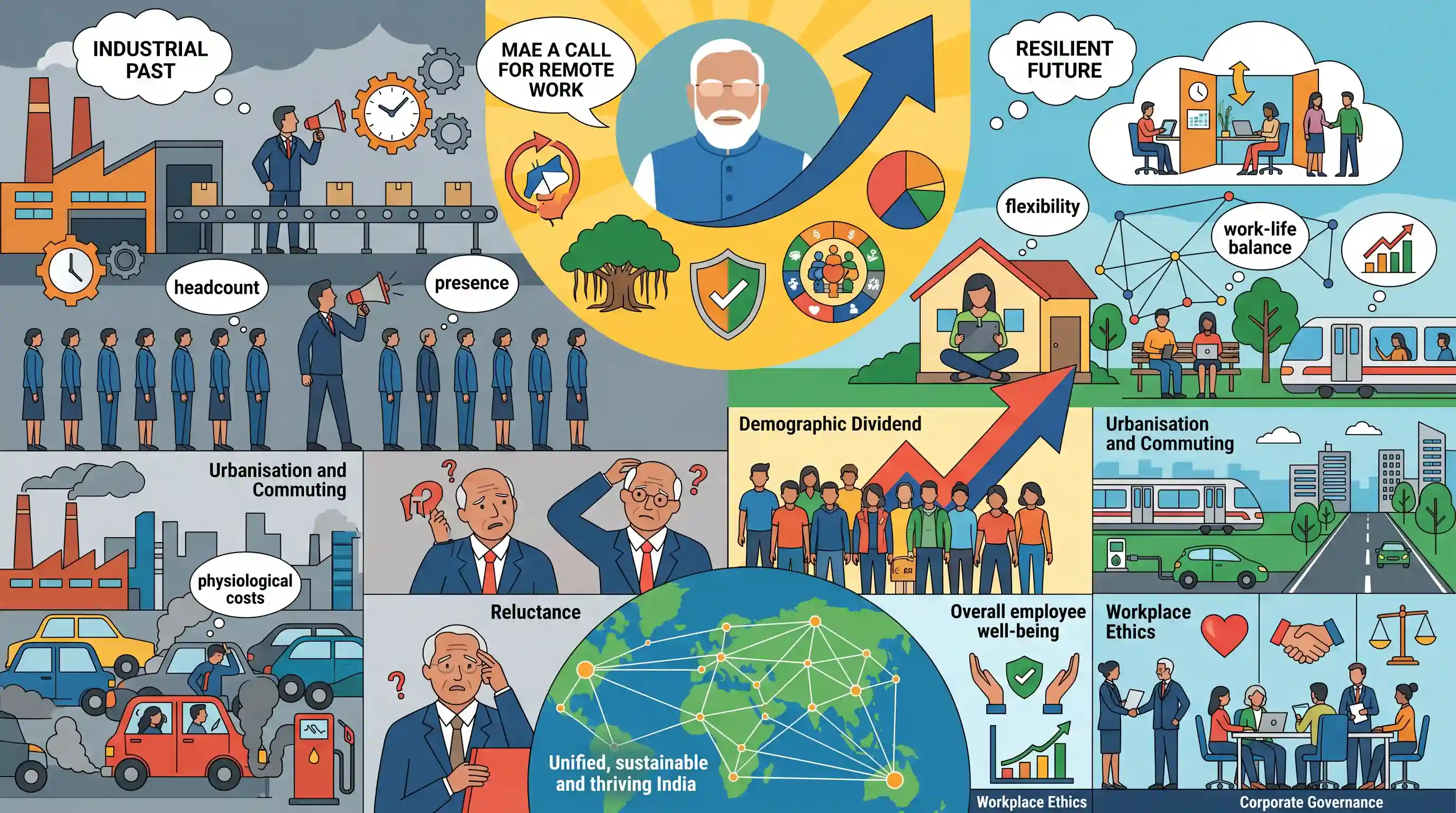
The article analyzes PM Narendra Modi's call to embrace remote work for national resilience, contrasting this with corporate India's reluctance to move past industrial-era management models. While the Indian economy thrives on digital transformation, workplace practices often continue to rely on physical presence and headcount to measure productivity. This rigid approach clashes with the expectations of the younger Gen Z workforce, who value flexibility and work-life balance. Furthermore, adopting widespread work-from-home policies could alleviate the severe economic and physiological costs of urban commuting, reducing congestion and fuel consumption while enhancing overall employee well-being.
Key Points
- Prime Minister Narendra Modi recently endorsed remote work to bolster national resilience in the face of geopolitical and energy uncertainties.
- Despite India's digital advancement, many corporate leaders and HR systems remain trapped in an industrial-era mindset that equates productivity with physical visibility and strict office attendance.
- Gen Z employees increasingly prioritize flexibility, work-life balance, and mental health, causing friction with traditional senior management approaches that view these expectations as psychological fragility.
- Extensive urban commuting in India imposes severe physiological stress and economic costs, including lost productivity and heavy fuel consumption.
- Embracing flexible and distributed work models can ease the burden on urban transport infrastructure, lower fuel demand, and significantly improve employee well-being.
Prelims Trap
The new Labour Codes provide a statutory right to Work From Home for service sector employees.
While draft rules acknowledge WFH, it is merely an enabling provision requiring employer agreement. There is no legal "right" to remote work.
Static Concepts Connected
What provisions exist for Work From Home in the new Labour Codes?
- Draft Standing Orders: The draft Model Standing Orders for the Services Sector recognize WFH, but only as an enabling provision.
- Mutual Agreement: It requires the consent of the employer and is bound by conditions of appointment, rather than being an absolute employee right.
- No Statutory Right: Neither the Industrial Relations Code nor the OSHW Code grants a legal 'right to WFH' to Indian workers.
What are the macroeconomic costs of urban congestion in India?
- Inflated Import Bill: Idling in traffic increases fossil fuel consumption, directly inflating India's crude oil import bill and widening the Current Account Deficit.
- Productivity Erosion: Severe traffic in metropolitan hubs erodes millions of productive man-hours daily, reducing gross economic output and worker efficiency.
- Health & Capital Loss: Long commutes induce physiological stress, leading to higher healthcare costs and reduced labor force participation over time.
Cross-Topic Patterns
Energy Security via Urban Planning
WFH is not just an HR issue; it acts as a macroeconomic tool to lower urban fuel demand, thereby easing pressure on India's current account deficit and forex reserves.
Demographic Dividend vs Labour Laws
India's demographic dividend (Gen-Z influx) is clashing with industrial-era labour governance, highlighting an urgent need to evolve corporate ethics and mental health frameworks under GS-4.

Expect a GS-3 Mains question connecting urban transport congestion directly to India's energy security and productivity loss.
Linked PYQs · 5
Linked PYQs · 5
- 2022MainsGS1
Explore and evaluate the impact of 'Work From Home' on family relationships.
- 2025MainsGS4
It is said that for an ethical work culture, there must be code of ethics in place in every organisation. To ensure value-based and compliance-based work culture, what suitable measures would you adopt in your work place?
- 2019MainsGS1
How is efficient and affordable urban mass transport key to the rapid economic development of India?
- 2022MainsGS3
Economic growth in the recent past has been led by increase in labour productivity." Explain this statement. Suggest the growth pattern that will lead to creation of more jobs without compromising labour productivity.
- 2014MainsGS3
While we flaunt India's demographic dividend, we ignore the dropping rates of employability. What are we missing while doing so? Where will the jobs that India desperately needs come from? Explain.
