Central Welfare Schemes Transform Lives Across the Nation
Source:canontimes ↗
Why It Matters
This topic is vital for UKPSC PCS Prelims as it covers central welfare schemes, their socioeconomic impact, and implementation metrics. Furthermore, it directly connects to the indicators of the National Multidimensional Poverty Index (MPI) measured by NITI Aayog (such as cooking fuel, drinking water, sanitation, and bank accounts), which are recurring themes in state civil services examinations.
Summary
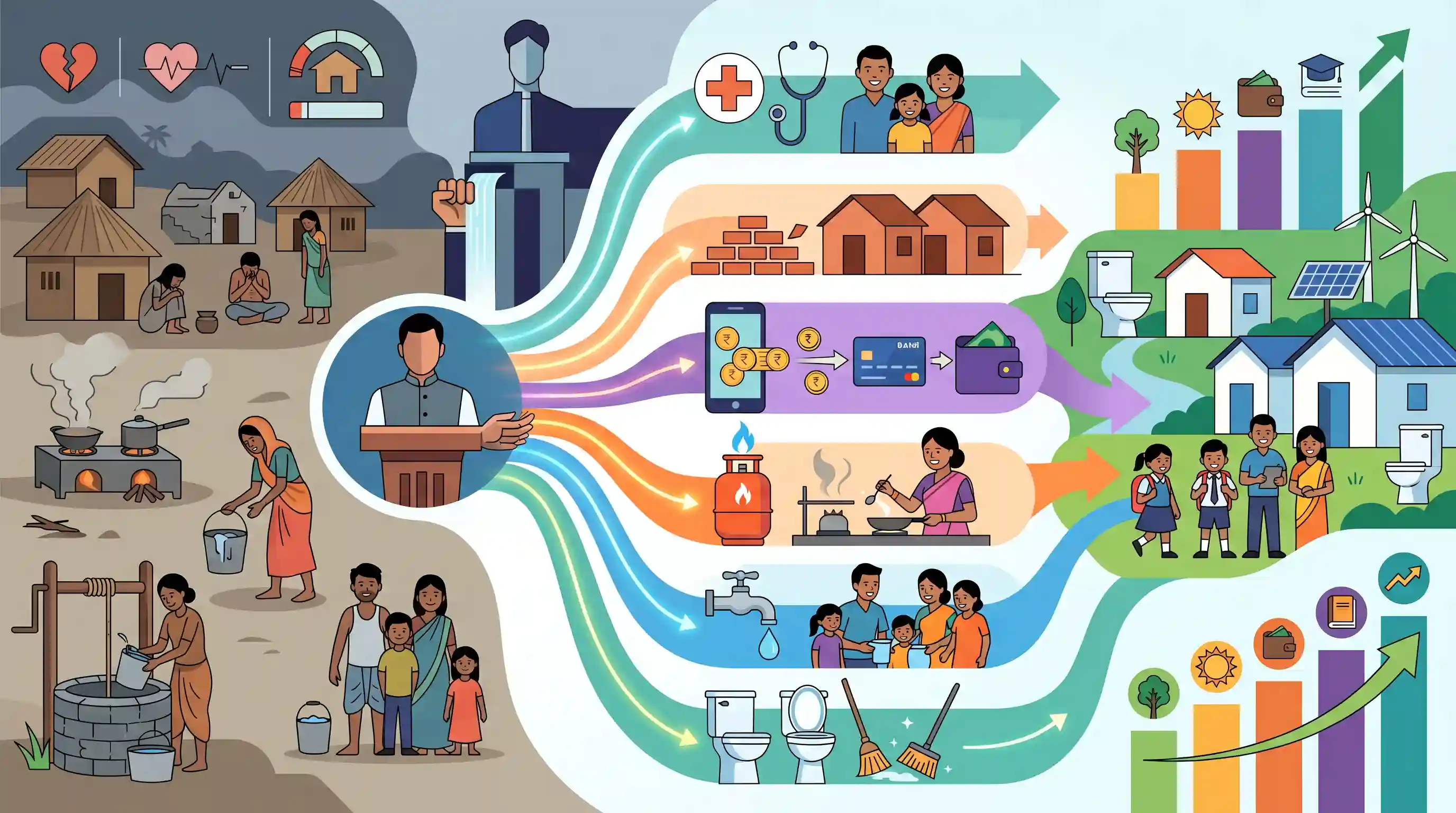
Uttarakhand Chief Minister Pushkar Singh Dhami lauded the central welfare schemes initiated under Prime Minister Narendra Modi's leadership, emphasizing their role in reshaping India's welfare landscape. According to CM Dhami, flagship initiatives like Ayushman Bharat, PM Awas Yojana, PM Jan Dhan Yojana, PM Ujjwala Yojana, Jal Jeevan Mission, and Swachh Bharat Mission have built a governance model focused on dignity, inclusion, and direct benefit delivery, transforming millions of lives in both rural and urban areas.
Key Points
- Uttarakhand Chief Minister Pushkar Singh Dhami highlighted the transformative impact of PM Narendra Modi's flagship welfare schemes across India.
- Key schemes mentioned include Ayushman Bharat, PM Awas Yojana (PMAY), Pradhan Mantri Ujjwala Yojana (PMUY), Pradhan Mantri Jan Dhan Yojana (PMJDY), Jal Jeevan Mission (JJM), and Swachh Bharat Mission (SBM).
- CM Dhami emphasized that these schemes have improved governance through direct benefit delivery, financial inclusion, health security, permanent housing, clean cooking fuel, tap water, and sanitation.
- These social initiatives are designed to foster dignity and inclusion, acting as critical pillars for India's social progress and the elimination of multidimensional poverty.
- The remarks underscore the alignment of the Uttarakhand state administration with the Central government's welfare-led developmental agenda.
Important Terms
Ayushman Bharat (Pradhan Mantri Jan Arogya Yojana)

A national public health insurance scheme launched in 2018 providing up to ₹5 lakh per family annually for secondary and tertiary hospitalized care to low-income and vulnerable households.
UPSC context
GS Paper II: Social Justice/Health. Tests knowledge of public health infrastructure, social security schemes, and out-of-pocket health expenditure mitigation.
Pradhan Mantri Awas Yojana (PMAY)
A flagship housing initiative launched in 2015 to provide affordable, pucca housing with basic amenities to urban and rural poor, striving to achieve "Housing for All" across India.
UPSC context
GS Paper II: Social Justice/Welfare Schemes. Tests understanding of urban-rural development, housing security, and multi-sectoral convergence models.
Pradhan Mantri Jan Dhan Yojana (PMJDY)
A national financial inclusion mission launched in 2014, providing unbanked citizens access to basic savings accounts with zero minimum balance, RuPay debit cards, and credit or insurance facilities.
UPSC context
GS Paper III: Economic Development/Financial Inclusion. Evaluates direct benefit transfer mechanics, banking accessibility, and economic empowerment of marginalized populations.
Jal Jeevan Mission (JJM)
A Ministry of Jal Shakti initiative launched in 2019 to provide safe, potable drinking water through Functional Household Tap Connections (FHTCs) to all rural households under "Har Ghar Jal."
UPSC context
GS Paper II: Governance/Welfare Schemes. Tests familiarity with rural water security, decentralization, community-led infrastructure management, and public hygiene.
Swachh Bharat Mission (SBM)
A nationwide sanitation campaign launched on October 2, 2014, aimed at eliminating open defecation, improving solid and liquid waste management, and encouraging behavioral change to achieve clean, ODF communities.
UPSC context
GS Paper II: Governance/Health. Assesses knowledge of sanitation policies, public health linkages, behavioral interventions, and sustainable waste management strategies.
Pradhan Mantri Ujjwala Yojana (PMUY)
A flagship social welfare scheme launched in 2016 to distribute deposit-free LPG connections to women from below-poverty-line families, replacing hazardous traditional cooking fuels with clean energy.
UPSC context
GS Paper II: Social Justice/Welfare. Tests understanding of clean energy access, health impacts of indoor air pollution, and gender-sensitive development interventions.
NITI Aayog
Established in 2015 to replace the Planning Commission, it acts as the premier policy think tank of the Indian Government, promoting cooperative federalism and bottom-up economic policymaking.
UPSC context
GS Paper II: Constitutional/Statutory Bodies & Governance. Tests knowledge of cooperative federalism, development planning transitions, and index-based monitoring frameworks.
Prelims Trap
The global Multidimensional Poverty Index (MPI) includes 'Bank Account' and 'Maternal Health' as core indicators under its standard of living dimension.
These two indicators are unique to NITI Aayog’s National MPI to reflect Indian policy realities; they do not exist in the global MPI developed by UNDP and OPHI.
Static Concepts Connected
How does the National Multidimensional Poverty Index (MPI) differ from the Global MPI?
- Indicator Count: The National MPI features 12 indicators across three dimensions, whereas the global MPI has only 10.
- Unique Additions: NITI Aayog added 'Maternal Health' (Health dimension) and 'Bank Account' (Standard of Living dimension) to align with Indian policy realities.
- Nodal Agency: NITI Aayog is the nodal agency for the National MPI, which relies on National Family Health Survey (NFHS) datasets.
What are the structural differences between Central Sector and Centrally Sponsored Schemes (CSS)?
- Funding Split: Central Sector Schemes are 100% funded by the Union; CSS are jointly funded by the Centre and States (e.g., 60:40 or 90:10).
- Implementation Agency: Central Sector Schemes are implemented directly by central ministries; CSS are implemented by state government machinery.
- Syllabus Domain: CSS usually target subjects under the State or Concurrent Lists to achieve national development priorities cooperatively.
Cross-Topic Patterns
Welfare indicators + Fiscal Devolution
State improvements in standard of living indicators (sanitation, water) directly influence NITI Aayog performance rankings and performance-linked grants under Finance Commission frameworks.
DBT + Informal Sector Formalization
PMJDY and the JAM trinity act as fiscal rails, transitioning rural informal credit dependencies to formal banking channels and improving monetary policy transmission.

Expect a 2026 question contrasting the 12 indicators of National MPI against CSS funding splits for mountain states under Jal Jeevan.
Linked PYQs · 3
Linked PYQs · 3
- 2025UKPSC_PRELIMSGS1
Which of the following is not an indicator for the dimension of Standard of Living in India's National Multidimensional Poverty Index?
- 2024UKPSC_PRELIMSGS1
'Pradhan Mantri Kisan Samman Nidhi' (PM-KISAN) Yojana came into effect from :
- 2025UKPSC_PRELIMSGS1
Arrange the following social welfare schemes in chronological order: i. Integrated Rural Development Programme (IRDP) ii. Rural Employment Generation Programme (REGP) iii. Prime Minister Rojgar Yojana (PMRY) iv. Rural Landless Employment Guarantee Programme (RLEGP)
