India and Malaysia elevate ties to comprehensive strategic partnership
Source:The Hindu ↗
Why It Matters
Demonstrates the practical application of India's 'Act East Policy' and its strategy to build multi-dimensional partnerships (economic, strategic, tech, and security) with key ASEAN nations. It also highlights ongoing efforts toward de-dollarisation via local currency trade and strengthening consensus on counter-terrorism.
Summary
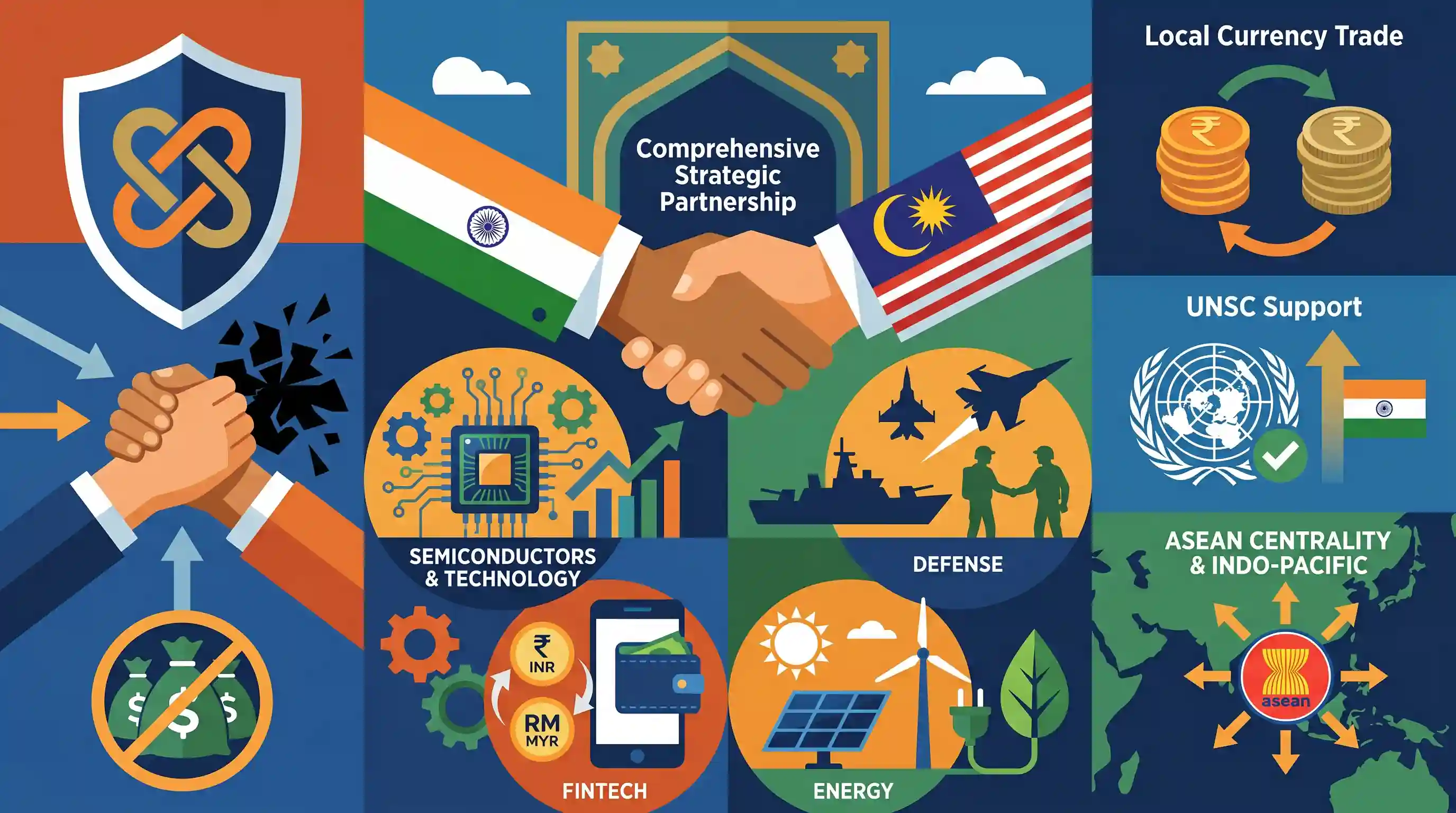
Prime Minister Narendra Modi's visit to Malaysia culminated in the elevation of India-Malaysia ties to a Comprehensive Strategic Partnership. The visit focused on expanding cooperation across strategic sectors such as semiconductors, defense, fintech, and energy. Both nations took a firm stance against terrorism, advocating for zero tolerance and coordinated action against terror financing. Significantly, the talks also highlighted the promotion of trade in local currencies, Malaysian support for India's permanent membership in a reformed UN Security Council, and a shared commitment to ASEAN centrality in the Indo-Pacific region.
Key Points
- India and Malaysia elevated their bilateral relationship to a 'Comprehensive Strategic Partnership'.
- Agreed to promote bilateral trade settlements in local currencies (Indian Rupee and Malaysian Ringgit).
- Emphasised a 'zero tolerance' policy towards terrorism, strongly condemning double standards and calling for robust action against terror financing.
- Malaysia reiterated its support for India's inclusion as a permanent member in a reformed UN Security Council.
- Prioritised expansion in high-tech sectors including semiconductors, fintech (UPI), defence, and advanced manufacturing.
- Reaffirmed support for ASEAN centrality and a free, open, and inclusive Indo-Pacific region.
Important Terms
Comprehensive Strategic Partnership

High-level bilateral framework upgraded in 2024, expanding the 2015 Enhanced Strategic Partnership to include semiconductors, fintech, and digital economy alongside traditional defense and trade.
UPSC context
GS Paper 2: Bilateral Relations. Tests understanding of diplomatic tiers and strategic shifts in India's regional engagement.
Act East Policy
India's 2014 diplomatic evolution of the 'Look East Policy,' prioritizing active economic, cultural, and security engagement with Southeast Asia and the wider Indo-Pacific.
UPSC context
GS Paper 2: Foreign Policy. Essential for questions on regional connectivity and India's 'Look East' vs 'Act East' transitions.
ASEAN
A 10-member regional organization promoting political and economic stability in Southeast Asia. It serves as the institutional core of India's engagement in the Indo-Pacific.
UPSC context
GS Paper 2: Regional Groupings. Focuses on regional architecture and India's role in Southeast Asian diplomacy.
UN Security Council (UNSC)
One of the six principal UN organs responsible for international peace. India seeks permanent membership to address outdated 1945-era representation.
UPSC context
GS Paper 2: International Institutions. Key for discussions on global governance reforms and India's 'Great Power' aspirations.
Local Currency Settlement
A mechanism enabling bilateral trade in Indian Rupee and Malaysian Ringgit to reduce dollar dependency, transaction costs, and exchange rate risks.
UPSC context
GS Paper 3: Indian Economy. Relevant for 'Internationalization of the Rupee' and global financial resilience.
ASEAN Centrality
The diplomatic principle that ASEAN should remain the primary architect and driver of the security and economic framework in the Indo-Pacific region.
UPSC context
GS Paper 2: International Relations. Crucial for understanding India's 'Indo-Pacific' strategy and respect for regional autonomy.
Prelims Trap
Malaysia is the first ASEAN nation to establish a Comprehensive Strategic Partnership with India.
India already has Comprehensive Strategic Partnerships with Vietnam and Indonesia, and elevated its ties with the ASEAN bloc itself to a CSP in 2022.
Static Concepts Connected
How does the Special Rupee Vostro Account (SRVA) facilitate local currency trade?
- Mechanism: Foreign banks open SRVAs with authorized Indian banks to hold balances in Indian Rupees (INR).
- Invoicing & Settlement: Bilateral exports and imports are denominated and settled in Rupees, bypassing the need for a vehicular currency like the US Dollar.
- Exchange Rate: The exchange rate between the trading partner currencies is market-determined, ensuring fair valuation without forced pegging.
What is the significance of ASEAN Centrality in India's foreign policy?
- Core Principle: It recognizes ASEAN as the primary driving force in shaping the regional economic and security architecture of the Indo-Pacific.
- Act East Pillar: ASEAN centrality is the cornerstone of India’s Act East Policy and is heavily featured in the Indo-Pacific Oceans Initiative (IPOI).
- Institutional Engagement: India operationalizes this by actively participating in ASEAN-led strategic forums like the East Asia Summit (EAS) and ADMM-Plus.
Cross-Topic Patterns
Act East meets Tech-Diplomacy
India is upgrading ASEAN ties from traditional maritime security to high-tech domains, focusing on semiconductor supply chain resilience and expanding its Digital Public Infrastructure (UPI) footprint.
Rupee Internationalization & ASEAN
Integrating the INR-MYR trade settlement mechanism mirrors India's broader macroeconomic strategy (as seen with the UAE) to internationalize the Rupee and insulate regional trade from dollar volatility.

Expect a 2026 Prelims question linking Rupee Internationalization mechanisms (Vostro accounts) directly with recent ASEAN bilateral pacts.
Linked PYQs · 3
Linked PYQs · 3
- 2016MainsGS2
Evaluate the economic and strategic dimensions of India's Look East Policy in the context of the post Cold War international scenario.
- 2020MainsGS2
What is the significance of Indo-US defence deals over Indo-Russian defence deals? Discuss with reference to stability in the Indo-Pacific region.
- 2021MainsGS3
Analyse the complexity and intensity of terrorism, its causes, linkages and obnoxious nexus. Also suggest measures required to be taken to eradicate the menace of terrorism.
