India Malaysia Strategic Pivot and Counter Terrorism Cooperation
Source:The Hindu ↗
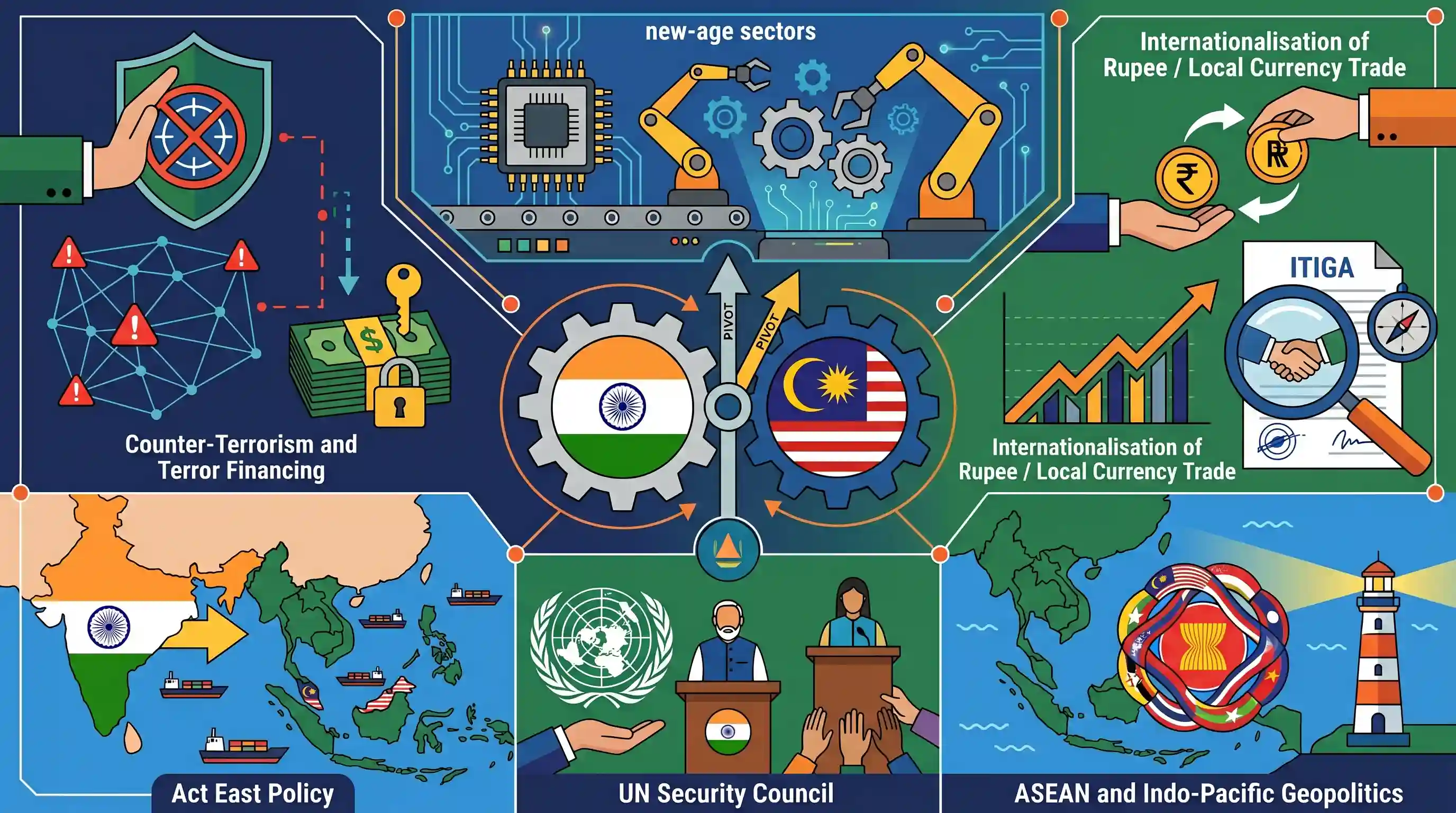
Why It Matters
The strategic elevation of India-Malaysia ties reflects India's deepening engagement with ASEAN under its Act East Policy. It holds significant implications for GS2 (International Relations) regarding Indo-Pacific stability and GS3 (Economy & Security) concerning resilient semiconductor supply chains, de-dollarisation efforts, and global counter-terrorism frameworks.
Summary
During Prime Minister Narendra Modi's visit to Malaysia, India and Malaysia agreed to a 'strategic pivot', upgrading their bilateral relationship to focus on new-age sectors such as semiconductors, digital technology, and advanced manufacturing. The leaders emphasized a firm, unified stance against terrorism, calling for zero tolerance and stronger mechanisms to combat terror financing without double standards. Economically, both countries are pushing for trade settlements in local currencies (Indian Rupee and Malaysian Ringgit) and have called for a timely review of the ASEAN-India Trade Agreement (ITIGA). The visit also reinforced India's 'Act East' policy, with Malaysia backing India's bid for a permanent seat at the UN Security Council and affirming the centrality of ASEAN in ensuring a stable Indo-Pacific region.
Key Points
- India and Malaysia have pledged to upgrade their strategic ties, expanding cooperation into areas like defence, advanced manufacturing, semiconductors, and energy.
- Both nations emphasized a 'zero tolerance' and 'no double standards' approach to terrorism, stressing the importance of combating terror financing and radicalisation.
- Economic discussions highlighted the positive momentum in settling bilateral trade in local currencies (Rupee and Ringgit) to reduce reliance on the US Dollar.
- Malaysia expressed support for India's permanent membership in a reformed UNSC and both sides reaffirmed the centrality of ASEAN in the Indo-Pacific region.
Important Terms
Act East policy

Proactive strategy launched in 2014 to deepen India’s economic, connectivity, and security ties with Southeast Asia and the Indo-Pacific. It upgrades the earlier "Look East" policy to focus on implementation and strategic stability.
UPSC context
GS Paper 2 (International Relations); tests understanding of regional diplomacy, ASEAN centrality, and the strategic importance of Northeast India as a gateway to Asia.
ASEAN
A 10-member regional organization promoting economic, security, and socio-cultural cooperation in Southeast Asia. Established in 1967, it remains the "central pillar" of India's Act East Policy and regional stability.
UPSC context
GS Paper 2 (International Relations/Bilateral Groupings); tests knowledge of regional architecture and India’s strategic convergence with Southeast Asian nations.
ASEAN-India Trade Agreement (ITIGA)
A free trade agreement implemented in 2010 to reduce tariffs and boost goods trade between India and the 10 ASEAN nations. A major review is ongoing to address India’s widening trade deficit.
UPSC context
GS Paper 3 (Economy) and GS Paper 2 (IR); tests understanding of trade pacts, non-tariff barriers, and India’s economic integration with the East.
UNSC
The UN's principal organ for global peace, featuring five permanent members with veto power. India seeks a permanent seat (G4 bid) to reflect contemporary geopolitical realities and its rise as a global power.
UPSC context
GS Paper 2 (International Relations/Global Institutions); tests understanding of UN reforms, multilateralism, and India’s aspirations for global leadership.
FATF
An intergovernmental body that sets global standards to combat money laundering and terrorist financing. India uses its "mutual evaluations" and lists to ensure global compliance and target cross-border terror funding.
UPSC context
GS Paper 2 (International Relations) and GS Paper 3 (Internal Security); tests knowledge of global governance mechanisms against illicit finance.
Prelims Trap
"India and ASEAN countries recently signed the AITIGA pact to initiate free trade in the Indo-Pacific region."
AITIGA was actually signed in 2009, not recently. The current bilateral focus is on REVIEWING the existing treaty to address massive trade deficits and plug loopholes.
Static Concepts Connected
What is the role of 'Rules of Origin' in Free Trade Agreements?
- Definition: Criteria determining the exact national source of a product, ensuring only actual FTA member-nations receive tariff concessions.
- Anti-circumvention: It prevents non-members (e.g., China) from exploiting FTA tariff cuts by slightly modifying and routing goods through partner countries like Malaysia.
- CAROTAR 2020: India's strict customs rules (implemented in 2020) enforcing proper verification of origin certificates before granting preferential trade access.
How do Special Rupee Vostro Accounts (SRVA) facilitate local currency trade?
- Mechanism: Domestic Indian banks open SRVAs for correspondent banks of partner countries (like Malaysia) to hold INR balances.
- Settlement: Indian importers pay in INR into the SRVA; Indian exporters are subsequently paid from this same INR pool.
- Forex conservation: It bypasses the US Dollar, insulates bilateral trade from global exchange rate volatility, and gradually internationalises the Rupee.
Cross-Topic Patterns
Act East meets Deep Tech
Bilateral relationships in Southeast Asia are pivoting from basic goods trade toward critical technologies, anchoring India's semiconductor ambitions and broader 'China Plus One' supply chain resilience strategy.
Trade Pacts vs. Rules of Origin
The push to review AITIGA ties directly to India's broader struggle with older FTAs, where trade deficits ballooned due to third countries (like China) dumping goods via treaty partners.

Expect a 2026 Prelims question linking the AITIGA review to India's CAROTAR rules and 'Rules of Origin' circumvention by third countries.
Linked PYQs · 5
Linked PYQs · 5
- 2024MainsGS2
Critically analyse India's evolving diplomatic, economic and strategic relations with the Central Asian Republics (CARs) highlighting their increasing significance in regional and global geopolitics.
- 2023MainsGS3
Give out the major sources of terror funding in India and the efforts being made to curtail these sources. In the light of this, also discuss the aim and objective of the 'No Money for Terror (NMFT)' Conference recently held at New Delhi in November 2022.
- 2025MainsGS3
India aims to become a semiconductor manufacturing hub. What are the challenges faced by the semiconductor industry in India? Mention the salient features of the India Semiconductor Mission.
- 2018PrelimsGS1
Consider the following countries: 1. Australia 2. Canada 3. China 4. India 5. Japan 6. USA Which of the above are among the 'free-trade partners' of ASEAN?
- 2023PrelimsGS1
With reference to Central Bank digital currencies, consider the following statements: 1. It is possible to make payments in a digital currency without using US dollar or SWIFT system. 2. A digital currency can be distributed with a condition programmed into it such as a time-frame for spending it. Which of the statements given above is/are correct?
