Prime Minister Reviews Flood Damage and Relief Operations
Source:Indian Express ↗
Why It Matters
The flooding underscores the vulnerability of downstream plains to extreme weather events in Himalayan catchment areas. It highlights the importance of institutional readiness, central-state coordination, and community-based volunteers (Aapda Mitra) in effective disaster response and resilience.
Summary
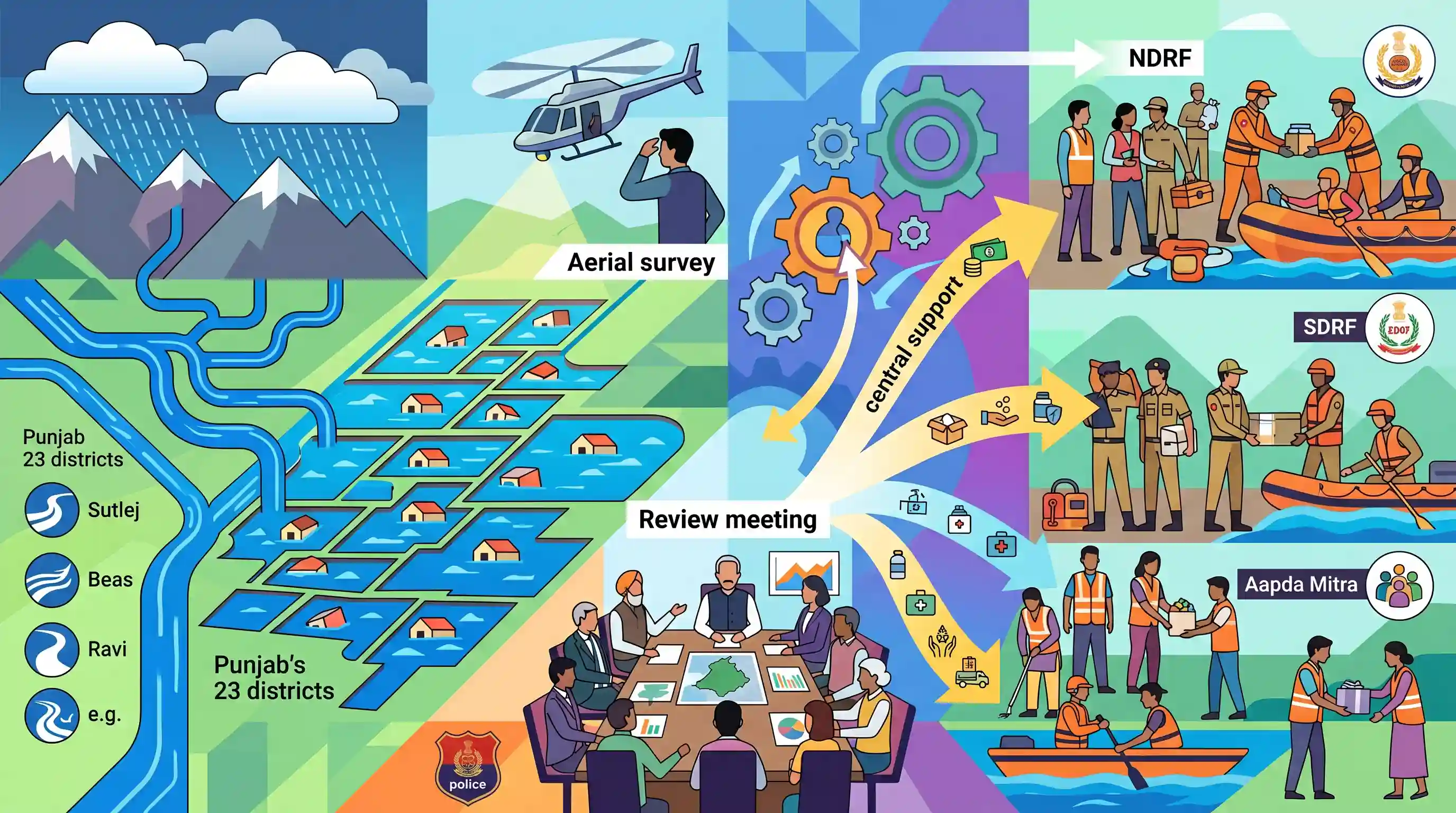
Prime Minister Narendra Modi conducted an aerial survey and review meetings in flood-affected regions of Himachal Pradesh and Punjab. Unprecedented rainfall in the catchment areas of Jammu & Kashmir and Himachal Pradesh caused severe swelling of the Sutlej, Beas, and Ravi rivers, leading to devastating floods in Punjab that affected all 23 districts. The Prime Minister interacted with relief personnel from the NDRF, SDRF, and Aapda Mitra teams, assuring central support and coordinated disaster management to aid the affected populations.
Key Points
- PM Modi visited flood-ravaged areas of Himachal Pradesh and Punjab to assess the damage caused by heavy rainfall and swollen rivers.
- In Punjab, all 23 districts were declared 'flood-hit' following unprecedented water levels in the Sutlej, Beas, and Ravi rivers, driven by intense rainfall in catchment areas.
- The disaster caused extensive damage in Punjab, including 51 deaths and the destruction of crops across 1.84 lakh hectares.
- The visit emphasized federal support in disaster relief, highlighting interactions with the NDRF, SDRF, and local volunteer groups under the Aapda Mitra scheme.
Important Terms
Aapda Mitra Scheme

A Central Sector Scheme by NDMA to train community volunteers as first responders in disaster-prone districts, enabling localized rescue tasks before formal help arrives.
UPSC context
GS3: Disaster Management; tests knowledge of community-led preparedness and the 'first responder' framework in crisis mitigation.
National Disaster Response Force (NDRF)
A specialized multi-skilled force under the Ministry of Home Affairs, established for high-tech response to natural and man-made disasters like floods and cyclones.
UPSC context
GS3: Disaster Management; essential for understanding India’s institutional emergency response and search-and-rescue capabilities.
State Disaster Response Force (SDRF)
A state-level specialized force trained for immediate localized rescue operations, complementing the NDRF during disasters within a specific state's jurisdiction.
UPSC context
GS3: Disaster Management; tests understanding of the layered (State-Center) response hierarchy and federal disaster coordination.
National Disaster Management Authority (NDMA)
India's apex statutory body for disaster management, chaired by the Prime Minister; responsible for laying down policies, plans, and guidelines for disaster resilience.
UPSC context
GS2/GS3: Statutory Bodies/Disaster Management; central to questions on national policy frameworks and command-and-control hierarchy.
Disaster Management Act, 2005
Landmark legislation providing the legal framework for disaster preparedness, mitigation, and response, establishing a three-tier institutional structure (National, State, District).
UPSC context
GS2/GS3: Governance/Disaster Management; the primary legal basis for all disaster response actions and institutional mandates in India.
Catchment Area
The geographic region where all surface water runoff drains into a single river or outlet; excessive rainfall here causes sudden swelling of downstream rivers.
UPSC context
GS1/GS3: Geography/Disaster Management; critical for analyzing flood dynamics, river basin management, and trans-boundary water issues.
Prelims Trap
"The NDRF is funded on a 75:25 cost-sharing basis between the Centre and States."
The 75:25 (or 90:10 for Special Category states) cost-sharing ratio applies strictly to the SDRF. The NDRF is entirely funded by the Centre.
Static Concepts Connected
What are the key hydrological differences between the Sutlej and Beas rivers?
- Antecedent Sutlej: Originates in Tibet (Rakshastal), making it an antecedent transboundary river that cuts through the Himalayas, entering India via Shipki La.
- Endemic Beas: Originates near Rohtang Pass in Himachal Pradesh and flows entirely within Indian territory before joining the Sutlej.
- Harike Confluence: The Beas meets the Sutlej at Harike in Punjab, which is the site of the internationally recognized Harike Wetland.
How is disaster relief and mitigation financed under the 15th Finance Commission?
- SDRF vs NDRF: SDRF is the primary fund (75:25 or 90:10 ratio); NDRF is 100% central, serving as a supplementary mechanism for 'severe' natural calamities.
- Mitigation Funds: The 15th FC mandated NDMF and SDMF, shifting India's disaster management architecture from a purely response-centric model to a preparedness-centric one.
Cross-Topic Patterns
Fluvial floods & Ramsar Sites
The confluence of the swollen Beas and Sutlej directly impacts the Harike Wetland, linking extreme catchment hydrology with Ramsar site conservation and ecology.
Aapda Mitra & Sendai Framework
Community-led disaster response via Aapda Mitra aligns directly with the Sendai Framework's mandate to invest in localized disaster risk reduction and community resilience.

Himalayan river antecedence paired with SDRF/NDMF cost-sharing formulas is highly likely as a geography/polity overlap question in 2026.
Linked PYQs · 5
Linked PYQs · 5
- 2024MainsGS3
Flooding in urban areas is an emerging climate-induced disaster. Discuss the causes of this disaster. Mention the features of two such major floods in the last two decades in India. Describe the policies and frameworks in India that aim at tackling such floods.
- 2019MainsGS3
Disaster preparedness is the first step in any disaster management process. Explain how hazard zonation mapping will help disaster mitigation in the case of landslides.
- 2020MainsGS1
The interlinking of rivers can provide viable solutions to the multi-dimensional inter-related problems of droughts, floods and interrupted navigation. Critically examine.
- 2024MainsGS3
What is disaster resilience? How is it determined? Describe various elements of a resilience framework. Also mention the global targets of Sendai Framework for Disaster Risk Reduction (2015–2030).
- 2024MainsGS2
What changes has the Union Government recently introduced in the domain of Centre-State relations ? Suggest measures to be adopted to build the trust between the Centre and the States and for strengthening federalism.
