PM Modi Urges Space Startups to Build Global Innovation Aura
Source:The Hindu ↗
हे का महत्त्वाचे आहे
The commercialization and privatization of India's space sector mark a critical policy shift. This article provides concrete examples of private sector capabilities (debris removal, space-based manufacturing, earth observation) and emphasizes the socio-economic applicability of space tech, both of which are central to GS Paper 3 questions on S&T and economic development.
सारांश
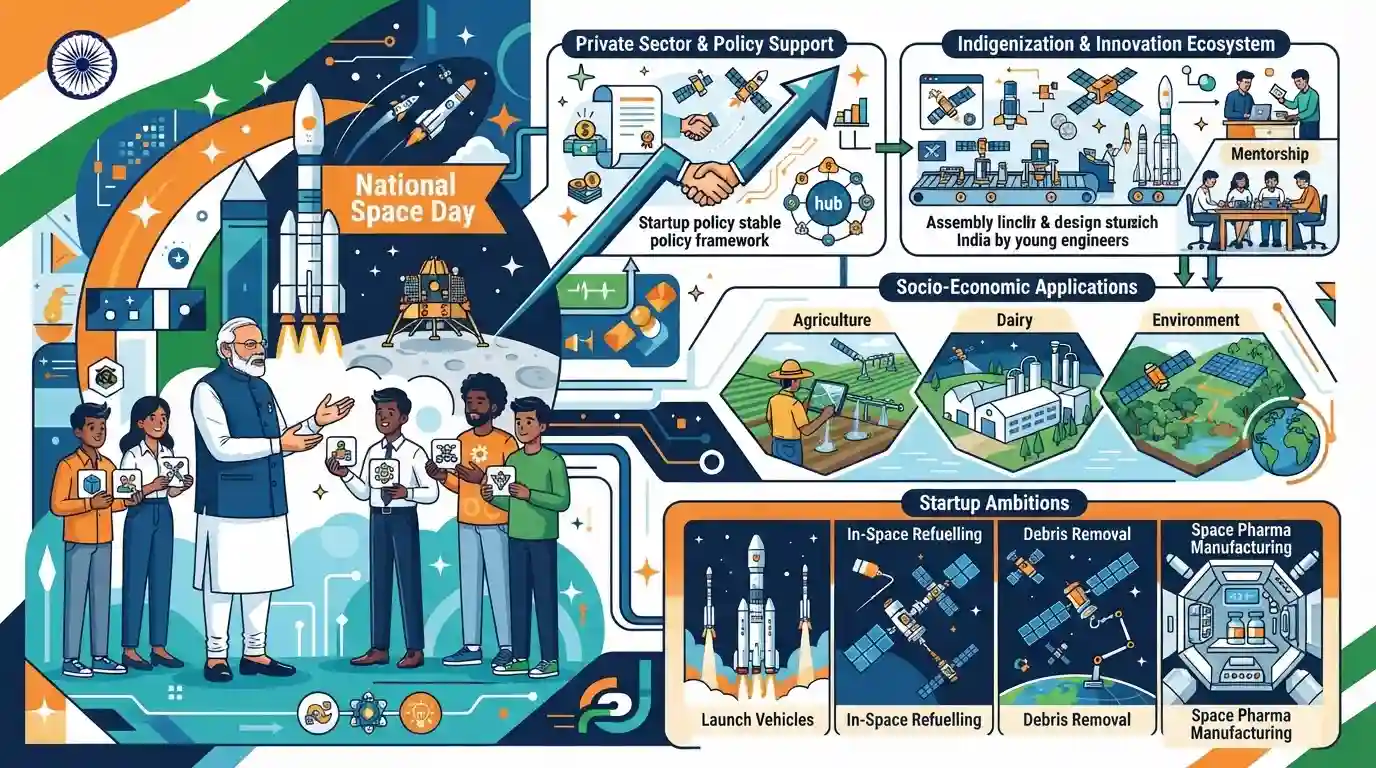
On the occasion of the first National Space Day, commemorating the Chandrayaan-3 landing, Prime Minister Narendra Modi interacted with the founders of 20 Indian space startups. He urged them to transform India into a global hub for space talent and investment, promising consistent policy support to de-risk private ventures. The PM highlighted the importance of applying space technology to terrestrial sectors such as agriculture, dairy, and environment, moving beyond traditional applications. Startups presented diverse ambitions, from scaling launch vehicles to pioneering in-space refuelling, debris removal, and space-based pharmaceutical manufacturing. He also encouraged leaders to mentor students through Atal Tinkering Labs to build a future innovation ecosystem.
मुख्य मुद्दे
- Prime Minister Narendra Modi addressed 20 Indian space startup founders on the first National Space Day, emphasizing India's potential as a premier destination for global space talent and investors.
- The PM assured a consistent government policy to support risk-taking in the space sector and encouraged the creation of a 'global aura' to attract top-tier investment.
- Startups were urged to explore socio-economic applications of space technology by collaborating with organizations in agriculture, livestock, dairy, and environment sectors.
- Modi suggested that startup founders engage with school students at Atal Tinkering Labs to cultivate a robust future talent pipeline for the industry.
- Startups shared innovations ranging from rocket scaling (Skyroot Aerospace) and agricultural monitoring to advanced concepts like orbital debris removal, space refuelling, and space-based pharmaceutical manufacturing.
महत्त्वाच्या संज्ञा
National Space Day

Observed annually on August 23 to commemorate the historic soft landing of Chandrayaan-3 on the lunar south pole, celebrating India's space achievements and inspiring STEM careers.
UPSC context
GS Paper III (Science & Technology); tests awareness of major space milestones, technological self-reliance, and space ecosystem policies.
Chandrayaan-3
India's third lunar exploration mission which achieved a historic soft-landing near the lunar South Pole on August 23, 2023, deploying the Vikram lander and Pragyan rover.
UPSC context
GS Paper III (Space Technology); tests knowledge of indigenous space missions, scientific payloads, and India’s global standing in planetary exploration.
Atal Tinkering Labs
A flagship initiative under NITI Aayog's Atal Innovation Mission (AIM) that establishes workspaces in schools to nurture curiosity, creativity, and computational thinking in STEM fields.
UPSC context
GS Paper II & III (Education & Innovation); tests understanding of initiatives promoting grassroots innovation and future-ready skills.
ISRO
India's premier space agency, established in 1969 under the Department of Space, responsible for national space exploration, satellite development, and space application missions.
UPSC context
GS Paper III (Science & Technology); tests awareness of institutional frameworks, technological self-reliance, and public-sector achievements in space.
Skyroot Aerospace
A pioneering Indian private aerospace manufacturer that built and launched Vikram-S, the nation's first privately developed suborbital rocket, and India's first space-tech unicorn.
UPSC context
GS Paper III (Space Economy & Privatisation); tests knowledge of private sector entry and market competitiveness in launch services.
Agnikul Cosmos
An IIT-Madras-incubated private startup that launched Agnibaan SOrTeD, featuring the world’s first fully 3D-printed semi-cryogenic engine, and established India's first private launchpad.
UPSC context
GS Paper III (Indigenization of Technology); tests awareness of cutting-edge manufacturing in space-tech and private startup initiatives.
Pixxel
A leading Indian space-tech startup that launched 'Firefly', India's first private hyperspectral Earth imaging satellite constellation, providing high-resolution global environmental data.
UPSC context
GS Paper III (Science & Technology); tests understanding of private commercial satellite constellations and applications in agriculture.
Dhruva Space
An Indian private space technology company developing Project Garud, an indigenous 500-kg modular flat-pack satellite platform designed for fast, high-volume production.
UPSC context
GS Paper III (Space Technology & Startups); tests understanding of indigenous satellite manufacturing systems and private industry contributions.
पूर्वपरीक्षा सापळा
IN-SPACe is a commercial public sector undertaking under the Department of Space tasked with technology transfer.
Aspirants confuse NSIL (the commercial PSU arm of ISRO) with IN-SPACe (the autonomous single-window regulator and facilitator for private entities).
संबंधित स्थिर संकल्पना
What are the roles of IN-SPACe and NSIL in India's space ecosystem?
- IN-SPACe mandate: Single-window autonomous agency under Department of Space that promotes, authorizes, and licenses space activities of non-government private entities.
- NSIL mandate: A Central Public Sector Enterprise serving as the commercial arm of ISRO, focused on technology transfer, satellite manufacturing, and commercial launch services.
- ISRO focus shift: Transitions away from routine operational launches to focus on advanced deep-space R&D, science missions, and technology demonstration.
What are the limits under India's 2024 Space Sector FDI Policy?
- Satellite manufacturing: Up to 74% automatic FDI is allowed for satellite manufacturing, satellite data products, and ground/user segment creation.
- Launch vehicles: Up to 49% automatic FDI is permitted for launch vehicles, associated systems, and creation of spaceports.
- Components & sub-systems: Up to 100% automatic FDI is allowed for manufacturing of components, systems, and sub-systems for satellites and ground segments.
आंतर-विषय नमुने
Space Tech + Climate-Smart Agriculture
Private hyperspectral constellations enable real-time micro-level crop health mapping, linking space indigenization directly to GS3 agricultural sustainability and disaster adaptation.
Debris cleanup + Outer Space Treaty
Indian startups targeting orbital debris removal must navigate international liability conventions, showing how domestic private innovation intersects with global outer space governance.

Multi-statement questions will likely test the specific institutional roles of IN-SPACe/NSIL alongside the 2024 relaxed space FDI limits.
संबंधित PYQ · 3
संबंधित PYQ · 3
- 2023MainsGS3
What is the main task of India's third moon mission which could not be achieved in its earlier mission? List the countries that have achieved this task. Introduce the subsystems in the spacecraft launched and explain the role of the Virtual Launch Control Centre' at the Vikram Sarabhai Space Centre which contributed to the successful launch from Sriharikota.
- 2016MainsGS3
Discuss India's achievements in the field of Space Science and Technology. How the application of this technology has helped India in its socio-economic development?
- 2017MainsGS3
India has achieved remarkable successes in unmanned space missions including the Chandrayaan and Mars Orbitter Mission, but has not ventured into manned space missions. What are the main obstacles to launching a manned space mission, both in terms of technology and logistics? Examine critically.
