Global Geopolitical Crisis and Macroeconomic Stability in India
Source:The Hindu ↗
Why It Matters
Highlights the direct impact of global geopolitical conflicts on India's macroeconomic stability and energy security. The proposed lifestyle and consumption adjustments—such as reducing gold imports, promoting EVs, shifting to natural farming, and embracing 'Vocal for Local'—are key strategies for managing current account deficits and inflation during crises.
Summary
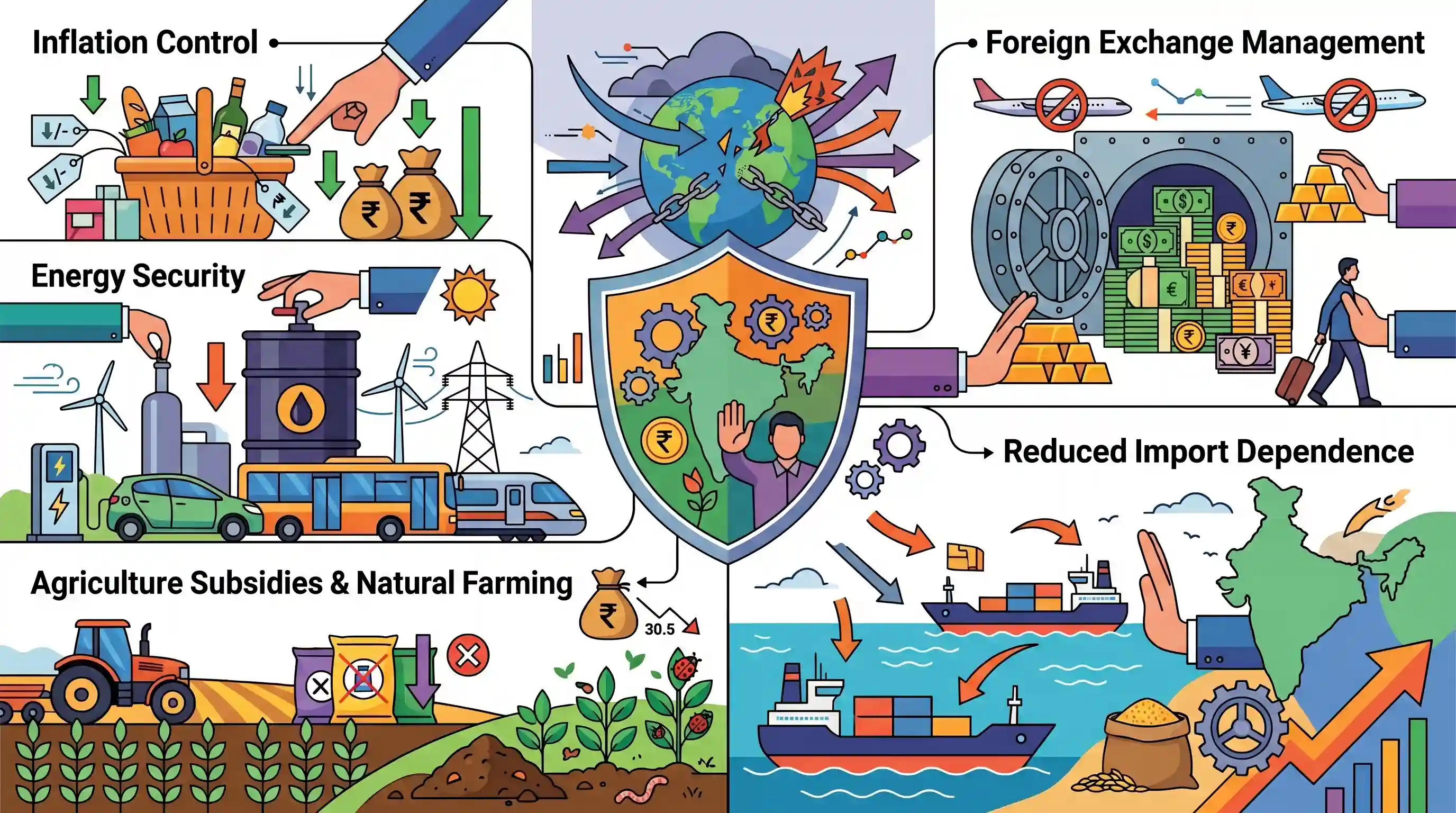
Addressing a public gathering in Secunderabad, PM Modi urged citizens to adopt a 'nationally responsible' lifestyle to shield the Indian economy from the global fallout of the U.S.-Iran conflict. He recommended reducing fuel and edible oil consumption, delaying gold purchases, avoiding foreign travel, and adopting public transport and EVs. Emphasizing the massive subsidy burden, he called on farmers to halve chemical fertilizer usage in favor of natural farming. These collective actions aim to manage domestic inflation, reduce import dependence, and conserve foreign exchange reserves amid disrupted international supply chains.
Key Points
- Global supply chains have been severely disrupted by the U.S.-Iran and Ukraine wars, leading to inflated prices for crude oil, fertilizers, and food.
- PM Modi urged citizens to adopt a nationally responsible lifestyle by reducing fuel consumption, using public transport and EVs, and utilizing solar irrigation pumps.
- He appealed to the public to avoid foreign travel, destination weddings abroad, and non-essential gold purchases for a year to conserve India's foreign exchange reserves.
- Highlighting the heavy burden of fertilizer subsidies (costing nearly ₹3000 globally but supplied at under ₹300), the PM asked farmers to halve chemical fertilizer use and shift to natural farming.
- The Prime Minister emphasized the need for self-sufficiency in edible oils and promoted the 'Vocal for Local' initiative to insulate the domestic economy from international shocks.
Important Terms
Foreign Exchange (Forex) Reserves

Foreign assets (currencies, gold, SDRs) held by the RBI to manage currency volatility, meet external obligations, and provide a buffer against global shocks.
UPSC context
GS Paper 3 (Economy); crucial for understanding Balance of Payments, rupee stability, and external sector resilience.
Current Account Deficit (CAD)
An economic indicator where a country's total value of imported goods, services, and transfers exceeds its total exports, necessitating external financing.
UPSC context
GS Paper 3 (Economy); tested for its causes (like fuel/gold imports) and impact on macroeconomic stability.
Natural Farming
A chemical-free, sustainable agricultural practice utilizing bio-inputs (e.g., Jeevamrut) and local resources to restore soil health and reduce reliance on synthetic fertilizers.
UPSC context
GS Paper 3 (Agriculture); vital for topics on sustainable development, food security, and reducing fiscal subsidy burdens.
Fertilizer Subsidy
A government financial assistance program that keeps prices of essential nutrients (Urea, P&K) low for farmers, often leading to a significant fiscal burden.
UPSC context
GS Paper 3 (Agriculture/Economics); tested regarding its impact on soil health, fiscal deficit, and direct benefit transfers (DBT).
Vocal for Local
An economic strategy and campaign urging the promotion and consumption of indigenous products to achieve self-reliance and strengthen domestic MSMEs.
UPSC context
GS Paper 3 (Economy); central to Atmanirbhar Bharat and the strategy of reducing import dependence.
Energy Security
The uninterrupted availability of energy sources at an affordable price, often managed in India by diversifying imports and promoting renewables/EVs.
UPSC context
GS Paper 3 (Infrastructure/Energy); key for addressing India's high crude oil import dependence and climate goals.
Prelims Trap
Fertilizer subsidies are transferred directly to farmers' bank accounts via Direct Benefit Transfer (DBT).
Fertilizer subsidies are routed to manufacturers, not directly to farmers. The 'DBT' in fertilizers refers to transferring the subsidy to companies after verifying retail sales via POS machines.
Static Concepts Connected
What are the primary drivers of India's Current Account Deficit (CAD)?
- Trade Deficit: The CAD is heavily driven by inelastic imports like crude oil, edible oils, and fertilizers, alongside historically high domestic demand for non-essential gold.
- Invisible Receipts: India's massive merchandise trade deficit is partially offset by a consistent surplus in services exports (IT/BPO) and robust inward remittances.
- Imported Inflation: Global price shocks in imported raw materials (crude, fertilizers) directly raise domestic costs, widening the CAD and depleting forex reserves.
How is fertilizer pricing regulated to protect Indian farmers from global shocks?
- Urea Pricing: The Centre statutorily fixes the Maximum Retail Price (MRP) of urea, absorbing global price fluctuations to keep it affordable, creating a massive fiscal burden.
- Nutrient Based Subsidy: For Phosphatic and Potassic (P&K) fertilizers, a fixed subsidy per kg of nutrient is provided, but manufacturers determine the final retail price.
Cross-Topic Patterns
Behavioural Economics + Macro-stability
Applying the 'LiFE' (Lifestyle for Environment) concept to macroeconomic management shows how citizen behavioral nudges are being leveraged to control Current Account Deficit and imported inflation.
PM-KUSUM + Water-Energy-Food Nexus
Shifting to solar pumps and natural farming reduces diesel import bills and fertilizer subsidies, simultaneously tackling the fiscal deficit, energy security, and soil degradation.

Expect a multi-statement question on 'Imported Inflation' linking crude/fertilizer price shocks to CAD widening and RBI forex interventions.
Linked PYQs · 5
Linked PYQs · 5
- 2023MainsGS3
The adoption of electric vehicles is rapidly growing worldwide. How do electric vehicles contribute to reducing carbon emissions and what are the key benefits they offer compared to traditional combustion engine vehicles?
- 2023MainsGS3
What are the direct and indirect subsidies provided to farm sector in India? Discuss the issues raised by the World Trade Organization (WTO) in relation to agricultural subsidies.
- 2017MainsGS3
How do subsidies affect the cropping pattern, crop diversity and economy of farmers? What is the significance of crop insurance, minimum support price and food processing for small and marginal farmers?
- 2015MainsGS3
In what way could replacement of price subsidy with Direct Benefit Transfer (DBT) change the scenario of subsidies in India ? Discuss.
- 2015PrelimsGS1
The problem of international liquidity is related to the non-availability of
