Defence Industrial Corridors Bolster Proactive Security Doctrine
Source:Indian Express ↗
Why It Matters
The article provides concrete examples of India's evolving national security doctrine—moving from strategic restraint to proactive deterrence—while highlighting the critical integration of domestic manufacturing (UP Defence Corridor) and energy infrastructure with strategic military needs.
Summary
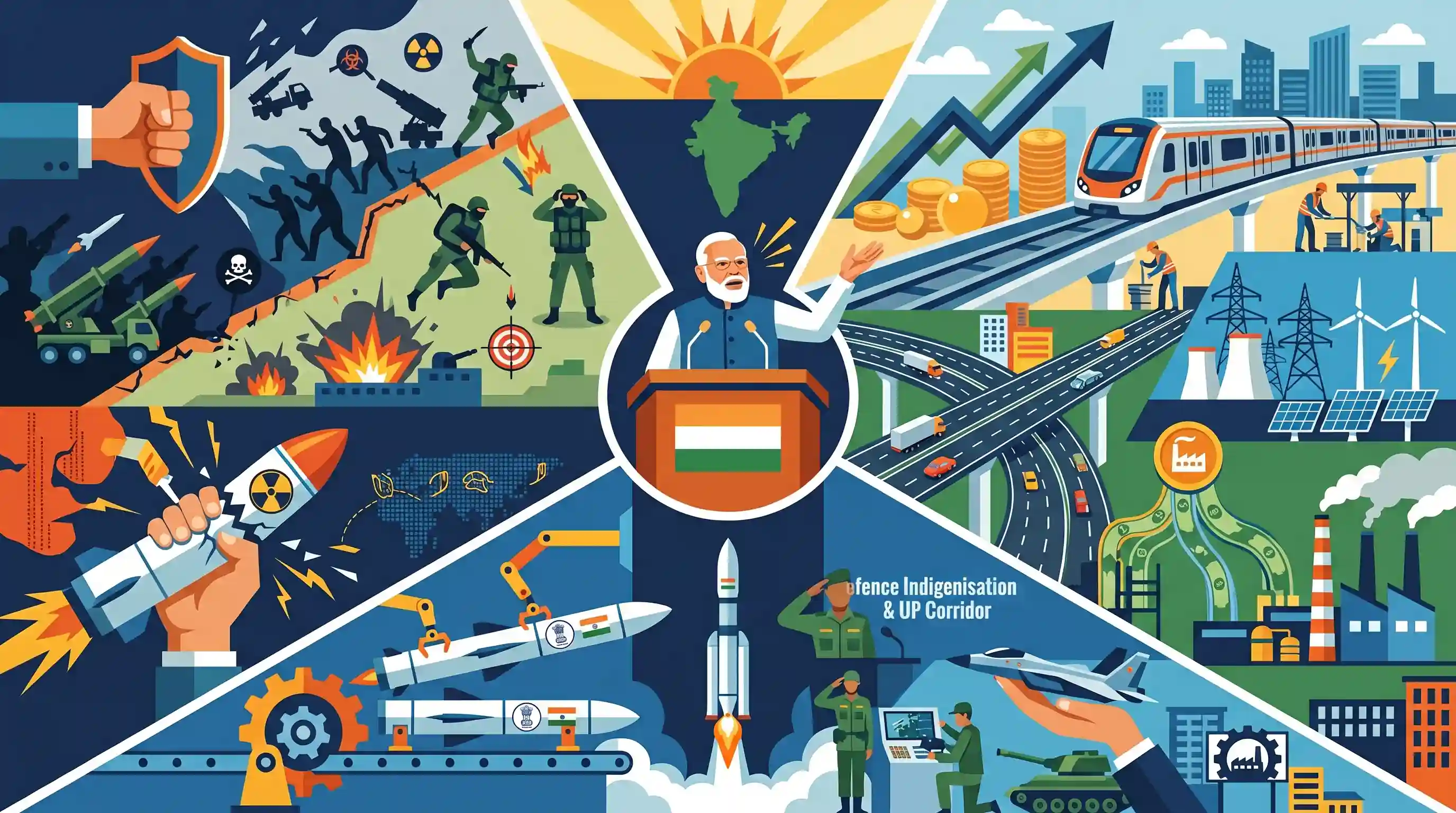
Speaking in Kanpur, PM Modi asserted India's aggressive counter-terrorism posture, highlighting 'Operation Sindoor' as a demonstration of indigenous military capabilities and a severe warning to state and non-state actors in Pakistan. He underscored India's rejection of nuclear blackmail and its commitment to 'Aatmanirbhar Bharat' in defence, citing the manufacturing of BrahMos missiles at the UP Defence Corridor. Additionally, he inaugurated major infrastructure and energy projects worth over Rs 47,600 crore, including multiple power plants, expressways, and the Kanpur Metro expansion, to catalyze industrial growth in Uttar Pradesh.
Key Points
- India has adopted a zero-tolerance stance on cross-border terrorism, declaring equal accountability for both state and non-state actors while openly rejecting nuclear blackmail.
- PM Modi highlighted 'Operation Sindoor' as a testament to India's proactive military strategy and the efficacy of its indigenous weaponry.
- The UP Defence Corridor is significantly advancing self-reliance (Aatmanirbhar Bharat) in defence manufacturing, prominently featuring a new BrahMos missile production unit in Kanpur and AK-203 rifle production in Amethi.
- To support industrial growth, five major power plants (Panki, Neyveli, Jawaharpur, Obra C, Khurja) were inaugurated in UP to ensure an uninterrupted electricity supply.
- Regional connectivity is being expanded through the Kanpur Metro's Orange Line and the upcoming Kanpur-Lucknow and Ganga expressways.
Important Terms
Operation Sindoor

A May 2025 Indian military operation involving precision missile and drone strikes on terrorist infrastructure in Pakistan, following a terror attack in Pahalgam.
UPSC context
GS Paper 3: Internal Security; tests understanding of India's 'proactive' counter-terrorism doctrine and 'non-contact' warfare capabilities.
BrahMos
A supersonic cruise missile developed as a joint venture between India (DRDO) and Russia; capable of being launched from land, sea, and air.
UPSC context
GS Paper 3: Science & Technology; relevant for indigenization of technology and strategic deterrence.
UP Defence Corridor
A strategic industrial zone in Uttar Pradesh (nodes: Lucknow, Kanpur, etc.) designed to boost domestic defense manufacturing and reduce import dependency.
UPSC context
GS Paper 3: Economy/Infrastructure; tests knowledge of regional development hubs and defense industrial bases.
Non-State Actors
Individuals or groups (e.g., terrorist outfits like LeT, JeM) that wield power and influence but lack formal state backing.
UPSC context
GS Paper 3: Internal Security; core topic regarding proxy wars and cross-border terrorism.
Aatmanirbhar Bharat (Defence)
The national vision for 'Self-Reliant India,' emphasizing domestic production, reduced imports (Negative Indigenisation Lists), and strategic autonomy in the defense sector.
UPSC context
GS Paper 3: Economy/Indigenisation; focuses on industrial policy and self-reliance in critical sectors.
Nuclear Blackmail
The use of nuclear threats by a state to deter conventional military action or shield its support for subversive activities.
UPSC context
GS Paper 2: International Relations; pertains to South Asian strategic stability and nuclear deterrence doctrines.
Prelims Trap
BrahMos is a single-stage solid-propellant hypersonic missile.
BrahMos is a two-stage missile (solid booster, liquid ramjet) and is currently supersonic (Mach 2.8). BrahMos-II, which is hypersonic, is in development.
Static Concepts Connected
What are the key technical specifications of the BrahMos missile?
- Propulsion: Uses a two-stage system: a solid-propellant booster for initial acceleration and a liquid ramjet for sustained supersonic cruise.
- Speed: It is a supersonic cruise missile flying at nearly Mach 2.8, making it highly difficult to intercept.
- Versatility: Can be launched from land, air (Sukhoi-30 MKI), sea (ships), and sub-sea (submarines) platforms.
What are India's Defence Industrial Corridors (DICs)?
- Locations: Only two are established in India—one in Uttar Pradesh (6 nodes) and one in Tamil Nadu (5 nodes).
- UP Nodes: Aligarh, Agra, Kanpur, Chitrakoot, Jhansi, and Lucknow. Notably, Noida and Meerut are NOT nodes.
- Objective: Designed to catalyse indigenous production, reduce imports, and promote MSMEs in the aerospace and defence sectors.
Cross-Topic Patterns
State vs Non-State Actors doctrine
The aggressive posture in 'Operation Sindoor' erases the distinction between state and non-state actors in Pakistan, linking cross-border terror directly to state accountability (relevant to FATF and UN CCIT).
Pithead vs Coastal Thermal Plants
UP's newly inaugurated thermal plants (Obra C, Jawaharpur) highlight the geographical clustering of coal-based power near coalfields (pithead) versus load centres, a recurring theme in GS1/GS3.

Expect a multi-statement question on BrahMos propulsion (ramjet/scramjet) mixed with Defence Corridor mapping (UP/TN nodes) in 2026.
Linked PYQs · 2
Linked PYQs · 2
- 2021MainsGS3
Analyse the multidimensional challenges posed by external state and non-state actors, to the internal security of India. Also discuss measures required to be taken to combat these threats.
- 2025MainsGS3
Terrorism is a global scourge. How has it manifested in India? Elaborate with contemporary examples. What are the counter measures adopted by the State? Explain.
