India UK strategic pact and foreign university campuses in Gurugram
Source:The Hindu ↗
Why It Matters
The sweeping multi-sectoral agreements demonstrate a maturing India-UK strategic partnership that expands beyond traditional ties into futuristic domains like critical minerals, AI, and green tech. Permitting foreign universities to set up campuses is a landmark shift in India's higher education policy, implementing key goals of the NEP.
Summary
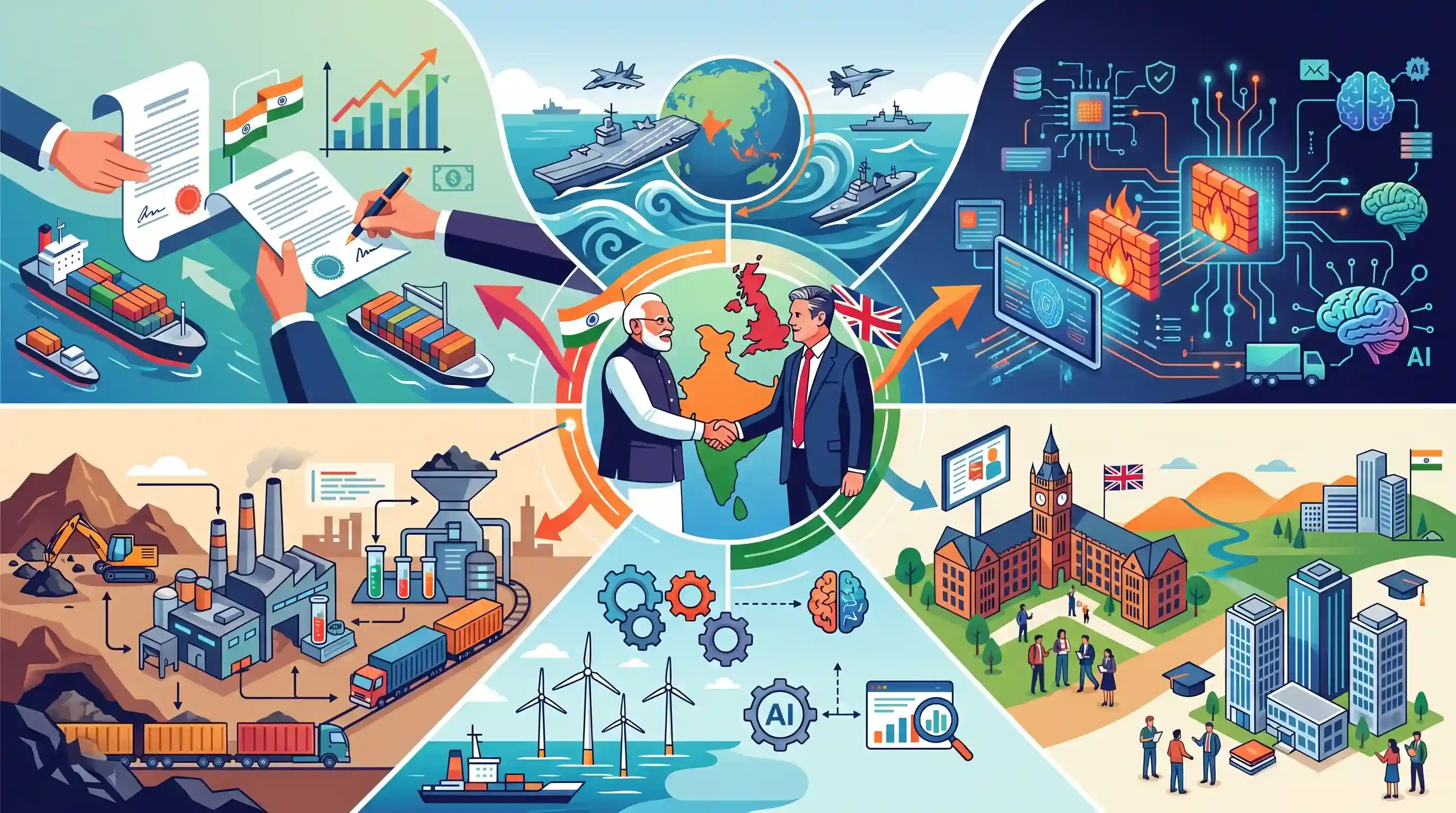
Indian Prime Minister Narendra Modi and UK Prime Minister Keir Starmer met in Mumbai on October 9, 2025, to deepen the India-UK Comprehensive Strategic Partnership. The leaders celebrated the signing of the Comprehensive Economic and Trade Agreement (CETA) and the repositioning of JETCO. They discussed enhanced defence ties, notably maritime security cooperation in the Indo-Pacific involving the UK Carrier Strike Group. The meeting also resulted in the launch of Several futuristic initiatives: the India-UK Technology Security Initiative, a Joint AI Research Centre, an Offshore Wind Taskforce, and a Supply Chain Observatory for critical minerals at ISM Dhanbad. Additionally, in a major boost for India's higher education internationalisation, the UK's Southampton University will open a campus in Gurugram, alongside three other institutions in GIFT City.
Key Points
- Trade and Economy: Strong commitment to executing the recently signed U.K.-India Comprehensive Economic and Trade Agreement (CETA) and upgrading the Joint Economic and Trade Committee (JETCO).
- Defence and Security: Shared vision for maritime security in the Indo-Pacific, featuring exercises between the Indian Navy and the UK Carrier Strike Group.
- Education Sector Liberalisation: Marking a major milestone, Southampton University will open a campus in Gurugram, and three other UK universities will set up in GIFT City.
- Technology and Supply Chains: Launch of the Technology Security Initiative, a Joint AI Research Centre, and a Supply Chain Observatory for critical minerals located at ISM Dhanbad.
- Green Transition: Establishing the India-U.K. Offshore Wind Taskforce and a Climate Technology Startup Fund to support climate initiatives.
Important Terms
U.K.-India Comprehensive Economic and Trade Agreement (CETA)

A landmark free trade agreement signed in 2025 to double bilateral trade. It eliminates tariffs on the majority of goods and enhances professional mobility and service sector access.
UPSC context
GS II/III: Bilateral agreements and trade policy. Tests knowledge of trade barriers, Rules of Origin, and economic integration.
India-U.K. Technology Security Initiative (TSI)
A strategic framework launched in 2024 to deepen cooperation in critical and emerging technologies like semiconductors, 6G, and AI, coordinated by National Security Advisors.
UPSC context
GS III: Science & Tech and Internal Security. Tests understanding of technological sovereignty and strategic partnerships.
Joint Economic and Trade Committee (JETCO)
A ministerial-level mechanism established in 2005 to develop the India-UK strategic economic relationship, serving as the primary forum for resolving market access issues and fostering business links.
UPSC context
GS II: Bilateral groupings. Relevant for understanding institutional frameworks that facilitate trade negotiations and ease of doing business.
UK Carrier Strike Group (CSG)
A high-readiness maritime force led by a Royal Navy aircraft carrier. Its Indo-Pacific deployment involves joint exercises with India, symbolizing shared maritime security goals.
UPSC context
GS II/III: Indo-Pacific security. Essential for discussing regional stability, naval interoperability, and the rules-based international order.
Supply Chain Observatory (Critical Minerals)
A digital project at ISM Dhanbad using AI and blockchain to track critical mineral flows, ensuring resilient supply chains for green energy and high-tech manufacturing.
UPSC context
GS III: Energy and Security. Tests knowledge of the green transition and dependence on critical minerals like lithium and cobalt.
India-U.K. Offshore Wind Taskforce
A collaborative body focused on accelerating offshore wind energy deployment through technical exchange, policy support, and supply chain development to meet net-zero targets.
UPSC context
GS III: Energy and Environment. Tests knowledge of renewable energy cooperation and international climate commitments.
Prelims Trap
"Foreign universities can only establish campuses in India within the GIFT City SEZ under IFSCA regulations."
UGC regulations now allow top-500 global foreign universities to set up campuses anywhere in India (e.g., Gurugram), distinct from the IFSCA-governed GIFT City route.
Static Concepts Connected
What are the regulatory routes for Foreign Universities in India?
- UGC Route: Governed by 2023 UGC regulations; requires universities to be in the global top 500 to set up campuses anywhere in India (e.g., Gurugram).
- IFSCA Route: Exempt from UGC norms; regulated by IFSCA to operate strictly within the GIFT IFSC, allowing greater financial, repatriation, and administrative autonomy.
- NEP 2020 Mandate: Aligned with NEP 2020's goal of "internationalisation at home" to prevent brain drain and save foreign exchange.
How do Free Trade Agreements (FTAs) differ from CEPAs/CETAs?
- Standard FTA: Primarily focuses on reducing or eliminating customs duties on a positive or negative list of traded physical goods.
- CEPA / CETA: More comprehensive; encompasses trade in goods, services, investments, intellectual property, and regulatory cooperation.
- Strategic Utility: India uses comprehensive pacts (like with UAE, Australia, and now UK) to secure easier visa access for service professionals (Mode 4).
Cross-Topic Patterns
Tech Security Pacts (iCET & TSI)
India is shifting strategic diplomacy from conventional defense to critical technologies, mirroring the US-India iCET framework with the new UK-India TSI covering AI, telecom, and semiconductors.
Critical Minerals & Supply Chain Resilience
The new Critical Minerals Observatory links directly to the Mines Ministry's 30 critical minerals list and global groupings like the Minerals Security Partnership (MSP) to de-risk supply chains from China.
Trade Pacts targeting Labour-Intensive Exports
The operationalisation of the CETA connects international trade goals to domestic PLI schemes, deliberately targeting zero-duty access for labor-intensive sectors (textiles, leather) to boost domestic employment.

Expect a 2026 Prelims question comparing UGC rules for foreign campuses (Gurugram) vs IFSCA rules (GIFT City), alongside CETA.
Linked PYQs · 4
Linked PYQs · 4
- 2015MainsGS2
The quality of higher education in India requires major improvements to make it internationally competitive. Do you think that the entry of foreign educational institutions would help improve the quality of higher and technical education in the country? Discuss.
- 2020MainsGS2
What is the significance of Indo-US defence deals over Indo-Russian defence deals? Discuss with reference to stability in the Indo-Pacific region.
- 2023MainsGS3
Introduce the concept of Artificial Intelligence (AI). How does Al help clinical diagnosis? Do you perceive any threat to privacy of the individual in the use of Al in healthcare?
- 2020MainsGS2
National Education Policy 2020 is in conformity with the Sustainable Development Goal-4 (2030). It intends to restructure and reorient education system in India. Critically examine the statement.
