India US Bilateral Trade Agreement and Tariff Revisions
Source:Indian Express ↗
Why It Matters
The trade agreement marks a major recalibration of India-US economic relations. It demonstrates how bilateral trade concessions are increasingly linked with broader geopolitical objectives, such as energy security and diversifying away from Russian oil, impacting India's strategic autonomy and export competitiveness.
Summary
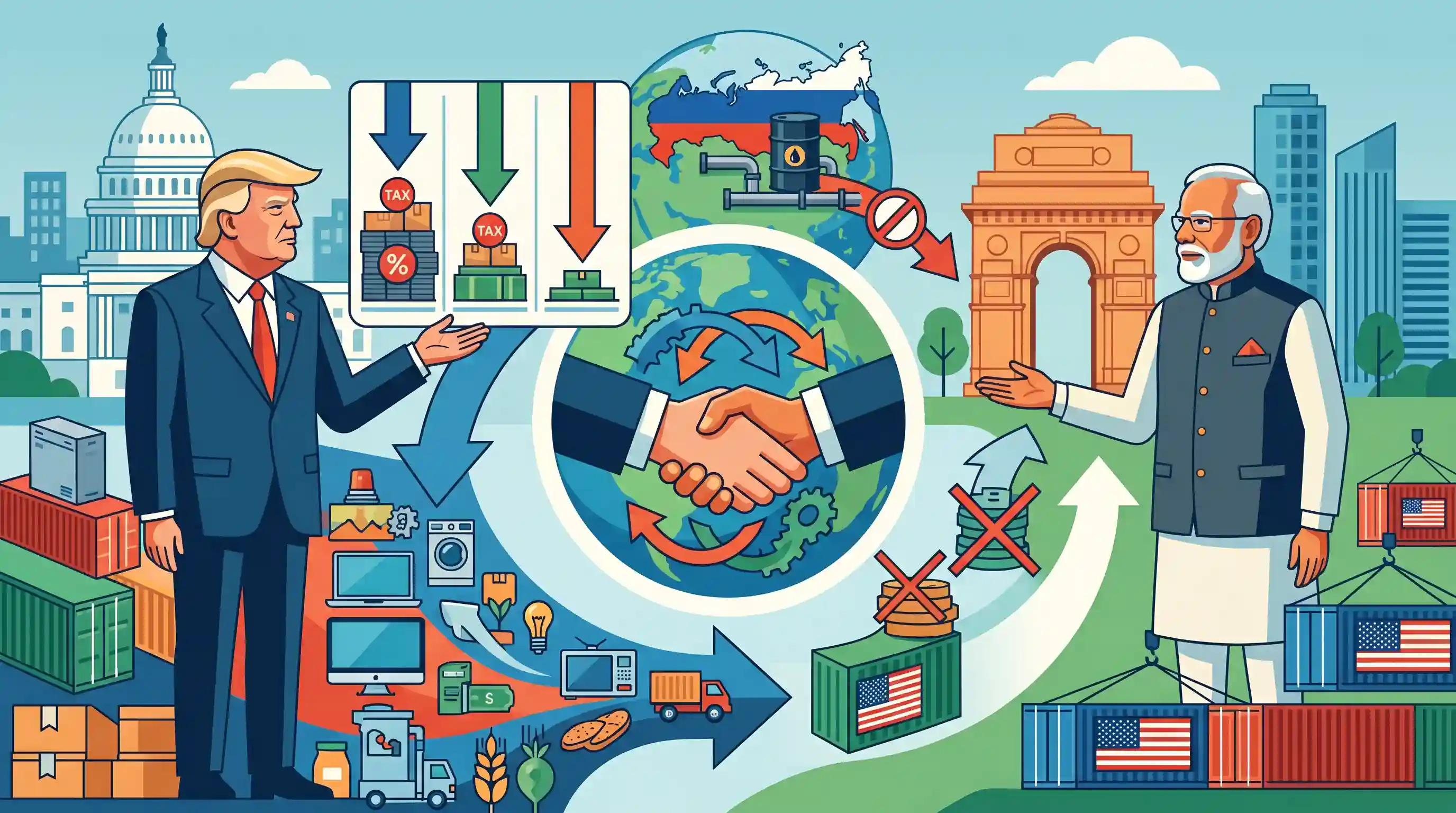
In a significant bilateral trade development, US President Donald Trump announced a reduction in US tariffs on 'Made in India' goods to 18%. In return, India is set to eliminate import taxes on US goods and purchase $500 billion worth of American products. The deal, welcomed by Prime Minister Narendra Modi, intertwines economic cooperation with geopolitical strategies, as it follows recent US pressure on India to reduce its dependence on Russian oil.
Key Points
- The US has lowered tariffs on 'Made in India' products to 18%.
- In a reciprocal move, India will reduce its import taxes on US goods to zero and commit to buying $500 billion worth of American products.
- This bilateral trade understanding comes after US pressure on India to decrease its reliance on Russian oil imports.
- The agreement highlights the intersection of trade policy and energy geopolitics in India-US relations.
Important Terms
Interim Trade Agreement

A preliminary pact covering a limited range of goods or services, often serving as a stepping stone toward a full-scale Free Trade Agreement (FTA).
UPSC context
GS II/III: Tests understanding of trade diplomacy and the incremental nature of international economic integration.
Strategic Autonomy
A nation's capacity to pursue its national interests and foreign policy without being constrained or coerced by other states in its sovereign decision-making.
UPSC context
GS II: Essential for analyzing India's balance between US trade partnerships and traditional energy ties with Russia.
Non-Tariff Barriers (NTBs)
Trade restrictions like quotas, technical standards, or licensing requirements that limit imports through means other than direct taxes (tariffs).
UPSC context
GS III: Relevant for trade facilitation, WTO compliance, and regulatory hurdles in global economic relations.
Reciprocal Trade
A trade policy approach where a country adjusts its import tariffs to match the levels imposed by its trading partners on its own exports.
UPSC context
GS II/III: Relevant for "Effect of policies of developed countries" and the shift toward bilateral transactionalism.
Market Access
The degree to which foreign products can enter a country’s market, influenced by tariffs, quotas, and domestic regulatory compliance requirements.
UPSC context
GS III: Central to understanding export competitiveness and the impacts of bilateral deals on the domestic economy.
Made in India
A government initiative launched in 2014 to encourage domestic manufacturing, attract foreign investment, and transform India into a global manufacturing hub.
UPSC context
GS III: Key for topics on industrial growth, employment, and the Atmanirbhar Bharat (Self-Reliant India) strategy.
Rules of Origin
Criteria used to determine the national source of a product, ensuring trade deal benefits apply only to the participating countries.
UPSC context
GS III: Tests knowledge of trade policy enforcement and prevention of "third-party" exploitation of bilateral agreements.
Prelims Trap
The trade deal is strictly reciprocal, maintaining an equal 18% tariff on both sides.
Reciprocity in trade negotiations does not always mean identical tariff rates. Here, India drops tariffs to 0% while the US maintains an 18% rate.
Static Concepts Connected
How do bilateral deals bypass WTO's MFN principle?
- MFN Rule: Under WTO rules, a concession granted to one member must be given to all.
- Article XXIV Exception: Allows countries to form FTAs or Customs Unions without extending the lower tariffs to all WTO members.
- Coverage Condition: To qualify for the exception, the agreement must cover "substantially all trade" between the partners.
How does the US enforce secondary economic coercion?
- CAATSA Legislation: The Countering America's Adversaries Through Sanctions Act (CAATSA) penalizes countries trading with Russia, Iran, or North Korea.
- Secondary Sanctions: These target foreign entities doing business with sanctioned countries, weaponizing the global dominance of the US dollar.
- Waiver Mechanism: The US President retains the power to grant waivers on national security grounds.
Cross-Topic Patterns
Energy Security vs Current Account Deficit
Conceding cheap Russian oil to secure US trade access risks structural inflation and a widened Current Account Deficit, potentially offsetting the macroeconomic benefits of 18% US tariffs.
Aatmanirbhar Bharat vs Zero-Tariff Access
Eliminating import taxes on US goods fundamentally challenges India's PLI schemes and Aatmanirbhar Bharat, exposing domestic manufacturing to unprotected competition.

Expect a 2026 Prelims question mixing US-India zero-tariff concessions with WTO's Article XXIV (MFN exceptions) and CAATSA waivers.
Linked PYQs · 3
Linked PYQs · 3
- 2025MainsGS3
What are the challenges before the Indian economy when the world is moving away from free trade and multilateralism to protectionism and bilateralism? How can these challenges be met?
- 2012MainsGS2
Discuss the likely negative impact of the protectionist measures proposed by the US on India's software industry.
- 2025MainsGS2
"Energy security constitutes the dominant kingpin of India's foreign policy, and is linked with India's overarching influence in Middle Eastern countries.” How would you integrate energy security with India's foreign policy trajectories in the coming years?
