India Principled Foreign Policy Stance on West Asia Mediation
Source:Indian Express ↗
Why It Matters
The article highlights India's evolving role in global conflict resolution, distinguishing its principled diplomatic approach from transactional mediation. It is highly relevant for GS Paper 2 (International Relations) as it touches upon India's strategic positioning in the volatile West Asia region, its bilateral interactions with the US to influence global peace, and the domestic political discourse surrounding foreign policy.
Summary
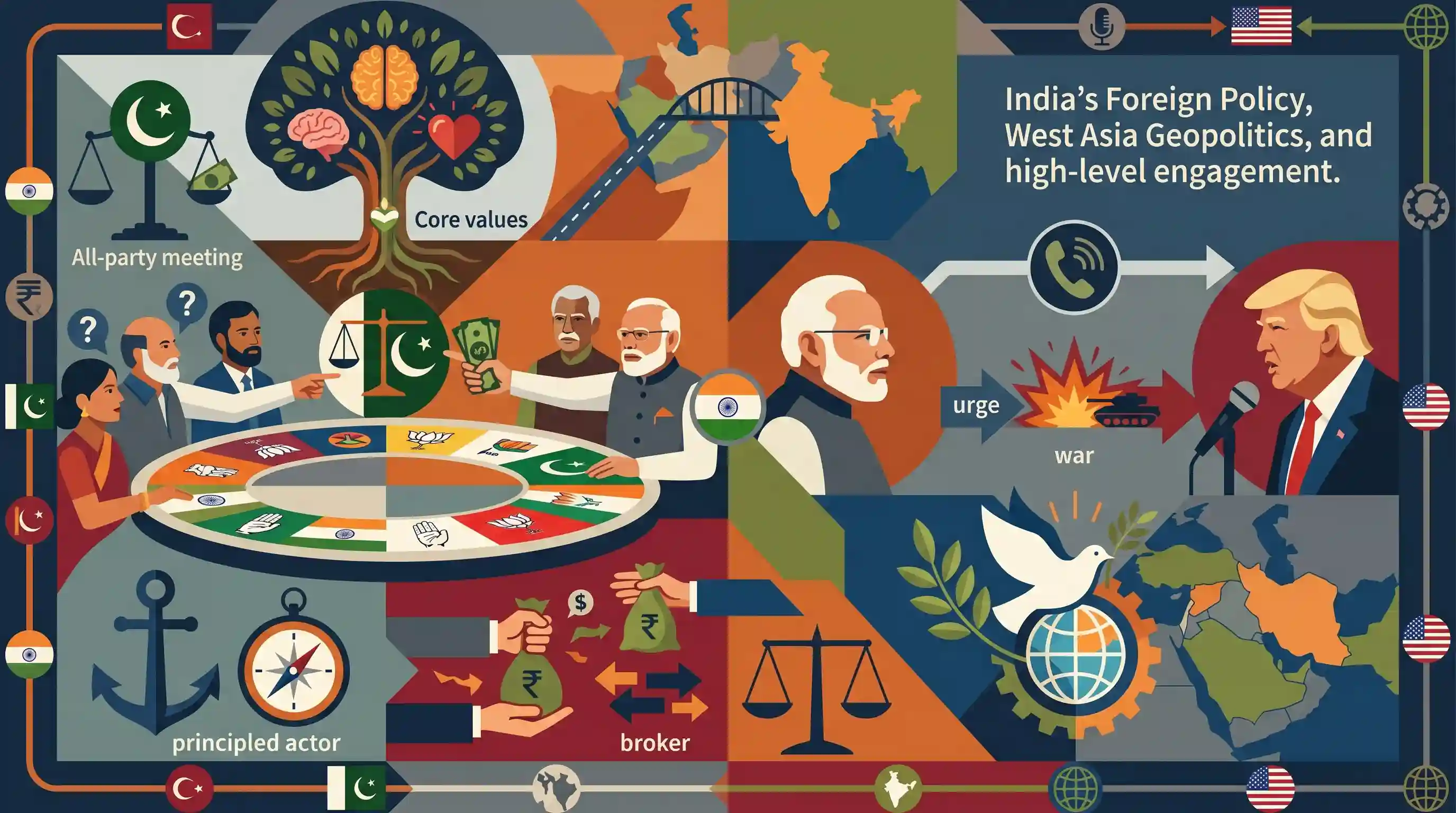
An all-party meeting on the West Asia crisis saw the Indian government clarify its diplomatic stance amid opposition concerns over Pakistan's potential role as a mediator. The government asserted that India is a principled actor, not a 'dalal' (broker) nation, emphasizing that its foreign policy is driven by core values rather than transactional opportunism. During the meeting, it was also highlighted that PM Modi proactively urged US President Donald Trump to bring an end to the war, underscoring India's commitment to global peace and high-level engagement to de-escalate the Middle East conflict.
Key Points
- The Indian government convened an all-party meeting to discuss the ongoing West Asia crisis and its geopolitical implications.
- Opposition parties raised concerns regarding reports of Pakistan attempting to play a mediatory role in the conflict.
- The government defended India's diplomatic approach, asserting that India engages in principled diplomacy rather than acting opportunistically, using the term 'not a dalal (broker) nation'.
- It was conveyed that PM Narendra Modi had directly urged US President Donald Trump to help end the war, showcasing India's proactive diplomatic engagement at the highest levels for de-escalation.
Important Terms
All-Party Meeting

An informal consultative mechanism where the government briefs leaders of various political parties on critical issues to build national consensus on foreign policy or security crises.
UPSC context
GS Paper II (Polity & Governance); tests understanding of parliamentary consensus-building and the role of the opposition in foreign policy.
Strategic Autonomy
A core foreign policy tenet ensuring independent decision-making based on national interest, without being pressured by alliances or acting as a transactional intermediary for other powers.
UPSC context
GS Paper II (International Relations); central theme in India's global positioning and its refusal to be a 'broker' nation.
Strait of Hormuz
A critical maritime chokepoint between the Persian Gulf and the Gulf of Oman, essential for global energy security as it handles roughly 20% of the world's oil transit.
UPSC context
GS Paper I (Geography) & II (IR); vital for India’s energy security and maritime trade routes in West Asia.
West Asia Policy
India’s strategic framework for the Middle East, balancing ties with rival powers (Iran, Israel, USA) while prioritizing energy interests and the safety of 9 million+ Indian citizens.
UPSC context
GS Paper II (IR); tests India’s 'Link West' strategy and balancing acts in a volatile region.
Diaspora Diplomacy
The use of political and economic influence to protect and leverage the 32 million-strong Indian community abroad, a high priority during regional conflicts.
UPSC context
GS Paper II (IR); focuses on the 'Indian Diaspora' sub-topic and the government's responsibility to protect citizens during crises.
Transactional Diplomacy
A form of foreign policy focused on short-term, quid-pro-quo exchanges or acting as a 'broker' (dalal), which India contrasted with its own principled, long-term strategic approach.
UPSC context
GS Paper II (IR); relevant for discussing the nature of India’s diplomatic engagement compared to its neighbors.
Prelims Trap
India's foreign policy strictly prohibits the use of third-party mediation in any international conflict.
India strictly rejects third-party mediation in its *own* bilateral disputes (via the 1972 Shimla Agreement), but actively encourages peace-brokering in global crises.
Static Concepts Connected
What are the core pillars of India's strategic stakes in West Asia?
- Energy Security: India imports over 60% of its crude oil and significant volumes of natural gas from the Gulf region.
- Diaspora & Remittances: The region hosts roughly 9 million Indian expatriates, contributing to a massive share of India's inward remittances.
- Geostrategic Connectivity: West Asia is the critical geographic hinge for mega-infrastructure projects like IMEC and the International North-South Transport Corridor (INSTC).
How does the 'Vishwamitra' concept define modern Indian diplomacy?
- Friend to All: Transitioning from non-alignment to multi-alignment, acting as a reliable, non-partisan friend to global actors.
- Bridging Power: Leveraging good relations with conflicting parties (e.g., Israel/Arab states, US/Russia) to de-escalate tensions without joining formal military alliances.
- Principled Engagement: Prioritizing rule-based global order and development assistance over transactional or opportunistic 'broker' statecraft.
Cross-Topic Patterns
IMEC disruption & supply chains
Prolonged instability in West Asia directly threatens the India-Middle East-Europe Economic Corridor (IMEC), forcing reliance on vulnerable traditional maritime routes like the Red Sea.
Domestic consensus in IR diplomacy
The convention of holding all-party meetings during foreign crises highlights how domestic political cohesion is weaponized as a strategic signal to global adversaries.

Expect a Mains GS2 question evaluating India's transition from 'Non-Alignment' to 'Vishwamitra' (bridging power) in global conflicts.
Linked PYQs · 3
Linked PYQs · 3
- 2025MainsGS2
"Energy security constitutes the dominant kingpin of India's foreign policy, and is linked with India's overarching influence in Middle Eastern countries.” How would you integrate energy security with India's foreign policy trajectories in the coming years?
- 2018MainsGS2
“India’s relations with Israel have, of late, acquired a depth and diversity, which cannot be rolled back.” Discuss.
- 2015MainsGS2
Terrorist activities and mutual distrust have clouded India-Pakistan relations. To what extent the use of soft power like sports and cultural exchanges could help generate goodwill between the two countries? Discuss with suitable examples.
