Prime Minister scheduled to visit Japan and China
Source:The Hindu ↗
Why It Matters
The upcoming visits underscore India's multi-aligned foreign policy. Strengthening the strategic partnership with Japan is crucial for Indo-Pacific stability and economic growth, while active participation in the SCO alongside China reflects India's strategic balancing and commitment to Eurasian security and cooperation.
Summary
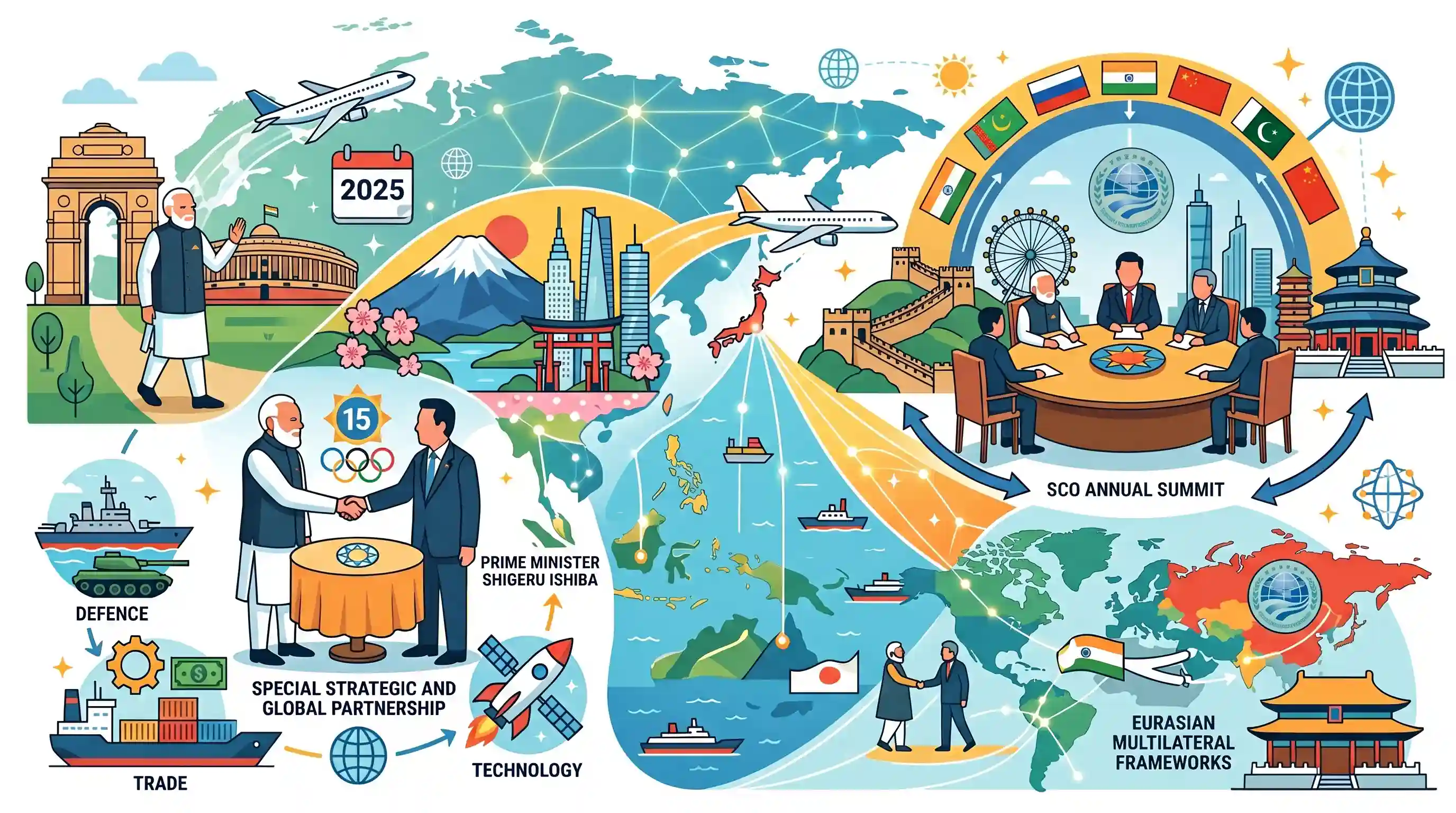
Prime Minister Narendra Modi is slated to undertake a four-day visit to Japan and China from late August to early September 2025. In Japan, he will participate in the 15th India-Japan annual summit with Prime Minister Shigeru Ishiba, focusing on deepening the Special Strategic and Global Partnership through discussions on defence, trade, and technology. Following this, he will travel to Tianjin, China, to attend the annual Shanghai Cooperation Organisation (SCO) summit at the invitation of Chinese President Xi Jinping. This diplomatic outreach underscores India's active engagement in both the Indo-Pacific region and Eurasian multilateral frameworks.
Key Points
- PM Narendra Modi is scheduled to visit Japan and China from August 29 to September 1, 2025.
- In Japan, PM Modi will attend the 15th India-Japan annual summit with his Japanese counterpart Shigeru Ishiba to review the Special Strategic and Global Partnership.
- The India-Japan bilateral discussions will focus on enhancing cooperation in defence and security, trade and economy, and technology.
- PM Modi will subsequently travel to Tianjin, China, to attend the Shanghai Cooperation Organisation (SCO) summit at the invitation of President Xi Jinping.
- The announcement of the China visit comes shortly after a trip to India by Chinese Foreign Minister Wang Yi.
Important Terms
Special Strategic and Global Partnership

A high-level bilateral framework between India and Japan focusing on defense, high-tech (AI, semiconductors), and a JPY 10 trillion investment goal for regional stability.
UPSC context
GS Paper II (Bilateral Relations). Tests understanding of India's most advanced strategic alignment in the Indo-Pacific.
Shanghai Cooperation Organisation (SCO)
A Eurasian political, economic, and security alliance. India uses it to engage Central Asia and counter terrorism via the Regional Anti-Terrorist Structure (RATS).
UPSC context
GS Paper II (Multilateral Groupings). Essential for analyzing India's "multi-aligned" foreign policy.
Tianjin Declaration
The central political document of the 2025 SCO Summit, outlining a 2035 development strategy and condemning cross-border terrorism.
UPSC context
GS Paper II (International Treaties). Tests ability to track outcomes of major global summits.
Ministry of External Affairs (MEA)
The government body responsible for India's foreign relations, managing over 200 diplomatic missions and implementing policies like 'Act East'.
UPSC context
GS Paper II (Institutions). Basic institutional knowledge for the International Relations segment.
Act East Policy
A strategic initiative to enhance engagement with Southeast and East Asia, moving beyond trade to include defense and connectivity.
UPSC context
GS Paper II (Policy). Central to questions on India's role in the Indo-Pacific.
Strategic Autonomy
India's pursuit of independent foreign policy decisions without joining formal military blocs, balancing ties with both the West and Eurasia.
UPSC context
GS Paper II (Foreign Policy). A recurring conceptual theme in UPSC Mains.
Prelims Trap
The SCO maintains distinct 'Observer' and 'Dialogue Partner' tiers for non-member engagement.
The 2025 Tianjin Summit restructured the organization, officially merging the 'Observer' and 'Dialogue Partner' categories into a single, unified 'SCO Partner' status.
Static Concepts Connected
What is the primary mandate and structure of the Shanghai Cooperation Organisation (SCO)?
- Origin: Evolved from the Shanghai Five (1996) into the SCO in 2001. India and Pakistan became full members in 2017.
- Core Mandate: Focuses on Eurasian political, economic, and security coordination, particularly counter-terrorism through its Regional Anti-Terrorist Structure (RATS) based in Tashkent.
- Recent Restructuring: In 2025 (Tianjin Summit), the SCO restructured its hierarchy, consolidating all non-member affiliations into a single 'SCO Partner' status.
What defines the "Special Strategic and Global Partnership" between India and Japan?
- Diplomatic Tier: Elevated in 2014, it establishes an annual Prime Ministerial summit mechanism, a rare diplomatic tier India shares only with Japan and Russia.
- Defence & Security: Facilitates joint exercises (Dharma Guardian, Malabar) and critical technology transfers, supported by Japan's recent easing of post-WWII pacifist arms export restrictions.
- Geopolitical Focus: Acts as a cornerstone for India's Act East Policy and the shared vision for a Free, Open, and Prosperous Indo-Pacific (FOIP).
Cross-Topic Patterns
Strategic Multi-alignment in action
India’s simultaneous summits in Japan (maritime Quad anchor) and China (continental SCO framework) perfectly illustrate its shift from Cold War non-alignment to active, issue-based multi-alignment.
Japan's pacifist shift & Indian defence
Japan's easing of its "Three Principles" on arms exports connects directly to India's defence indigenisation, allowing critical maritime tech transfers previously blocked by Tokyo's pacifist constitution.

Expect a 2026 Mains question contrasting India's maritime Indo-Pacific strategy (Quad) with its continental Eurasian engagement (SCO).
Linked PYQs · 4
Linked PYQs · 4
- 2019MainsGS2
‘The time has come for India and Japan to build a strong contemporary relationship, one involving global and strategic partnership that will have a great significance for Asia and the world as a whole.’ Comment.
- 2021MainsGS2
Critically examine the aims and objectives of SCO. What importance does it hold for India?
- 2023MainsGS2
‘Virus of Conflict is affecting the functioning of the SCO’ In the light of the above statement point out the role of India in mitigating the problems.
- 2014MainsGS2
With respect to the South China sea, maritime territorial disputes and rising tension affirm the need for safeguarding maritime security to ensure freedom of navigation and over flight throughout the region. In this context, discuss the bilateral issues between India and China.
