PM Modi Indo Pacific Tour to Strengthen Regional and Trade Ties
Source:The Hindu ↗
Why It Matters
This article highlights a major milestone in India\'s foreign policy and trade diplomacy. The signing of the India-New Zealand FTA and the first prime ministerial visit in four decades signal India\'s proactive engagement in the Southern Hemisphere and its strategic leverage in the Indo-Pacific. For civil services aspirants, it provides excellent case studies on bilateral trade negotiations, the shifting dynamics of global trade away from multilateralism towards bilateral FTAs, and India\'s expanding Act East footprint.
Summary
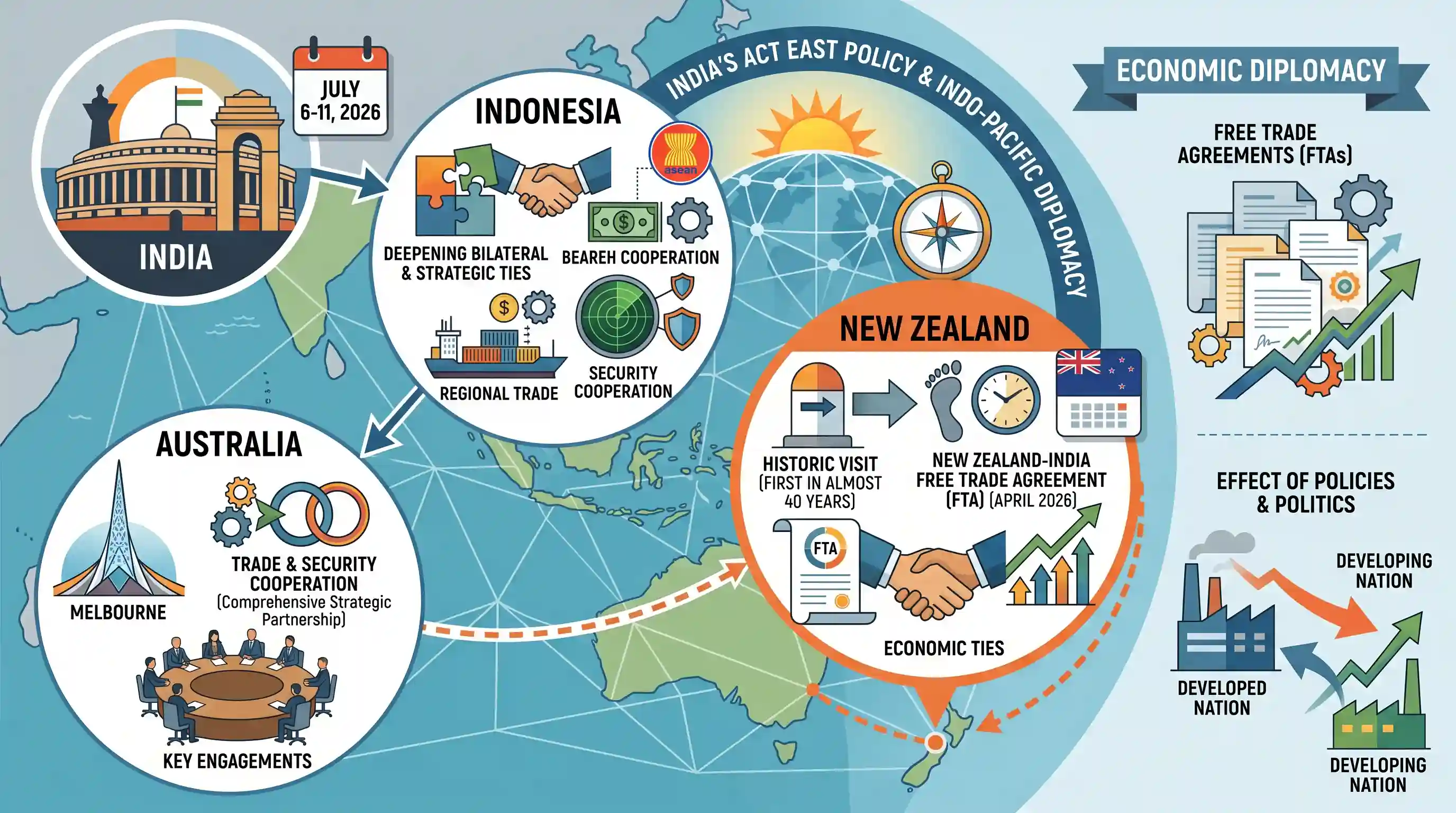
Prime Minister Narendra Modi is scheduled to undertake a three-nation visit to Indonesia, Australia, and New Zealand from July 6-11, 2026. The visit, announced by the Ministry of External Affairs, is aimed at deepening India's bilateral and strategic ties with key Indo-Pacific nations. A major highlight of the tour is the historic visit to New Zealand—the first by an Indian PM in almost 40 years—following the signing of the New Zealand-India Free Trade Agreement (FTA) in April 2026. The visit also features key engagements in Indonesia and Melbourne, Australia, to strengthen regional trade and security cooperation.
Key Points
- Prime Minister Narendra Modi will embark on a strategic three-nation tour visiting Indonesia, Australia, and New Zealand from July 6-11, 2026.
- The visit to New Zealand is highly significant and historic, marking the first visit by an Indian Prime Minister to the island nation in nearly 40 years.
- A key highlight of India-New Zealand ties is the bilateral Free Trade Agreement (FTA) signed in April 2026, which is aimed at boosting two-way trade in goods and services, fostering investment, and stimulating economic growth.
- In Australia, PM Modi will hold major engagements in Melbourne to further deepen economic and strategic cooperation, while the Indonesia leg of the tour underscores India\'s commitment to its Act East Policy and maritime cooperation in the Indo-Pacific.
Important Terms
New Zealand-India Free Trade Agreement (FTA)

A bilateral pact signed on April 27, 2026, granting immediate duty-free access to all Indian exports in New Zealand, reducing tariffs on 95% of New Zealand exports, and committing USD 20 billion in investment to India.
UPSC context
GS Paper II (Bilateral Agreements) & GS Paper III (Indian Economy). Tests knowledge of trade policy, investment flows, and regional economic integrations.
Act East Policy
India's diplomatic initiative, launched in 2014, upgrading the 'Look East' policy to proactively strengthen strategic, economic, connectivity, and cultural ties with the Asia-Pacific and Indo-Pacific regions, with ASEAN at its core.
UPSC context
GS Paper II (International Relations). Tests understanding of India's foreign policy shift, regional integration, and counter-balancing geopolitical strategies in the Indo-Pacific.
Ministry of External Affairs (MEA)
The central government agency of India responsible for formulating and executing foreign policy, representing India in international forums, managing bilateral and multilateral relations, and providing consular services like passports and visas.
UPSC context
GS Paper II (Polity and Governance). Tests understanding of India's executive structure, foreign policy implementation machinery, and international relations administration.
Government of India
The federal executive, legislative, and judicial authority of India, established by the Constitution, which governs the union of states and manages national affairs, security, development, and external relations.
UPSC context
GS Paper II (Indian Polity). Tests understanding of constitutional governance, separation of powers, and the administration of federal, national, and external policies.
Government of New Zealand
The constitutional monarchy and parliamentary democracy governing New Zealand, which signed a landmark bilateral FTA with India in April 2026 to enhance economic, professional, and strategic cooperation.
UPSC context
GS Paper II (Bilateral Relations). Tests understanding of trade partnerships, Oceania diplomacy, and strategic economic alliances in the Indo-Pacific region.
Government of Australia
The federal democratic authority governing the Commonwealth of Australia, a key Indo-Pacific partner of India engaged in strategic cooperation through bilateral agreements and groupings like the Quad.
UPSC context
GS Paper II (International Relations). Tests knowledge of India-Australia bilateral relations, Indo-Pacific strategic cooperation, and multilateral defense partnerships like the Quad.
Government of Indonesia
The executive body governing the Republic of Indonesia, a critical Southeast Asian partner for India's maritime security, bilateral trade, Act East Policy, and strategic cooperation in the Indo-Pacific.
UPSC context
GS Paper II (Bilateral Relations). Tests knowledge of maritime security cooperation, Southeast Asian geopolitics, and India's Act East Policy implementation.
Prelims Trap
The India-New Zealand FTA (2026) offers reciprocal 100% duty-free access across all sectors, including dairy and agriculture, to boost bilateral trade.
India strategically excluded 29.97% of its sensitive sectors—notably dairy, sugar, and agriculture—from tariff liberalization to protect domestic livelihoods, despite New Zealand granting 100% duty-free access to Indian exports.
Static Concepts Connected
What distinguishes PTAs, FTAs, and CEPAs/CECAs?
- PTA definition: Uses a positive list approach where duties are lowered on a select, limited number of goods.
- FTA scope: Uses a negative list approach to eliminate tariffs on nearly all traded merchandise, maintaining small exclusion lists.
- CECA/CEPA depth: Broader agreements covering trade in services, investment, intellectual property, and economic cooperation beyond physical goods.
What are the core pillars of India's Act East Policy?
- Look East upgrade: Launched in 2014 to shift focus from economic integration to active strategic, security, and defense cooperation in the Indo-Pacific.
- The 4 Cs: Emphasizes Culture, Connectivity, Commerce, and Capacity-building as key mechanisms to deepen ties with ASEAN and regional partners.
Cross-Topic Patterns
Dairy lobby vs Trade diplomacy
India's exclusion of dairy in the New Zealand and Australia pacts reflects the strong domestic lobby of cooperative dairy unions protecting smallholder farmers.
Critical minerals and Indo-Pacific security
Securing supply chains via Australia's CECA serves both economic manufacturing goals (FAME scheme) and strategic counter-balancing of China's dominance in raw materials.

Expect a multi-statement question on India's FTA strategies, focusing on tariff exclusions (dairy/sugar) and service mobility quotas.
Linked PYQs · 2
Linked PYQs · 2
- 2018PrelimsGS1
Consider the following countries: 1. Australia 2. Canada 3. China 4. India 5. Japan 6. USA Which of the above are among the 'free-trade partners' of ASEAN?
- 2025MainsGS3
What are the challenges before the Indian economy when the world is moving away from free trade and multilateralism to protectionism and bilateralism? How can these challenges be met?
