Nationwide HPV Vaccination Drive for Cervical Cancer Prevention
Source:The Hindu ↗
Why It Matters
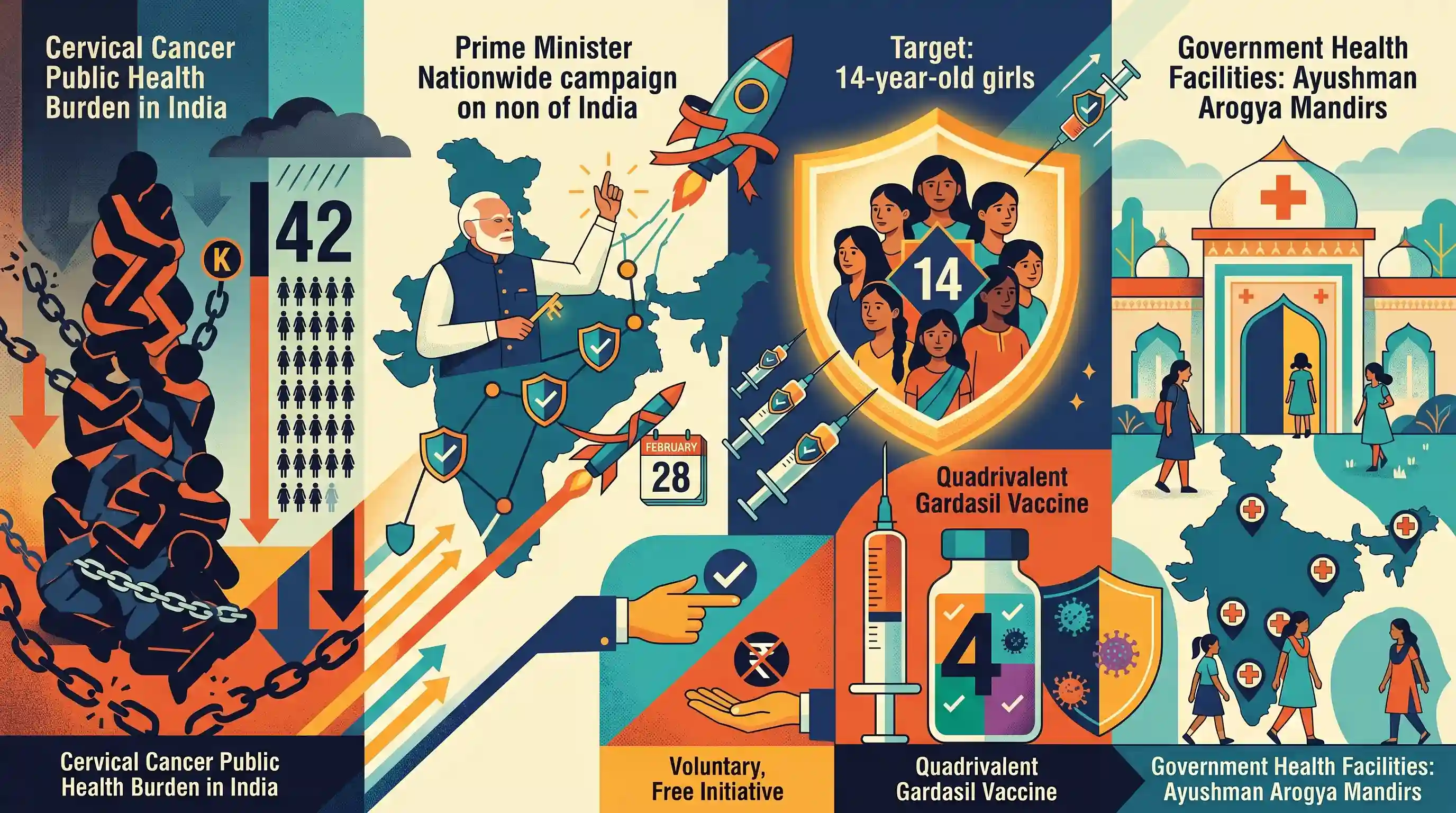
Cervical cancer is the second most frequent cancer among women in India. The introduction of a free, nationwide HPV vaccination drive marks a major preventive public health intervention, aligning with goals to improve maternal and women's health outcomes.
Summary
Prime Minister Narendra Modi is scheduled to launch a nationwide Human Papillomavirus (HPV) vaccination campaign on February 28 to protect 14-year-old girls from cervical cancer. The voluntary and free initiative will utilize the quadrivalent Gardasil vaccine and will be administered through government health facilities such as Ayushman Arogya Mandirs. Cervical cancer is a significant public health burden in India, causing over 42,000 deaths annually, making this preventive healthcare measure highly crucial.
Key Points
- Prime Minister Narendra Modi will launch a nationwide Human Papillomavirus (HPV) vaccination campaign on February 28 from Ajmer.
- The campaign targets 14-year-old girls to protect them against cervical cancer, the second most common cancer among women in India.
- The drive will utilize Gardasil, a quadrivalent HPV vaccine that protects against four types of HPV (16, 18, 6, and 11).
- Vaccination is voluntary and will be provided free of cost at various government health facilities, including Ayushman Arogya Mandirs and community health centres.
Important Terms
Nationwide HPV Vaccination Drive

A government-led campaign launching February 28, 2026, providing free Human Papillomavirus (HPV) vaccines to 14-year-old girls to prevent cervical cancer.
UPSC context
GS Paper II: Health/Social Sector; GS Paper III: Science & Tech (Vaccines/Immunization). Tests knowledge of national health missions.
Ayushman Arogya Mandirs
Renamed from Ayushman Bharat Health and Wellness Centres, these are primary health facilities providing comprehensive care, including preventive services like the HPV vaccine.
UPSC context
GS Paper II: Governance/Health Infrastructure. Relevant for schemes improving last-mile healthcare delivery.
Human Papillomavirus (HPV)
A common virus transmitted through contact; persistent infection with high-risk strains (16 and 18) is the primary cause of cervical cancer.
UPSC context
GS Paper III: Science & Technology. Essential for understanding viral diseases and preventive medicine.
Cervical Cancer
A type of cancer occurring in the cervix; it is the second most common cancer among Indian women, causing significant annual mortality.
UPSC context
GS Paper II: Issues related to women and health. Tests awareness of disease burden and gender-specific health challenges.
Quadrivalent Vaccine
A vaccine that protects against four different strains of a virus; the Gardasil 4 vaccine targets HPV types 6, 11, 16, and 18.
UPSC context
GS Paper III: Science & Technology (Bio-technology/Vaccines). Technical term for immunization types.
CERVAVAC
India's first indigenous quadrivalent HPV vaccine, developed by the Serum Institute of India, intended for future inclusion in national health programs.
UPSC context
GS Paper III: Science & Tech/Indigenization of Technology. Highlights 'Atmanirbhar Bharat' in pharmaceuticals.
Prelims Trap
"The HPV vaccine drive is mandatory for all adult women and cures cervical cancer."
The HPV vaccine is preventive, not curative. Furthermore, this nationwide public drive is entirely voluntary and specifically targets 14-year-old girls, not adult women.
Static Concepts Connected
What distinguishes a quadrivalent vaccine in immunization?
- Strain coverage: It is designed to stimulate an immune response against four different antigens or virus strains simultaneously (e.g., HPV 16, 18, 6, 11).
- VLP mechanism: Often utilizes Virus-Like Particles (VLPs) that mimic the virus to build neutralizing antibodies without containing live biological material that could cause disease.
What is the mandate of Ayushman Arogya Mandirs?
- Rebranded infrastructure: They are the rebranded Ayushman Bharat Health and Wellness Centres (AB-HWCs), serving as the foundational tier of India's healthcare system.
- Comprehensive care: They shift focus from selective rural healthcare to Comprehensive Primary Health Care (CPHC), expanding coverage to non-communicable diseases and preventive oncology.
Cross-Topic Patterns
Gardasil vs. Indigenous Cervavac
While Gardasil is being deployed here, UPSC frequently tests indigenous alternatives like the Serum Institute's CERVAVAC, highlighting India's push for self-reliance in biotechnology.
WHO 90-70-90 elimination targets
India's targeted vaccination aligns directly with WHO’s 90-70-90 goal to eliminate cervical cancer by 2030, a prime area for GS2 international health policy questions.

Expect a multi-statement question pairing HPV vaccine mechanisms (quadrivalent), indigenous Cervavac, and WHO's 90-70-90 target.
Linked PYQs · 4
Linked PYQs · 4
- 2019PrelimsGS1
Which one of the following statements is not correct?
- 2024MainsGS2
In a crucial domain like the public healthcare system the Indian State should play a vital role to contain the adverse impact of marketisation of the system. Suggest some measures through which the State can enhance the reach of public healthcare at the grassroots level.
- 2021MainsGS2
“Besides being a moral imperative of a Welfare State, primary health structure is a necessary precondition for sustainable development.” Analyze.
- 2022MainsGS3
What is the basic principle behind vaccine development ? How do vaccines work? What approaches were adopted by the Indian vaccine manufacturers to produce COVID-19 vaccines ?
